


The Summit That Defines the New Order: Expectations and Challenges in the Putin-Trump Meeting
August 11, 2025 Hour: 2:16 pm
🔗 Comparte este artículo
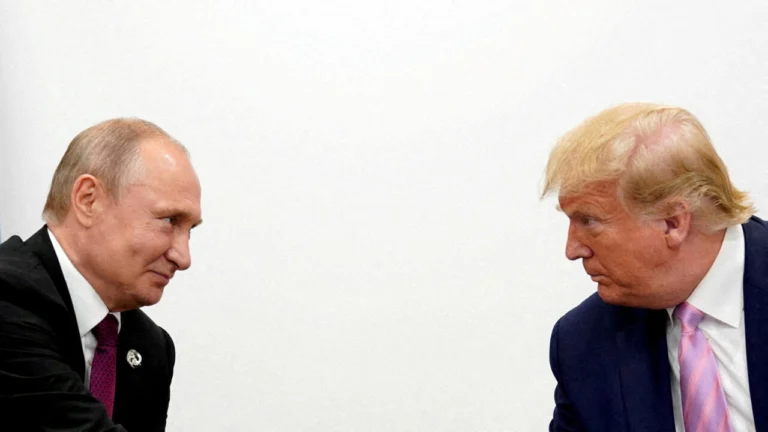
The global geopolitical landscape is undergoing a profound transformation, and the highly anticipated meeting between Russian President Vladimir Putin and former U.S. President Donald Trump marks a milestone in this dynamic.
Scheduled for August 15, 2025, in Alaska, this summit attracts worldwide attention not only because of the importance of its protagonists but also due to the critical context in which it takes place: a world grappling with the war in Ukraine, tensions in the Middle East, and a redefinition of international alliances.
The Importance of the Summit in a World in Conflict
This encounter between Putin and Trump is far more than a diplomatic formality or a simple protocol exchange. It occurs at a time of high geopolitical tension, where two nuclear powers with a history of both confrontation and cooperation are seeking possible resolutions or at least a rapprochement to avoid a greater conflict.
Alaska, a U.S. state but with strong historical and geographical ties to Russia, it was Russian territory until 1867 and is separated from Russia by just 4 kilometers across the Bering Strait, presents itself as a symbolic and practical location for the summit.
Moreover, it will be the first visit of a Russian president to Alaska, adding a special historical dimension to the event.
Since the announcement of the meeting, Putin has held talks with various global leaders, including China’s Xi Jinping, India’s Draupadi Murmu, and Brazil’s Lula da Silva, reaffirming the urgency of a political solution to the Ukrainian crisis.
This multilateral effort signals Moscow’s understanding of the complexity of the situation and its pursuit to consolidate support or at least open broader dialogue channels.
Meanwhile, the international community closely watches the summit, aware that any progress or setback in the Washington-Moscow relationship will have direct implications for NATO’s stability and other global security frameworks.
Key Topics on the Agenda: Ukraine and Beyond
Although the detailed agenda remains confidential, the primary topic is expected to be the conflict in Ukraine, which has dominated international focus since 2022.
Russia insists firmly on recognition of its control over regions such as Donbas, Crimea, and other areas, while Ukraine insists on preserving its sovereignty and demands respect for its international borders.
Trump, in his statements, has hinted at possible territorial exchanges “for the benefit of both parties,” a proposal immediately rejected by Ukrainian President Volodymyr Zelensky and his European allies, who consider any solution must involve Ukraine directly.
The exclusion of Kyiv from direct dialogue has drawn criticism in Europe, where leaders from France, the UK, Germany, Italy, Poland, Finland, and the European Commission emphasized that peace must be a just agreement including Ukraine.
The prevailing stance warns that a unilateral negotiation between the U.S. and Russia without Ukraine poses a risk to long-term stability.
Additionally, economic aspects are expected to be discussed, especially concerning U.S.-imposed sanctions on Russia and “secondary tariffs” targeting trading partners such as India and China, aiming to weaken the Russian economy and its exports.
Equally important is the personal dimension between Putin and Trump, whose atypical and highly personalized relationship could significantly influence the summit’s development and outcomes. Analysts highlight that this bond may foster unprecedented understandings or, in cases of disagreement, deepen polarization.
Expectations and Post-Summit Scenarios
The world watches with varied expectations and multiple possible scenarios following this historic encounter:
- Optimistic Scenario: The meeting unlocks significant progress toward peace in Ukraine, reactivating high-level negotiations. Simply having Putin and Trump meet face-to-face could be seen as a diplomatic success, triggering future agreements and easing tensions.
- Realistic Scenario: The meeting does not resolve deep differences between Washington and Moscow but succeeds in restoring direct communication channels, reducing hostile rhetoric, and laying the groundwork for longer-term conversations. This gradual rapprochement would be a success in such a delicate moment.
- Pessimistic Scenario: The summit ends without concrete agreements, increasing uncertainty and reaffirming the impossibility of real dialogue at this stage. It would be interpreted as a deadlock in bilateral diplomacy, likely prolonging the conflict and global tensions indefinitely.
Observers also underscore the significance of the chosen location: Alaska holds historical and geopolitical value and could serve as a catalyst to promote closer trade relations between Russia and the U.S., potentially contributing to reduced hostilities.
The political climate around the summit also reveals internal resistance both in the U.S. and Russia, where neoconservative sectors and hawkish forces oppose rapprochement, fearing strategic consequences or loss of influence.
Conclusion
The Putin-Trump summit in Alaska represents an unprecedented event that could redefine international politics rules amid a profound crisis.
With a focus on the war in Ukraine but implications extending to the global security and economic architecture, this meeting symbolizes both hope for possible change and the reflection of complex persisting divisions.
While no immediate or miraculous solutions are expected, dialogue between these two key figures may mark the beginning of a new chapter, where the balance between confrontation and cooperation will determine the course of the emerging new world order.