


JD Vance Says Russia and Ukraine Will Not Be “Super Happy” With Trump-Brokered Deal
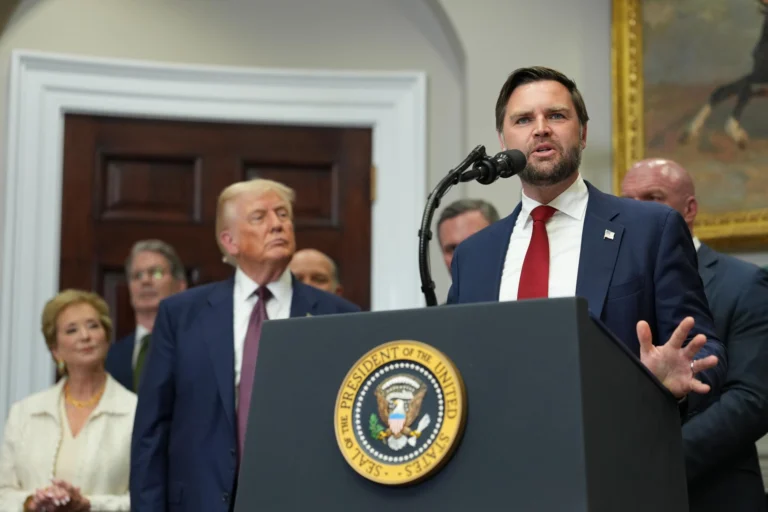
US Vice President JD Vance (R), speaks during an executive order signing ceremony in the Roosevelt Room of the White House in Washington, DC, USA, 31 July 2025. Photo: EFE/EPA/ERIC LEE / POOL
August 10, 2025 Hour: 6:42 pm
🔗 Comparte este artículo
U.S. Vice President JD Vance publicly acknowledged that neither Russia nor Ukraine will be fully satisfied with the peace agreement that former President Donald Trump is promoting.
RELATED:
Trump Suggests Territory Swap Between Russia and Ukraine Is Necessary for a Peace Deal
This admission came ahead of a highly controversial summit scheduled for August 15 in Alaska between Trump and Russian President Vladimir Putin, marking the first direct encounter between the two leaders since the devastating conflict in Ukraine began in February 2022.
In an interview with Fox News, Vance bluntly stated, “The agreement will not make anyone super happy. Both Russians and Ukrainians will likely be dissatisfied with it.” Nevertheless, he insisted that such a negotiation could not succeed without Trump’s leadership. Vance asserted that Washington aims to secure a “negotiated agreement with which both Ukrainians and Russians can live, where relative peace prevails and the killing stops.”
This meeting comes after months of rising tensions and mounting humanitarian crises caused by Russia’s invasion of Ukraine, which has upended global security and inflicted massive suffering, especially on the Ukrainian people. The Trump-Putin summit, set in Alaska—a symbolic location long ago ceded by Russia to the United States—stokes deep unease among observers who worry that the interests of Ukraine might be sidelined in favor of geopolitical posturing.
The announcement followed a recent visit by Steve Witkoff, the White House envoy for peace missions, who met with Kremlin officials in Moscow. The discussions came just before the deadline Trump had set for Russia to take steps toward peace, threatening further sanctions if no progress was made. Although some U.S. officials emphasize that no significant territorial concessions will be made “that have not been fought for and won on the battlefield,” references to possible “territory swaps” in the media have sparked alarm.
Ukrainian President Volodymyr Zelenskyy condemned the idea of negotiations excluding his country, calling any decisions made without Ukrainian consent “dead on arrival.” He refuted any suggestion that Ukraine might willingly cede land, emphasizing his country’s right to sovereignty and self-determination. Similarly, leaders from the United Kingdom, France, Germany, Italy, Poland, and Finland, joined by European Commission President Ursula von der Leyen, issued a joint statement underscoring that “the path to peace in Ukraine cannot be decided without Ukraine.”
This international consensus reflects broader concerns over the possibility that peace talks driven or heavily influenced by Trump might prioritize appeasement of Putin’s aggressive expansionism over justice, accountability, and Ukraine’s territorial integrity. Critics note that Trump’s posture—often friendly toward Russia’s authoritarian regime despite widespread evidence of war crimes and human suffering—risks undermining the united front that the West has sought to maintain against Russian aggression.
Moreover, the proposed summit arrives amid growing frustration over the enormous human cost of the war. Since February 2022, the conflict has claimed tens of thousands of lives, displaced millions, and destroyed countless communities. It has also triggered a migration crisis and global economic disruption, with sanctions on Russia and energy insecurity reverberating worldwide.
While Trump portrays himself as a peacemaker capable of resolving the conflict swiftly, his approach has raised skepticism. His hints at territorial swaps raise fears that peace may come at the expense of Ukraine’s sovereignty and the sacrifices of its people. The possibility that Moscow could maintain control over annexed regions such as Crimea and parts of the eastern Donbas—territories seized through military force—threatens to entrench a status quo that many view as illegal under international law.
The summit’s setting in Alaska carries symbolic weight. Once Russian territory, Alaska was sold to the United States in 1867 for a fraction of its worth, a historical footnote layered with irony as these two powers meet there to negotiate a new balance of power. Some observers interpret the meeting location as a subtle reminder of shifting borders and contested sovereignties.
For the millions affected by the war, the hope remains that any eventual peace accord will prioritize human rights, the rule of law, and an end to violence—not merely geopolitical expediency. As Vice President Vance admitted, a perfect deal is unlikely; but the real question is whether the negotiations will uphold the principles of justice and democracy or surrender them to realpolitik.
International observers and Ukrainian officials alike emphasize that lasting peace must respect Ukraine’s agency as a sovereign nation. Any sidelining of Ukraine in these high-stakes talks risks perpetuating conflict and instability in the region and beyond.
The world watches closely as Trump and Putin prepare to meet in Alaska. The stakes could not be higher for Ukraine’s future, regional security, and the international order founded on respect for sovereignty and human rights.