


Uganda Bus Collision Kills 46 in One of the Country’s Deadliest Road Accidents in Years
A midnight collision between two buses in western Uganda has left 46 people dead, exposing the country’s worsening road safety crisis and weak traffic enforcement.
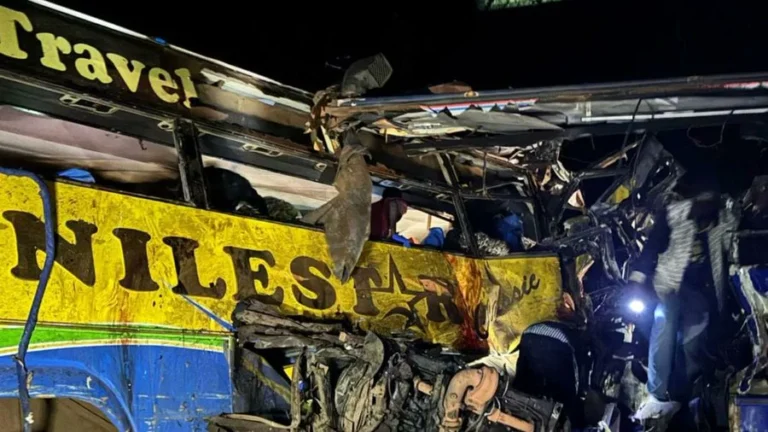
Emergency responders work at the scene of a fatal bus collision on the Gulu highway near Kiryandongo, western Uganda. Photo: @MirrorBreaking_
October 22, 2025 Hour: 7:00 am
🔗 Comparte este artículo
At least 46 people were killed and dozens more injured early Wednesday when two buses and two other vehicles collided on a major highway in western Uganda — a tragedy that underscores the country’s growing road safety crisis.
RELATED:
Israel Has Killed Over 20,000 Palestinian Students Since 2023
The accident occurred shortly after midnight on the Gulu highway near Kiryandongo, when two buses traveling in opposite directions attempted to overtake other vehicles and crashed head-on, police reported.
“In the process, both buses met head-on during the overtaking maneuvers,” authorities said in an official statement.
Police initially put the death toll at 63 but later revised it to 46 after discovering that some victims found unconscious were still alive. “At the time of the crash, several victims were found unconscious, and some may have been mistakenly included in the initial fatality count,” the statement clarified.
Most of the injured were taken to a nearby government hospital for treatment, while emergency responders and residents assisted at the scene.
Uganda has one of the highest rates of road fatalities in East Africa, driven by reckless driving, poor infrastructure, and weak enforcement of traffic laws. Official figures show 5,144 people died in road crashes in 2024 — up from 4,806 in 2023 and 4,534 in 2022. Careless overtaking and speeding accounted for nearly 45% of all crashes, according to the latest police report.
“As investigations continue, we strongly urge all motorists to exercise maximum caution on the roads, especially avoiding dangerous and careless overtaking, which remains one of the leading causes of crashes in the country,” police said.
Ugandan Red Cross spokesperson Irene Nakasiita described the aftermath as “too gruesome to share,” saying many victims had broken limbs and severe bleeding. “The magnitude of this incident is so big,” she said, noting that nighttime crashes are particularly deadly because fewer bystanders are available to help.
Road safety advocate Joseph Beyanga, known as Joe Walker, said the Kiryandongo disaster reflects years of government neglect and lack of traffic law enforcement. “These crashes are just a cruel reminder that we still have a long way to go,” he said. “On the government side, there is total absence of enforcement. What’s happening on the roads is anarchy.”
Beyanga, who leads long-distance awareness walks from Kampala to rural towns, announced that his next 60-kilometer memorial walk in November will honor thousands of Ugandans killed or injured in road accidents.
The Kiryandongo tragedy adds to mounting pressure on Ugandan authorities to strengthen road safety regulations and curb the rising number of deadly crashes, which have become an enduring public health concern across the region.