


Kidnapping of Venezuelan President Maduro is a Dangerous Precedent: Brazil
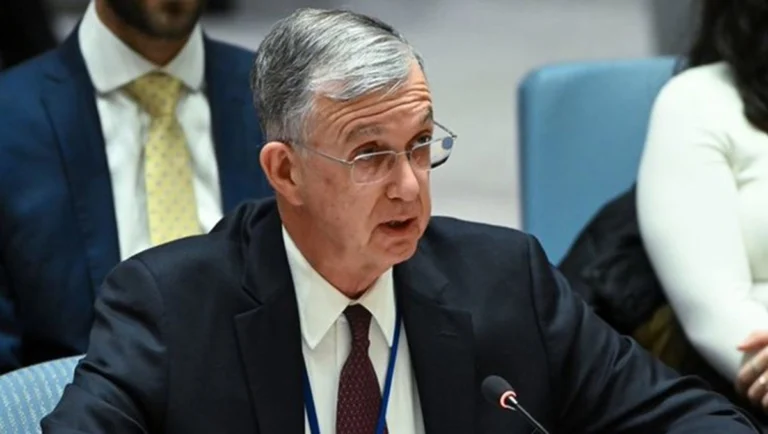
Brazilian diplomat Sergio Danese, Jan. 5, 2026. X/ @Metropoles
January 5, 2026 Hour: 2:17 pm
🔗 Comparte este artículo
The South American country condemns U.S. attack on Venezuela at the United Nations Security Council.
On Monday, Brazil’s permanent representative to the United Nations, Sergio Danese, condemned the U.S. armed intervention on Venezuelan territory.
RELATED:
UN Secretary Voices Deep Concern Over U.S. Military Action in Venezuela
During an emergency meeting of the United Nations Security Council (UNSC), he said the Venezuelan crisis would not be resolved through the establishment of a protectorate but through solutions that respect Venezuelans’ self-determination.
The Brazilian diplomat, who was granted the floor despite not being a UNSC member, described the U.S. military action in Venezuela and the abduction of President Nicolas Maduro as “an extremely dangerous precedent for the entire international community.”
The following is the statement delivered by the Brazilian diplomat at the UNSC emergency meeting, which was chaired by Somalia’s representative:
“Brazil thanks the Somali presidency for convening this emergency session of the Security Council. Brazil categorically and firmly rejects the armed intervention on Venezuelan territory, in blatant violation of the United Nations Charter and international law.
The bombings on Venezuelan territory and the capture of its president cross an unacceptable line. These acts constitute a very serious affront to Venezuela’s sovereignty and set an extremely dangerous precedent for the entire international community.
The United Nations Charter establishes, as a pillar of the international order, the prohibition of the use of force against the territorial integrity or political independence of any state, except in the circumstances strictly provided for therein.
Acceptance of actions of this nature would inexorably lead to a scenario marked by violence, disorder and the erosion of multilateralism, to the detriment of law and international institutions.
The effects of the weakening of international governance and cooperation mechanisms are already evident: the record number, since World War II, of 61 active armed conflicts; the unprecedented figure of 117 million people facing humanitarian catastrophe worldwide, reflecting the increase in wars, displacement and crimes against humanity, such as the genocide in Gaza; and the global rise in military spending, which is approaching the historic mark of US$2.7 trillion.
As Brazil has repeatedly maintained, the rules governing relations among states are mandatory and universal. They admit no exceptions based on ideological, geopolitical, political, economic or any other interests or projects. They do not allow the exploitation of natural or economic resources to justify the use of force or the illegal change of a government.
The multipolar world of the 21st century, which seeks to promote peace and prosperity, is not to be confused with spheres of influence.
We cannot accept the argument that the end justifies the means. This reasoning lacks legitimacy and opens the door to granting the strongest the right to define what is just or unjust, what is right or wrong, and even to ignore national sovereignties by imposing decisions that the weakest must adopt.
Latin America and the Caribbean have made peace a conscious, lasting and irreversible choice. The use of force in our region evokes chapters of history we believed had been overcome and jeopardizes the collective effort to preserve the region as a zone of peace and cooperation, free of armed conflict, respectful of international law and the principle of nonintervention.
Past armed interventions have had deeply negative and long-lasting consequences. Rather than freedom and democracy, those interventions produced authoritarian regimes and serious human rights violations, leaving behind the regrettable toll of thousands of dead, political prisoners, tortured individuals and disappeared persons, whose families still seek their loved ones, as well as justice and reparations.
For the first time in South America, a deeply alarming event has occurred: an external armed aggression involving the deployment of troops and bombings in a neighboring country contiguous to Brazil, with which we share more than 2,000 kilometers of border.
Mr. President, South America is a zone of peace. I insist on this. We have upheld and will continue to uphold, with full determination, peace and nonintervention in our surroundings.
Moreover, Brazil does not believe that a solution to the situation in Venezuela lies in the creation of protectorates in the country, but rather in solutions that respect the self-determination of the Venezuelan people, within the framework of their constitution.
The events of January 3 go beyond the regional sphere. An attack on the sovereignty of any country, regardless of the orientation of its government, affects the entire international community.
This and other cases of armed intervention against a country’s sovereignty, territorial integrity or institutions must be condemned forcefully. It is incumbent upon this Council to assume its responsibility and respond with determination, clarity and adherence to international law, in order to prevent the law of force from prevailing over the force of law.
Brazil trusts that Venezuela’s future will be built by the Venezuelan people, through dialogue, without external interference and within the framework of international law.
Thank you.”
teleSUR/ JF
Sources: EFE – teleSUR