


Iraq Oil Depot Fire Claims 1 Life and Sparks Urgent Safety Response
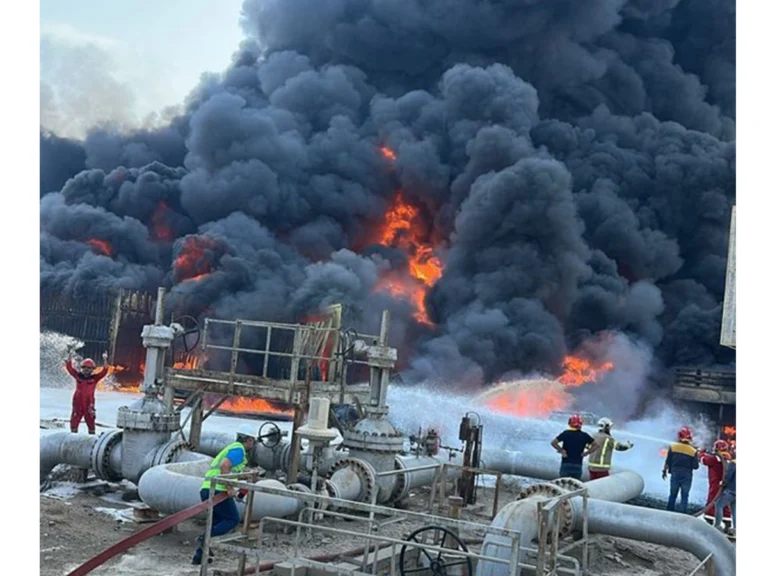
Emergency crews work to extinguish the Iraq oil depot fire at the Zubair field, a strategic energy hub in Basra.
October 26, 2025 Hour: 3:30 pm
🔗 Comparte este artículo
A gas leak caused a deadly Iraq oil depot fire in Basra’s Zubair field, leaving one worker dead and four injured, officials confirm.
Related: Baghdad Rejects Netanyahu’s Threats Against Iraqis
Iraq Oil Depot Fire Kills One Worker in Basra
At least one worker was killed and four others were injured in a massive fire that erupted on Sunday at an oil storage facility in Iraq’s Zubair field, located in the southern province of Basra, the country’s Ministry of Oil reported.
According to an official statement, the blaze broke out around 9:15 a.m. local time following a gas leak in one of the systems of the Zubair 1 depot, specifically in the old pumping system. Preliminary data confirmed that an employee of the Basra Oil Company died, while others sustained injuries of varying degrees.
The ministry extended its deepest condolences to the victim’s family and expressed hopes for a swift recovery of the wounded. Emergency crews promptly arrived on site to contain the incident.
Firefighting Efforts Underway at Zubair Facility
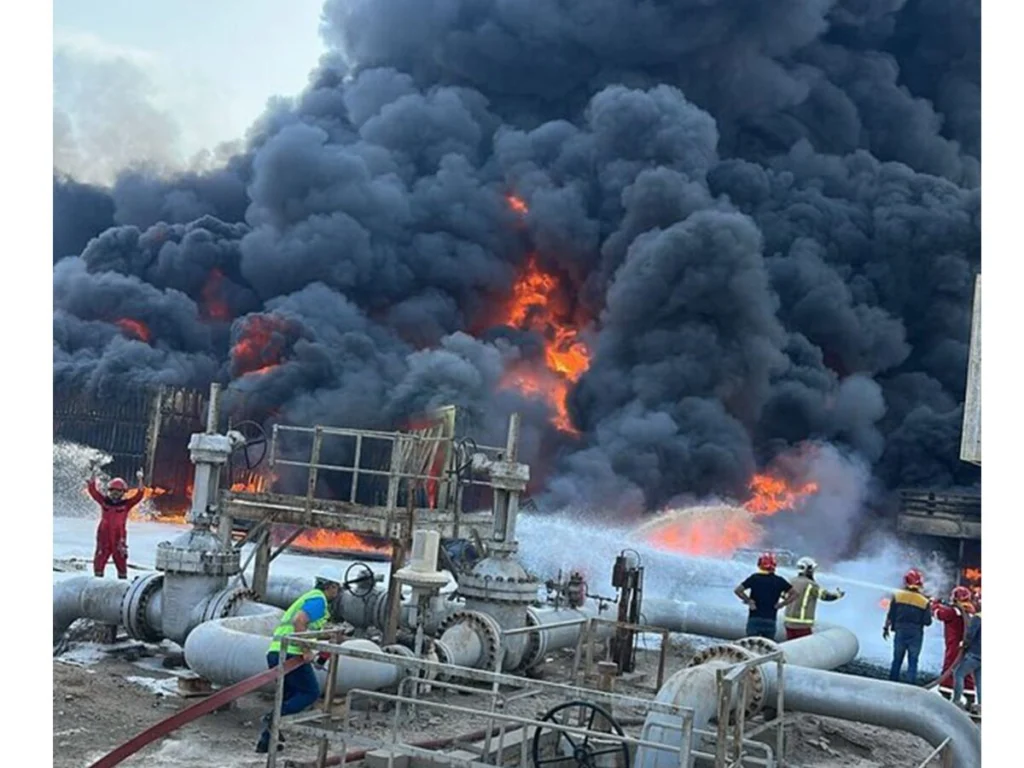
Security and firefighting units were quickly deployed to the Zubair oil field as thick plumes of smoke filled the sky. The Iraq oil depot fire was partially contained, though authorities stated that efforts continue to fully extinguish the remaining flames.
In a brief statement broadcast by state media, officials confirmed that specialized teams are monitoring gas pressure systems and ensuring that nearby facilities are isolated to prevent the fire from spreading to other tanks.
The Basra Oil Company reiterated its commitment to worker safety, noting that an internal investigation has begun to determine the exact cause of the gas leak that triggered the accident.
- Ministry of Oil Iraq official updates (https://oil.gov.iq)
- Basra Oil Company safety reports (https://boc.oil.gov.iq)
Risk of Export Disruption Due to Iraq Oil Depot Fire
The storage depot impacted by the fire plays a critical role in holding crude oil before it’s pumped and exported to ships through Basra’s terminals. This means that the Iraq oil depot fire could potentially disrupt export operations, though Iraqi authorities have not yet provided detailed assessments of the economic impact.
Experts indicate that damage to pumping infrastructure and containment units often requires days—or even weeks—to be fully restored depending on the severity of the blaze. The Ministry of Oil acknowledged that incidents of this kind “require extended efforts to completely contain and extinguish” the fires, especially when they occur near active gas systems.
Basra’s Zubair field, managed jointly with foreign partners including Eni and Schlumberger, is among Iraq’s most productive oil zones. The field produces hundreds of thousands of barrels daily, making it vital to Iraq’s national revenue stream.
External link suggestions:
- International Energy Agency (https://www.iea.org)
- Reuters – Iraq oil sector coverage (https://www.reuters.com/energy)
Impact on Exports and National Economy
Immediate concerns focus on how the Iraq oil depot fire could affect the country’s crude export capacity. The Zubair 1 facility serves as a key transit point for oil pumped to shipping terminals, and even temporary disruptions could reduce daily export volumes.
According to analysts, the Basra oil sector produces over 70% of Iraq’s total crude, making any production halt particularly sensitive to the national budget, which depends on oil revenue for more than 90% of government income.
Energy experts have emphasized that maintenance negligence and outdated infrastructure remain systemic challenges. Iraq’s aging network of storage depots and pipelines has suffered repeated breakdowns, fires, and leaks in recent years, exposing deep structural vulnerabilities in its energy sector.
External link: International Energy Agency
Technical Analysis: Gas Leak and Systemic Safety Failures
Preliminary investigations suggest that the gas leak originated within an obsolete pumping system dating back to the late 1990s. Experts from the Basra Oil Company’s Technical Directorate indicated that the lack of automatic detection sensors and outdated emergency cut-off valves could have worsened the incident.
Fire and safety officials insist that similar accidents could be mitigated through modernized control systems, including AI-based leak detection, automated temperature monitors, and high-integrity safety valves—technologies now standard at many international refineries.
The event has reignited public debate about the pace of Iraq’s energy modernization program, which has faced delays due to bureaucratic inertia, limited foreign investment, and regional instability.
Environmental Concerns Over Residual Emissions
Environmental authorities in Basra have raised alarms about potential air quality deterioration resulting from the Iraq oil depot fire, as burning petroleum releases toxic vapors and particulates into the atmosphere.
Local monitoring stations reported temporary increases in sulfur dioxide and carbon monoxide levels, though initial readings indicate that concentrations remain below high-risk thresholds. However, environmental activists argue that the lack of transparency in emission reporting hinders proper assessment.
The Ministry of Environment stated that soil and water testing will continue in the area surrounding Zubair to evaluate possible contamination from extinguishing foams and runoff residues.
External link: UN Environment Programme – West Asia
Geopolitical Context: Security and Energy Stability
The Iraq oil depot fire underscores the fragile balance between economic reconstruction and security in Iraq’s strategic regions. Basra, home to the country’s main oil infrastructure and export terminals, remains under constant pressure from smuggling networks, political rivalries, and militia presence.
Regional observers warn that repeated technical and safety incidents could weaken Iraq’s global reliability as an oil supplier, potentially altering OPEC production strategies and impacting global crude benchmarks.
The Baghdad government, aware of the political weight of the energy sector, has vowed to accelerate investment in safety infrastructure, reinforcing partnerships with Italy’s Eni, the China National Petroleum Corporation, and domestic engineering firms.
Author: JMVR
Source: EFE