



ASEAN Summit Malaysia: 7 Crucial Highlights from a High-Stakes Meeting of World Leaders
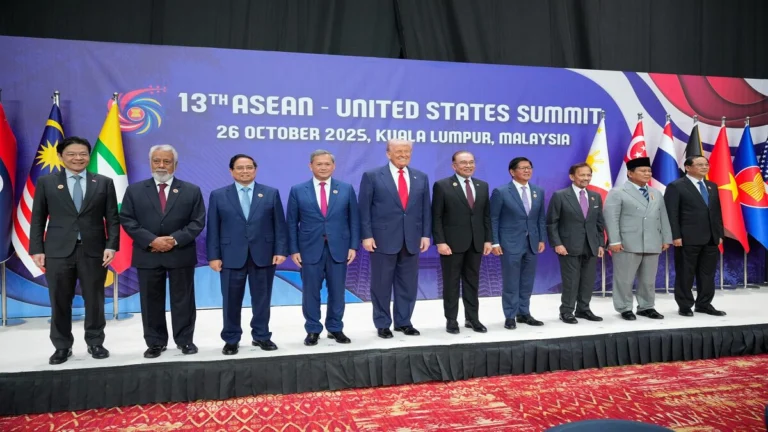
World leaders including Donald Trump, António Guterres, and António Costa attend the 47th ASEAN Summit in Kuala Lumpur.
October 26, 2025 Hour: 9:40 am
🔗 Comparte este artículo
ASEAN Summit Malaysia gathers world leaders including Trump, Guterres, and Costa to strengthen alliances and discuss global peace initiatives.
Related: Lula Trump Mediation: 5 Key Breakthroughs in Brazil–US Talks Amid Venezuela Tensions
ASEAN Summit Malaysia Opens with Strong Global Presence
The ASEAN Summit Malaysia began this Sunday, marking the start of the 47th edition of one of Asia’s key diplomatic gatherings. World leaders and representatives from allied countries arrived in Kuala Lumpur to discuss trade, regional peace, and emerging partnerships.
Among the notable attendees are U.S. President Donald Trump, UN Secretary-General António Guterres, European Council President António Costa, and Canadian Prime Minister Mark Carney, all present to reinforce cooperation between Southeast Asian and international partners.
The atmosphere in the Malaysian capital reflects the gravity of the summit. Security forces have been deployed extensively, and local authorities implemented strict measures days ahead to ensure a smooth and safe event.
Regional Cooperation and Key Agendas
Telesur report on ASEAN Summit opening
The ASEAN Summit Malaysia began with a symbolic opening ceremony, followed by a historic act: the formal admission of Timor-Leste as the newest member of the Association of Southeast Asian Nations (ASEAN). The regional bloc now counts ten full members, including Malaysia, Singapore, Vietnam, Indonesia, Myanmar, Thailand, the Philippines, Brunei, and Cambodia.
The three-day meeting aims to strengthen regional alliances and forge new cooperation frameworks, particularly in trade and sustainable development. Analysts note that the presence of major world leaders underlines ASEAN’s rising strategic importance in global geopolitics.
The summit’s first day will also address pressing security issues such as the Cambodia–Thailand conflict, which reignited briefly in July and left 50 dead. A peace agreement between the two nations is expected to be signed during the morning with President Trump in attendance, signaling a step toward stability and reconciliation in Southeast Asia.
Global Leaders Gather: Trade, Diplomacy, and Bilateral Prospects
The afternoon sessions are reserved for bilateral meetings, creating opportunities for crucial diplomatic exchanges. A possible face-to-face between President Donald Trump and Brazilian President Luiz Inácio Lula da Silva has drawn significant attention, given the recent diplomatic tensions between Washington and Brasília.
While the meeting has not been officially confirmed, both governments expressed willingness to engage. If realized, it would rank among the most consequential dialogues of the summit, especially in the absence of high-profile figures such as India’s Prime Minister Narendra Modi and Russia’s President Vladimir Putin, who sent senior envoys in their place.
According to data from the International Monetary Fund (IMF), ASEAN’s first day will close with individual sessions involving Japan, the United States, and India, the region’s principal trade and investment partners. Combined, their economies represent a GDP of 4.1 trillion dollars, equating to the scale of India or Japan’s total output — underscoring the region’s growing economic leverage in the global arena.
This set of high-level talks positions ASEAN Summit Malaysia as a strategic hub connecting Asia, the Americas, and Europe through active economic and diplomatic channels.
ASEAN Summit Malaysia and Its Broader Geopolitical Context
The ASEAN Summit Malaysia symbolizes more than a multilateral dialogue — it is a test of strategic alignment in an increasingly polarized global order. The bloc now finds itself balancing between Washington’s political partnerships and Beijing’s growing economic influence, reflecting ASEAN’s dual challenge of preserving sovereignty while boosting integration.
In this context, Malaysia plays a crucial mediating role. As host nation, it aims to promote solutions that emphasize peace, multilateralism, and economic equality among member states and external partners.
Moreover, the expected U.S.–Brazil encounter, coupled with peace negotiations in the region, shows that Kuala Lumpur’s summit could set the tone for upcoming global forums, including G20 and BRICS meetings later in the year.
For countries in Latin America, the event also represents a parallel opportunity: Brazil’s attempt to expand its outreach in the Asia-Pacific region, contributing to South–South cooperation and policy diversification beyond traditional Western partners.
Thus, ASEAN Summit Malaysia encapsulates a cross-regional axis of influence, bridging continents through diplomatic pragmatism and collective negotiation.
Security and Humanitarian Considerations
Ahead of the summit, Kuala Lumpur was placed under heightened security measures. Police presence increased throughout the city, checkpoints were set up, and areas near the convention site were restricted. Malaysian authorities stated that these efforts were “preventive and strictly operational,” aimed at ensuring uninterrupted proceedings amid global attention.
Observers note that the level of security parallels that seen during prior G20 summits, reflecting Malaysia’s logistical capacity and diplomatic weight in hosting complex and high-profile multilateral events.
The ASEAN Summit Malaysia also draws attention to humanitarian exchanges and regional resilience. Delegates are expected to discuss cross-border cooperation on issues including climate response, migration management, and energy transitions, alongside traditional trade disputes and political mediation.
Outlook and Key Takeaways
As the summit unfolds, analysts expect a series of joint communiqués and strategic announcements regarding intra-regional connectivity, digital economy initiatives, and collective security measures.
If the rumored Lula–Trump meeting materializes, it could inject fresh dynamics into hemispheric relations, linking Latin American initiatives with Asia-Pacific dialogues for the first time in this format.
The ASEAN Summit Malaysia therefore stands as both a symbol of partnership and a platform for renewal in an era of global uncertainty. Its outcomes may shape the regional agenda not only for ASEAN nations but also for Western and Southern counterparts alike.
The next two days are expected to bring clarity on new alliances and economic commitments set to define the future trajectory of the Southeast Asian bloc.
Author: JMVR
Source: Agencias