







Venezuela-U.S. High-Level Energy Talks Seek Hydrocarbon Cooperation

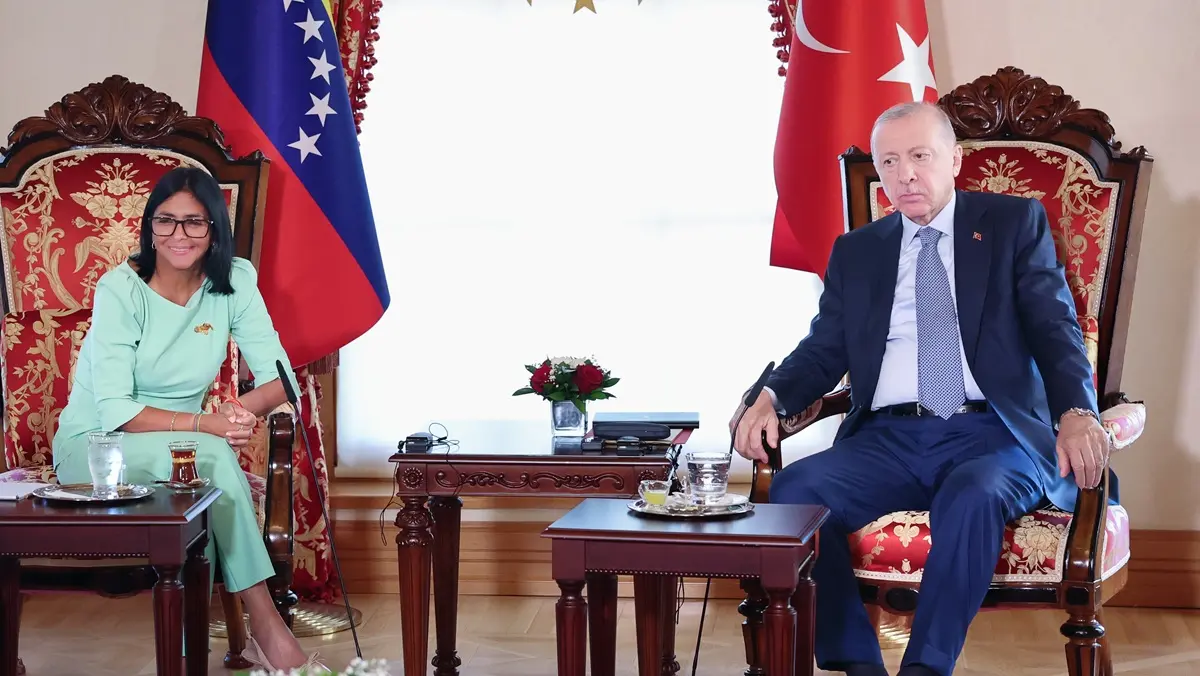
The high-level gathering, which included Kyle Haustveit, U.S. Undersecretary for Hydrocarbons and Geothermal Energy, alongside CEOs from specialized companies, focused on exploring mechanisms to enhance foreign capital participation in Venezuela’s energy sector under a vision of shared development. Photo: Venezuelan Presidential Press.
April 14, 2026 Hour: 8:02 pm
🔗 Comparte este artículo
Venezuela’s Acting President reaffirmed today the nation’s push for strong energy cooperation with the United States, urging an end to sanctions to secure a sustainable long-term relationship during a Caracas meeting with U.S. delegates and energy executives.
Venezuelan Acting President, Delcy Rodríguez, received this Tuesday at the Palace of Miraflores an energy delegation from the United States, led by Undersecretary Kyle Haustveit.
This high-level meeting signified a crucial step towards de-escalating tensions and building a framework for stable energy partnerships between the two nations, leveraging Venezuelan vast hydrocarbon resources.
During a strategic meeting, held to consolidate diplomatic and commercial ties, Rodríguez underscored the imperative to lift sanctions to ensure legal security and foster a sustainable long-term energy relationship, emphasizing the need to overcome current geopolitical complexities for mutual benefit and focusing on the analysis of new investment options alongside technical cooperation in the field of hydrocarbons.
Sanctions Hinder Progress
Acting President Rodríguez highlighted the intricate nature of the international energy market, asserting that it is imperative to move beyond the existing U.S. sanctions regime to establish greater legal security. “Sanctions must cease so that all investments can fully develop”, she stated, making clear that the current framework of temporary licenses does not provide the necessary stability for enduring energy projects.
Rodríguez emphasized that “a license does not provide legal security in terms of time projection because it is subject to temporality. Both the United States and Venezuela possess sufficient maturity to establish energy relations within the framework of the legislations of both countries”, following the recent OFAC decision of lift bank’s sanctions, which undermines investor confidence and hinders the strategic planning essential for the magnitude of energy investments required.
“We insist that President Trump must immediately end the sanctions so that all investments can develop fully”, Rodríguez emphasized.
In this context, she urged the attendees to adopt a future-oriented perspective, characterized by a State vision, with the objective of constructing a long-term energy agenda. Such an agenda, Rodríguez underscored, should yield sustainable benefits for the coming decades, ensuring predictable and reliable energy flows that can contribute to both regional and global stability.
The Venezuelan National Executive has consistently maintained an “open-door policy” to engage with and listen to the diverse perspectives of various economic actors, as Rodríguez indicated. This proactive engagement aims to optimize the national regulatory framework, making it more conducive to foreign investment and fostering a transparent and predictable operating environment for international energy companies.
Future Cooperation Discussed
Concluding her remarks, Delcy Rodríguez stressed the importance of establishing a symbiotic relationship that transcends geographical borders. In this sense, she affirmed that Venezuela’s energy stability possesses a global impact, recognizing the interconnectedness of energy security on an international scale.
The discussions held during this high-level meeting aimed to not only evaluate the current map of hydrocarbon cooperation, but also to identify new opportunities for investment and technical cooperation within the hydrocarbon sector, fostering a mutually beneficial architectural business model.
This encounter followed a strategic agreement signed just the day before, on April 13, between the state-owned Petróleos de Venezuela (PDVSA) and the U.S. company Chevron. This agreement for the exchange of energy assets serves as a tangible demonstration of Venezuela’s commitment to re-establishing and strengthening its energy ties with international partners, particularly those from the United States.
The meeting with Undersecretary Haustveit and the U.S. Energy delegation today, further solidifies the mutual interest in guaranteeing regional energy stability and promoting a business architecture founded on respect and shared benefit.
The Acting President was accompanied by U.S. Chargé d’Affaires, Laura Dogu, and Minister of Hydrocarbons, Paula Henao. Also participated in the meeting the President of PDVSA, Héctor Obregón, the Vice-president of Economy, Calixto Ortega, and the Deputy Minister for North America, Oliver Blanco.
The current working groups are focusing their efforts on the marketing of crude oil and the signing of new hydrocarbon contracts, which are fundamental to economic stability and the strengthening of the country’s energy industry.
By engaging in such high-level diplomatic and commercial exchanges, Venezuela continues to position itself as a reliable and secure partner, reaffirming its unwavering commitment to sustainable economic recovery and the consolidation of alliances.
Author: Laura V. Mor
Source: Venezuelan Presidential Press