


Venezuela Questions Essequibo Arbitral Award via Geneva Accord
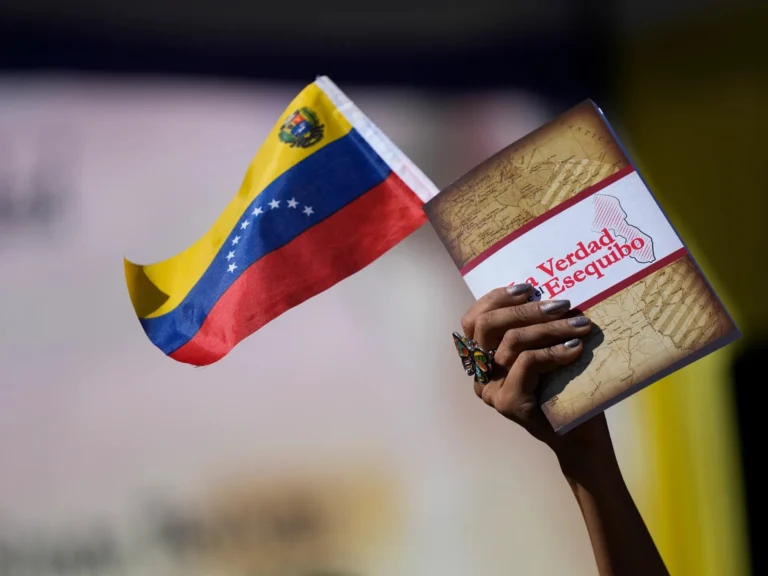
The sign on the book reads, “The Truth about Essequibo”. Photo: Al Jazeera
February 20, 2026 Hour: 2:13 pm
🔗 Comparte este artículo
British cartographic arbitrariness in the 19th century fueled a territorial dispute for decades.
The territorial dispute between Venezuela and Guyana over the Essequibo region — a 159,500-square-kilometer area rich in biodiversity and minerals — is often described in the mainstream media as a modern geopolitical crisis.
RELATED:
Venezuela Ratifies Geneva Accord on Essequibo Sovereignty
However, to understand today’s tensions, one must examine the mapmaking strategies of the 19th-century British Empire.
This in-depth article reviews the origins of the conflict and the interpretations of the agreements by Venezuela and Guyana, as well as the intervention of foreign powers.
Imperial cartography: origins of the conflict
The controversy began with the transition from Spanish colonial rule to the establishment of independent republics in Latin America.
According to the legal principle uti possidetis iuris (“as you possessed, so you shall possess”), Venezuela inherited the borders of the Captaincy General of Venezuela, which Spain created in 1777. Historically, this placed the Essequibo River as the natural eastern border.
The dispute intensified after 1814 when the United Kingdom acquired the Demerara, Berbice, and Essequibo colonies from the Netherlands.
Although the Dutch had settled to the east of the Essequibo River, the British began a steady and deliberate expansion westward into territory claimed by Venezuela.
In 1835, the British government sent explorer Robert Schomburgk to survey the area. His work produced what became known as the Schomburgk Line.
His initial map expanded British territory by around 30,000 square kilometers, but as gold was discovered in the region, subsequent versions of the “Schomburgk Lines” pushed the border further west.
Ultimately, this expansion claimed over 140,000 square kilometers of territory, approaching the mouth of the Orinoco River.
Faced with Venezuelan protests and U.S. pressure through the Monroe Doctrine, the parties agreed to submit the dispute to arbitration in Paris in 1899.
However, Venezuela was not permitted to appoint its own judges and was instead represented by U.S. lawyers. Ultimately, the tribunal ruled in favor of Great Britain, granting it approximately 90 percent of the disputed land.
Venezuela has long denounced this decision as a “diplomatic heist” arranged behind closed doors.
The Mallet-Prevost revelation and the 1966 Geneva Accord
For decades, the 1899 ruling was considered final internationally. However, this perception shifted in 1949 when a posthumous memorandum by Severo Mallet-Prevost, a Venezuelan lawyer who practiced in the United States, was published and circulated widely.
In the memorandum, Mallet-Prevost argued that the 1899 decision was the result of a political deal rather than a ruling based on international law.
He claimed that the Russian president of the tribunal, Friedrich Martens, pressured the American arbitrators to accept a compromise favorable to Britain.
Martens threatened to support an even more extreme British claim if the arbitrators refused. This later helped Venezuela argue that the award was “null and void.”
As Guyana neared independence from the United Kingdom, Venezuelan pressure led all parties back to the negotiating table. This culminated in the 1966 Geneva Accord, a legally binding treaty deposited with the United Nations.
For Caracas, this agreement replaced the 1899 award as the main framework for seeking a negotiated solution to the territorial controversy.
The Geneva Accord has three key elements. First, by signing it, the United Kingdom and, later, Guyana formally recognized that a dispute existed concerning the 1899 ruling.
Second, the treaty committed the parties to reach a “practical settlement” that was acceptable to both sides.
Third, the treaty established that no new claims or expansions of existing claims could be made while the treaty was in effect. This clause is central to current debates on oil concessions in the area.
The 2015 turning point: oil and the “ExxonMobil factor”
For nearly fifty years following the Geneva Accord, the Essequibo issue was primarily a diplomatic concern, managed through discreet negotiations and United Nations mechanisms.
This changed dramatically with the discovery of major offshore oil reserves, transforming a historical territorial dispute into a high-stakes struggle over natural resources.
In 2015, ExxonMobil announced a significant find in the 6.6-million-acre Stabroek Block offshore area off the coast of Guyana, adjacent to the Essequibo region.
Since then, more than 30 significant discoveries have been reported, positioning Guyana to become one of the world’s leading oil producers per capita and drawing intense interest from transnational energy corporations.
Venezuela argues that these offshore operations violate the spirit and letter of the 1966 Geneva Accord, which it interprets as prohibiting the unilateral exploitation of resources in disputed areas before a practical settlement is reached.
From Caracas’s perspective, Guyana’s decision to grant licenses to ExxonMobil and its partners, Hess and CNOOC, is a provocative move that aligns with broader Western corporate interests rather than regional dialogue.
Current legal proceedings: the ICJ and consent
In recent years, the focus of the dispute has shifted from diplomatic negotiations to the International Court of Justice (ICJ) in The Hague. This development has become a major point of contention between Guyana and Venezuela.
After decades of unsuccessful “good offices” mediation under the UN Secretary-General, Guyana brought a case before the ICJ in 2018. They asked the court to confirm the legal validity and binding nature of the 1899 Arbitral Award.
Georgetown’s goal is for the court to declare the 1899 border final and enforceable, thereby securing its current land control as well as its offshore and maritime entitlements.
However, Venezuela has consistently rejected the Court’s jurisdiction, arguing that the ICJ can only hear a case when both parties clearly consent.
Caracas maintains that it never gave such consent and that the 1966 Geneva Accord calls for a negotiated solution instead of a judicial ruling. Nevertheless, it has submitted documentation and arguments “under protest” during the proceedings.
As of February 2026, the case is moving into its final phase at the ICJ, including oral hearings scheduled for midyear.
Although the court has declared its jurisdiction, Venezuela maintains that any decision made without its explicit consent would violate its sovereignty.
Foreign influence: a geopolitical tug-of-war
The Essequibo dispute has become a focal point of broader global tensions, with outside powers exploiting the conflict to project influence and gain strategic advantages.
Now, military cooperation, defense exercises, and diplomatic alignments are part of the broader picture.
The United States has become Guyana’s primary security partner, strengthening military collaboration via the U.S. Southern Command (SOUTHCOM).
As a former colonial power, the United Kingdom has also reasserted its presence in the region. In late 2023, the deployment of HMS Trent to Guyanese waters and Venezuela’s subsequent defensive exercises symbolized London’s support for its Commonwealth partner and its determination to maintain influence in the Atlantic.
In contrast, regional actors such as Brazil and the Community of Latin American and Caribbean States (CELAC) have sought to lower tensions.
The 2023 Argyle Declaration, promoted by Caribbean and Latin American leaders, reaffirmed the Caribbean as a “Zone of Peace” and played a central role in preventing a direct military clash between Venezuela and Guyana.
Divergent expectations: what lies ahead?
As 2026 approaches, Venezuela and Guyana are approaching the future with different strategies, timelines, and concepts of justice and regional integration.
These contrasting expectations influence their diplomatic behavior and messaging to their populations. Guyana is focused on obtaining a definitive legal judgment from the ICJ that fully upholds the 1899 border.
For Georgetown, such a ruling is essential to maintaining territorial control and offering the “legal certainty” needed to attract foreign investment and consolidate its role as a new energy hub. Any deviation from this judicial route is seen as a risk to national development plans.
Venezuela, for its part, seeks historical rectification within the framework of the 1966 Geneva Accord. Backed by a 2023 national referendum, the Venezuelan government is advocating for a negotiated “practical settlement” that would acknowledge the alleged fraud of 1899.
This settlement would open the door to joint development schemes or border adjustments that would reflect what Venezuela considers to be its legitimate historical rights.
Sovereignty, oil, and decolonization
The Essequibo is one of the most complex legacies of the colonial period in South America. Although oil discoveries have raised the stakes, the conflict’s core remains sovereignty, historical borders, and the rejection of imperial cartography that redrew maps without consulting the local populations.
As debates continue in The Hague and regional forums across the Caribbean and South America, the world watches to see which path will prevail.
Many in the region hope for a solution that guarantees peace, respects international commitments, and prioritizes the dignity and self-determination of South American peoples over the interests of multinational corporations.
Sources: Venezuelanalysis – Department of State (Venezuela) – Department of State (Guayana) – Al Jazeera – Responsible Statecraft – BBC – New York Times – TeleSUR
Author: Silvana Solano
Source: teleSUR