


Trump Claims “Transformation” as Data and Courts Challenge Narrative
Trump presented his second-term record as historic progress, while official data, court rulings and protests revealed mounting contradictions.
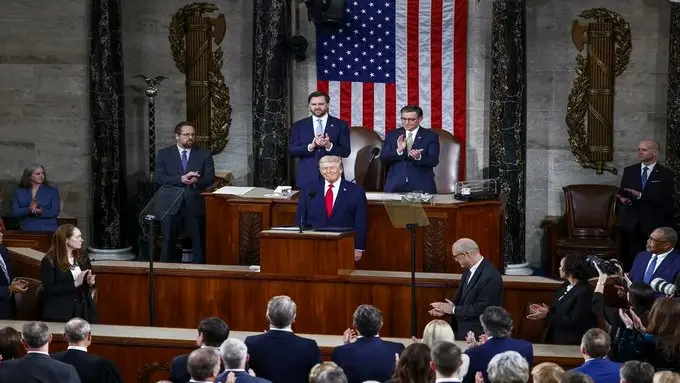
U.S. President Donald Trump addresses Congress during his annual speech. Photo: EFE
February 25, 2026 Hour: 2:37 am
🔗 Comparte este artículo
President defends economic record in State of the Union before Congress while statistics, rulings and protests expose widening gaps.
U.S. President Donald Trump told Congress on Tuesday that his second term has produced a historic transformation, presenting economic strength and foreign policy assertiveness as evidence of success. Yet official data, recent court decisions and visible public dissent underscored contradictions between his claims and measurable outcomes.
RELATED: Jeffrey Sachs Urges Trump to Provide Relief to Families Torn by Tariffs
“We have achieved a transformation like never before seen,” Trump declared before lawmakers, less than nine months ahead of midterm elections that could reshape control of Washington. Republican members applauded and chanted in support, while most Democrats remained seated in silence.
The president centered his address on the economy. He asserted that “factories, jobs, investments and trillions of dollars will continue to flow into the United States,” cited the Dow Jones surpassing 50,000 points, and claimed egg prices had fallen 60 percent due to his policies.
However, the Consumer Price Index published on February 13 reports a 34.2 percent year-over-year decline in egg prices. In January 2026, a dozen eggs cost more than $9 in some stores. Economic growth slowed in the final quarter of 2025, and polls show cost-of-living concerns remain central for voters. Stock market gains do not directly affect households without investments.
Text Reads: Donald Trump subió este martes al podio del Congreso con una sola tarea: convencer a un país escéptico de que todo va bien.
Jeff Shesol, former speechwriter for President Bill Clinton, warned of the political implications: “If he insists that the upside is gold, nobody’s going to believe it. It will be a very difficult position for Republicans to defend in the campaign.”
The address followed a 6–3 Supreme Court ruling invalidating tariffs that had formed a cornerstone of Trump’s economic strategy. Rather than signal compliance, the president announced his intention to bypass the decision without congressional approval or market disruption — a move critics interpret as a challenge to judicial authority.
In a shift toward populist messaging, Trump called on Congress to permanently limit the number of homes large corporations can purchase. “We want houses for people, not for corporations. Corporations are already fine,” he said.
On healthcare, he announced the termination of premium tax credits under the Affordable Care Act, proposing health savings accounts instead. “I want to stop making payments to big insurance companies and give that money directly to the people,” he stated. The proposal has divided Republicans and strengthened Democratic opposition.
In the technology sector, Trump revealed an agreement allowing companies to construct dedicated power plants linked to artificial intelligence data centers. “Electricity prices for the community will drop considerably,” he promised, responding to concerns over the energy impact of such facilities.
On foreign policy, Trump highlighted airstrikes on Iranian nuclear facilities, mediation efforts toward a ceasefire between Israel and Hamas in Gaza, the designation of Mexican drug cartels as terrorist organizations, and what he described as the kidnapping of Venezuelan President Nicolás Maduro and his wife Cilia Flores.
The speech did not address strained relations with NATO, pressure on Denmark regarding Greenland, or his position toward Russian President Vladimir Putin as the conflict in Ukraine marked its fourth anniversary.
While Trump spoke inside the Capitol, opposition mobilized outside. Hundreds gathered at the National Mall for the “People’s State of the Union,” including around 30 Democratic lawmakers. Signs read “No money for ICE” and “Healthcare, not war.” Senator Chris Murphy of Connecticut explained his absence from the official address: “These are not normal times, and Democrats have to stop acting normal.” A Trump supporter briefly disrupted the rally before being escorted away.
Text Reads: A lo largo de la intervención del presidente estadounidense, los representantes demócratas pusieron en duda las cifras económicas anunciadas por Trump.
At the National Press Club, actor Robert De Niro led the “State of the Swamp” event organized by Defiance.org and allied groups. MoveOn director Katie Bethell stated: “Trump’s State of the Union will look nothing like what is actually happening in this country today.”
Virginia Governor Abigail Spanberger delivered the official Democratic response, focusing on cost-of-living pressures. Senator Alex Padilla addressed Spanish-speaking audiences. Together, they framed a central counterargument: the economic momentum described by the president does not align with the lived experience of many Americans.
Throughout the address, Trump did not reference declining approval ratings, sustained protests against immigration raids, or the continued rise in living costs — issues that remain politically significant ahead of November’s elections.
Author: MK
Source: Agencies