Russia and Ukraine Move Toward a Prisoner Exchange Following Negotiations in Abu Dhabi
Russia and Ukraine, with the mediation of the United States, agreed in Abu Dhabi to carry out a large-scale prisoner exchange, even as differences persist regarding European security and territorial issues.
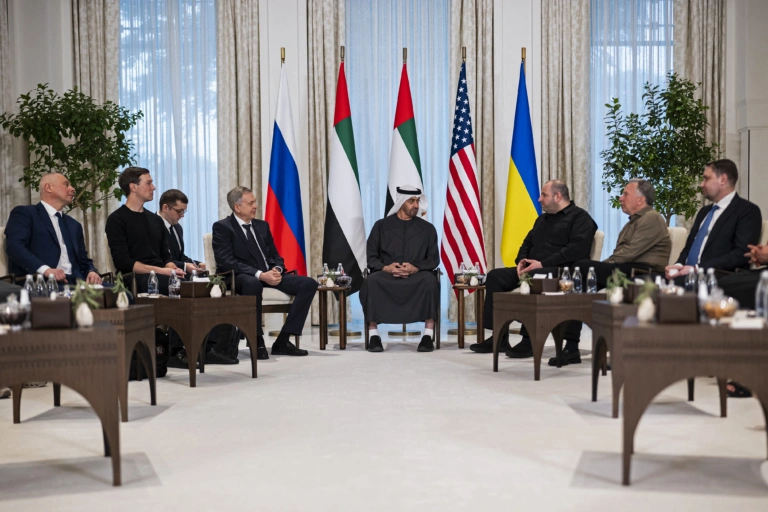
Delegations from Russia, Ukraine, and the United States held two days of negotiations in Abu Dhabi, mediated by Washington. Photo: TASS
November 11, 2026 Hour: 3:16 pm
🔗 Comparte este artículo
On Wednesday, Russia and Ukraine reached an agreement in principle to carry out a large-scale prisoner exchange, following two days of trilateral talks held in Abu Dhabi, the capital of the United Arab Emirates (UAE), with the United States acting as a mediator.
RELATED:
Russia and Ukraine Complete New Prisoner Exchange with UAE Mediation
The announcement was made by the head of the Russian delegation, Vladimir Medinsky, who stated that the specific terms would be disclosed shortly.
The meeting, which took place between November 10 and 11, marked the resumption of the tripartite dialogue after a hiatus of several months, as part of a negotiation process that began in early 2026 in Geneva and the Emirati capital itself.
Medinsky announced that the parties had reached an understanding regarding a major prisoner exchange, though he did not disclose figures, timelines, or conditions. “We have reached a fundamental agreement on another large-scale prisoner exchange. The details will be made public shortly,” the Russian negotiator stated, according to comments reported by the TASS news agency.
The official explained that Moscow does not release information regarding negotiation processes until a definitive agreement is reached. “Until a final agreement is secured, the details are never discussed,” he maintained.
For his part, the head of the Ukrainian negotiating team, Rustem Umerov, also confirmed the commitment, noting that the parties are working to define the specifics and move toward practical implementation.
European security on the agenda
The architecture of European security took center stage during the Abu Dhabi talks. Medinsky indicated that the Russian and U.S. delegations exchanged positions and identified common ground on certain issues, though differences remain.
“We believe it is appropriate to ask what will happen after the inevitable end of the conflict in Ukraine. Russia has repeatedly raised the need to create a new, comprehensive, and fair security system in Europe,” Medinsky stated. The topics addressed included security guarantees, mechanisms for de-escalating the conflict, humanitarian efforts, and the restructuring of the global security architecture in the post-conflict period.
Regarding reports in Western media about potential Ukrainian resistance to making territorial concessions, Medinsky reaffirmed Moscow’s position. “As for territorial issues, every inch of our land will be returned to Russia, one way or another,” he declared.
The head of the Russian delegation also ruled out any contacts with European representatives in Abu Dhabi, stating that Europe has not put forward any concrete peace initiatives. “We have not received a single peace initiative or any specific peace proposal from European countries,” he lamented.
Medinsky accused European leaders of deceiving the Ukrainian people and prolonging the conflict through funding and the supply of weapons. “They are collectively deceiving the Ukrainian people. They are funding and supplying arms to one of the parties to the conflict, thereby contributing, in essence, to the mass death of civilians,” he asserted. Without concrete proposals, he added, there is no basis for discussion.
Despite the humanitarian agreement, the talks concluded without any announced progress regarding a ceasefire or territorial disputes—issues that continue to divide Moscow and Kyiv.
Analysts warn that political tensions persist, limiting the possibility of immediate results.
President Vladimir Putin and Russian diplomatic officials reiterated that any definitive agreement must address the structural causes of the conflict and be based on lasting security guarantees for the Russian Federation.
Author: HGV
Source: Telesur/TASS