







Pakistan Becomes Last Resort Mediator in the U.S. War on Iran
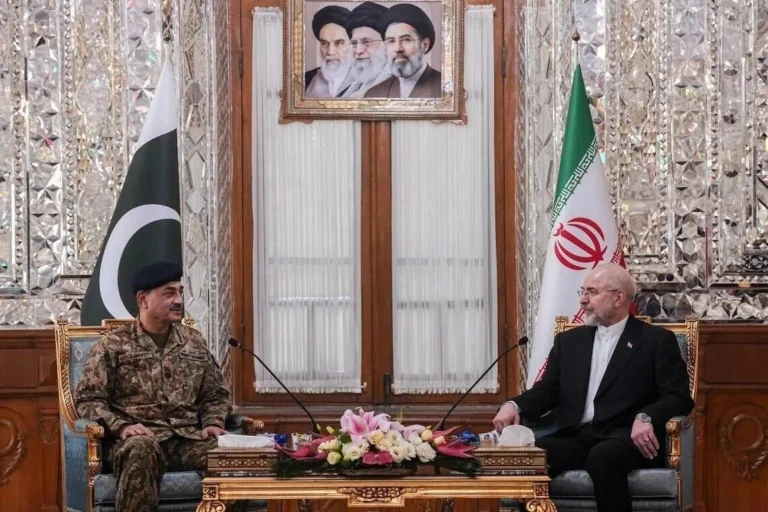
Iranian Parliament Speaker Mohammad Bagher Ghalibaf (right) met Pakistan army chief Asim Munir in Tehran. Photo: The Straits Time
April 23, 2026 Hour: 2:44 pm
🔗 Comparte este artículo
A deep dive into the diplomatic shuttle missions and military-led peace initiatives hosted in Pakistan.
Since its 1947 partition from British India, Pakistan has navigated a complex path from a nation burdened by its colonial history to a pivotal geopolitical conduit between South Asia, Central Asia, and the Middle East.
RELATED:
Iran Denies Sending Delegation for U.S. Talks to Pakistan
Since its 1947 partition from British India, Pakistan has navigated a complex path from a nation burdened by its colonial history to a pivotal geopolitical conduit between South Asia, Central Asia, and the Middle East.
Historically caught in the crossfire of global power struggles, the state has recently undergone a structural metamorphosis that redefined its governance.
By late 2025, the 27th Constitutional Amendment had shifted the country’s delicate balance of power towards a “unified command” system, centralizing the Army, Navy and Air Force under the first Chief of Defense Forces (CDF), Field Marshal Asim Munir.
With a mandate extending to 2030 and authority over specialized councils that bypass traditional bureaucracy, the military has evolved into the primary architect of Pakistan’s foreign policy and economic strategy.
In today’s global context, this centralized leadership is vital for Pakistan’s growing role as a respected mediator in a regional landscape marked by division.
A History of Balancing Power
Pakistan’s international relations are defined by a “diversified portfolio” approach, designed to maintain sovereignty while managing regional rivalries. The most consistent factor in this history is the relationship with India, which has been marked by decades of conflict over the territory of Kashmir.
This ongoing rivalry has prompted Pakistan to pursue strategic “contrapuntal” alliances to ensure its security, eventually leading to its declaration as a nuclear-weapons state in 1998.
Historically, Pakistan has had to deal with an unstable relationship with the United States that extends beyond its immediate neighborhood. During the Cold War and the subsequent “War on Terror,” Islamabad played a pivotal role as a logistical hub for Washington. However, the partnership has frequently been strained by conflicting interests and shifting American priorities.
In contrast, the relationship with China has remained remarkably stable. The China-Pakistan Economic Corridor (CPEC) is a multi-billion-dollar infrastructure project that provides China with direct access to the Arabian Sea via the port of Gwadar. This bond is often described as an “all-weather friendship” and is a key component of the strategic partnership between the two nations.
The country’s position in the region is further complicated by its relationship with its western neighbors, Iran and Afghanistan. While there are deep cultural and religious ties shared between them, the borders have often been sites of security concerns. In regard to Iran, Pakistan has cultivated a pragmatic relationship, engaging in collaborative energy initiatives such as the “Peace Pipeline” while concurrently addressing border stability in the Balochistan region.
The Mediator of Last Resort
Pakistan has assumed a pivotal role in mediating the ongoing tensions between the United States and Iran, a position that was formally established during the pivotal Islamabad Peace Talks in April 2026.
This mediation is not just symbolic; it is a strategic necessity for the Pakistani state, which is keen to prevent a total regional war that would have a devastating effect on its energy security and economic stability.
Islamabad has strategically positioned itself as a “bridge” between these two regions, leveraging its unique status as a nuclear-armed nation with established working relationships in both Washington and Tehran.
The primary mechanism for this mediation has been a series of high-level diplomatic rounds hosted in Islamabad. These talks have brought together high-ranking officials, including U.S. Vice President J.D. Vance and Iranian Parliament Speaker Mohammad Baqer Qalibaf.
Pakistan’s mediation strategy relies on “shuttle diplomacy”, with Prime Minister Shehbaz Sharif and Field Marshal Asim Munir maintaining continuous communication with both capitals to secure ceasefire extensions.
The Pakistani government has successfully lobbied the Trump administration to extend truce periods, arguing that a cessation in hostilities is the only way to reach a “unified proposal” for regional peace.
Internationally, Pakistan has strategically leveraged its membership in the Organization of Islamic Cooperation (OIC) and the Shanghai Cooperation Organization (SCO) to foster a comprehensive consensus for de-escalation.
The Ministry of Foreign Affairs has issued an official statement emphasizing a policy of “non-interference” and the protection of sovereign maritime rights. By hosting these dialogues, Pakistan has not only sought to protect its own borders but has also raised its international standing, transitioning from a regional player to a pivotal actor in global security.
Border Security and the Cost of Conflict
The security of Pakistan’s 900-kilometre border with Iran remains a top priority for the country as regional tensions persist. Since the conflict intensified in late February 2026, Islamabad has significantly reinforced its military presence in Balochistan province.
This mobilisation, known as the “Goldad Line” reinforcement, is designed to prevent the conflict from spilling over into Pakistani territory and to ensure that non-state actors do not exploit the instability to target national infrastructure or projects related to the China-Pakistan Economic Corridor.
The economic consequences of the war have been both immediate and severe. Pakistan is a net importer of oil, with over 90% of its oil requirements being sourced from the region, much of which is transported through the Strait of Hormuz.
The obstruction of this vital shipping lane has resulted in a 30% increase in global oil prices since February, contributing to Pakistan’s inflation rate reaching double digits. Energy costs in the country are projected to rise by nearly 30% year-on-year, placing an immense burden on the transport and agricultural sectors. These costs have had a knock-on effect on the broader economy, impacting the price of essential goods and leading to domestic unrest.
Pakistan’s Strategic Stance Since February
Since the onset of the current conflict in late February 2026, Pakistan has maintained a policy of “active neutrality,” a stance that emphasizes diplomatic involvement while strictly avoiding military entanglement.
In contrast to previous regional crises, the Ministry of Foreign Affairs has issued consistent official statements condemning the violation of any sovereign territory, emphasizing that a wider war would yield no victors, only regional collapse.
This positioning is supported by a series of specific policy decisions. Since late February, Pakistan has officially closed its airspace to any foreign military flights directed towards the conflict zone and has reaffirmed that no domestic bases will be used for offensive operations.
This “red line” has been communicated clearly to Washington, signaling a shift toward protecting the integrity of the regional geography. Islamabad has also used its seat at the United Nations and the OIC to call for an immediate cessation of hostilities, focusing on the protection of civilian infrastructure and the global energy supply.
Economic and Security Consequences
The practical consequences of the war have exposed the country’s domestic resilience. In terms of security, the conflict has necessitated a significant realignment of resources towards the western border.
In response, the military has initiated “Operation Safeguard” to monitor the borders and prevent the infiltration of militant groups that might seek to capitalize on the regional chaos.
Economically, the country has successfully navigated a period of intense volatility. The disruption of maritime trade in the Arabian Sea has led to a surge in shipping costs, affecting both exports and the import of essential machinery.
The rising cost of electricity and fuel has had a particularly significant impact on small and medium-sized enterprises (SMEs), resulting in a temporary slowdown in industrial production.
However, the government has countered these effects by strengthening its bilateral trade agreements with China, ensuring that essential supplies for the CPEC projects continue to flow through land routes when sea lanes are compromised.
The social dimension of the conflict is also evident in Pakistan’s urban centers. Public opinion has largely supported the government’s mediation efforts, with a strong consensus for a peaceful resolution that respects Islamic solidarity.
The Future of the “Multipolar Pivot”
The current role of Pakistan in the Middle East conflict marks a fundamental shift in its national identity on the global stage. The country has moved beyond its traditional role as a secondary player in Western-led security architectures.
Utilizing its centralized leadership and strategic geography, it has established itself as an indispensable mediator. By successfully facilitating the communication that led to the April 2026 truce extensions, Islamabad has demonstrated that its “military-economic” model can provide the stability necessary to prevent a broader international catastrophe.
The sustainability of this position depends on Pakistan’s ability to manage its internal economic pressures while resisting the “zero-sum” demands of global superpowers. The consolidation of power under Field Marshal Asim Munir has provided a consistent diplomatic voice, yet the long-term challenge remains the restoration of economic sovereignty amidst global energy volatility.
It is clear that, since February 2026, Pakistan’s security has been inextricably linked to the stability of the entire Asian landmass. The “Islamabad Talks” were more than a temporary diplomatic success; they provided a blueprint for how a nation in the Global South can navigate the fractures of the 21st century.
Historically caught in the crossfire of global power struggles, the state has recently undergone a structural metamorphosis that redefined its governance.
By late 2025, the 27th Constitutional Amendment had shifted the country’s delicate balance of power towards a “unified command” system, centralizing the Army, Navy and Air Force under the first Chief of Defense Forces (CDF), Field Marshal Asim Munir.
With a mandate extending to 2030 and authority over specialized councils that bypass traditional bureaucracy, the military has evolved into the primary architect of Pakistan’s foreign policy and economic strategy.
In today’s global context, this centralized leadership is vital for Pakistan’s growing role as a respected mediator in a regional landscape marked by division.
A History of Balancing Power
Pakistan’s international relations are defined by a “diversified portfolio” approach, designed to maintain sovereignty while managing regional rivalries. The most consistent factor in this history is the relationship with India, which has been marked by decades of conflict over the territory of Kashmir.
This ongoing rivalry has prompted Pakistan to pursue strategic “contrapuntal” alliances to ensure its security, eventually leading to its declaration as a nuclear-weapons state in 1998.
Historically, Pakistan has had to deal with an unstable relationship with the United States that extends beyond its immediate neighborhood. During the Cold War and the subsequent “War on Terror,” Islamabad played a pivotal role as a logistical hub for Washington.
However, the partnership has frequently been strained by conflicting interests and shifting American priorities.
In contrast, the relationship with China has remained remarkably stable. The China-Pakistan Economic Corridor (CPEC) is a multi-billion-dollar infrastructure project that provides China with direct access to the Arabian Sea via the port of Gwadar. This bond is often described as an “all-weather friendship” and is a key component of the strategic partnership between the two nations.
The country’s position in the region is further complicated by its relationship with its western neighbors, Iran and Afghanistan. While there are deep cultural and religious ties shared between them, the borders have often been sites of security concerns. In regard to Iran, Pakistan has cultivated a pragmatic relationship, engaging in collaborative energy initiatives such as the “Peace Pipeline” while concurrently addressing border stability in the Balochistan region.
The Mediator of Last Resort
Pakistan has assumed a pivotal role in mediating the ongoing tensions between the United States and Iran, a position that was formally established during the pivotal Islamabad Peace Talks in April 2026.
This mediation is not just symbolic; it is a strategic necessity for the Pakistani state, which is keen to prevent a total regional war that would have a devastating effect on its energy security and economic stability.
Islamabad has strategically positioned itself as a “bridge” between these two regions, leveraging its unique status as a nuclear-armed nation with established working relationships in both Washington and Tehran.
The primary mechanism for this mediation has been a series of high-level diplomatic rounds hosted in Islamabad. These talks have brought together high-ranking officials, including U.S. Vice President J.D. Vance and Iranian Parliament Speaker Mohammad Baqer Qalibaf.
Pakistan’s mediation strategy relies on “shuttle diplomacy”, with Prime Minister Shehbaz Sharif and Field Marshal Asim Munir maintaining continuous communication with both capitals to secure ceasefire extensions.
The Pakistani government has successfully lobbied the Trump administration to extend truce periods, arguing that a cessation in hostilities is the only way to reach a “unified proposal” for regional peace.
Internationally, Pakistan has strategically leveraged its membership in the Organization of Islamic Cooperation (OIC) and the Shanghai Cooperation Organization (SCO) to foster a comprehensive consensus for de-escalation.
The Ministry of Foreign Affairs has issued an official statement emphasizing a policy of “non-interference” and the protection of sovereign maritime rights. By hosting these dialogues, Pakistan has not only sought to protect its own borders but has also raised its international standing, transitioning from a regional player to a pivotal actor in global security.
Border Security and the Cost of Conflict
The security of Pakistan’s 900-kilometre border with Iran remains a top priority for the country as regional tensions persist. Since the conflict intensified in late February 2026, Islamabad has significantly reinforced its military presence in Balochistan province.
This mobilisation, known as the “Goldad Line” reinforcement, is designed to prevent the conflict from spilling over into Pakistani territory and to ensure that non-state actors do not exploit the instability to target national infrastructure or projects related to the China-Pakistan Economic Corridor.
The economic consequences of the war have been both immediate and severe. Pakistan is a net importer of oil, with over 90% of its oil requirements being sourced from the region, much of which is transported through the Strait of Hormuz.
The obstruction of this vital shipping lane has resulted in a 30% increase in global oil prices since February, contributing to Pakistan’s inflation rate reaching double digits. Energy costs in the country are projected to rise by nearly 30% year-on-year, placing an immense burden on the transport and agricultural sectors. These costs have had a knock-on effect on the broader economy, impacting the price of essential goods and leading to domestic unrest.
Pakistan’s Strategic Stance Since February
Since the onset of the current conflict in late February 2026, Pakistan has maintained a policy of “active neutrality,” a stance that emphasizes diplomatic involvement while strictly avoiding military entanglement.
In contrast to previous regional crises, the Ministry of Foreign Affairs has issued consistent official statements condemning the violation of any sovereign territory, emphasizing that a wider war would yield no victors, only regional collapse.
This positioning is supported by a series of specific policy decisions. Since late February, Pakistan has officially closed its airspace to any foreign military flights directed towards the conflict zone and has reaffirmed that no domestic bases will be used for offensive operations.
This “red line” has been communicated clearly to Washington, signaling a shift toward protecting the integrity of the regional geography. Islamabad has also used its seat at the United Nations and the OIC to call for an immediate cessation of hostilities, focusing on the protection of civilian infrastructure and the global energy supply.
The Future of the “Multipolar Pivot”
The current role of Pakistan in the Middle East conflict marks a fundamental shift in its national identity on the global stage. The country has moved beyond its traditional role as a secondary player in Western-led security architectures.
Utilizing its centralized leadership and strategic geography, it has established itself as an indispensable mediator. By successfully facilitating the communication that led to the April 2026 truce extensions, Islamabad has demonstrated that its “military-economic” model can provide the stability necessary to prevent a broader international catastrophe.
The sustainability of this position depends on Pakistan’s ability to manage its internal economic pressures while resisting the “zero-sum” demands of global superpowers. The consolidation of power under Field Marshal Asim Munir has provided a consistent diplomatic voice, yet the long-term challenge remains the restoration of economic sovereignty amidst global energy volatility.
It is clear that, since February 2026, Pakistan’s security has been inextricably linked to the stability of the entire Asian landmass. The “Islamabad Talks” were more than a temporary diplomatic success; they provided a blueprint for how a nation in the Global South can navigate the fractures of the 21st century.
Sources: Al JAzeera – Al Mayadeen – Xinhua – India Times – The Guardian – TRT World – AA.com
Author: Sivana Solano
Source: teleSUR