


Noboa’s Polemical Laws Temporarily Halted by the Constitutional Court
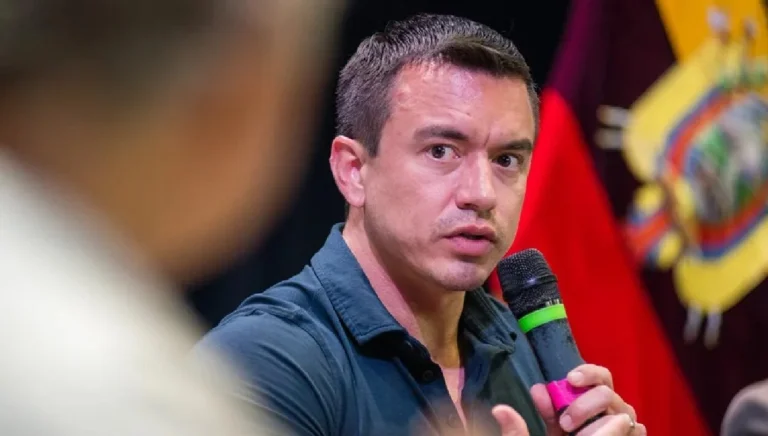
(FILE) Ecuatorian President Daniel Noboa. Photo: EFE.
August 5, 2025 Hour: 12:24 am
🔗 Comparte este artículo
The Constitutional Court of Ecuador provisionally suspended on Monday a series of articles from several laws promoted by President Daniel Noboa, following multiple constitutional challenges from organizations warning of violations of fundamental rights.
RELATED: Ecuador and US Sign Controversial Security Agreement Amid Rising Social Unrest
Among the suspended articles are some controversial provisions of the Organic Intelligence Law, such as those allowing undercover intelligence agents to assume false identities, enabling the national intelligence system to request information from telephone companies and other entities, and authorizing the use of funds without complying with public procurement laws.
Specifically, the Court suspended Articles 5, 13, 22, 41, 42, 43, 47, 48, 50, 51, 52, and 55 of the Intelligence Law. It also applied the same preliminary suspension to Articles 9, 16, 17, 25, 33, 34, 35, 36, and General Provision One of its corresponding regulations, pending a final ruling.
Among the suspended provisions are those that would allow intelligence agents—both police and military—to operate undercover and use “technological techniques and tools (software and hardware) in the electromagnetic spectrum and cyberspace.”
Both the opposition and civil society organizations have warned that such Intelligence Law could open the door to espionage and persecution of political opponents and journalists.
“Early pardon” halted
Regarding the so-called National Solidarity Law, whose initial purpose was to secure more resources for law enforcement to combat organized crime, the Constitutional Court preliminarily suspended the article that grants Noboa the prerogative of an “early pardon” for police and military personnel prosecuted for crimes committed within the framework of the “internal armed conflict”.
In that same law, the definition of an organized armed group was also suspended. This was originally defined as “any structured group of three or more people with an organized power structure that exercises prolonged violence against the State, the population, and civilian property.”
Conversion of savings cooperatives suspended
Regarding the Organic Law of Public Integrity, the Constitutional Court also suspended the article that required savings and credit cooperatives to convert into private-sector corporations, as a measure to “protect savings and preserve financial stability.”
These laws were approved on Noboa’s initiative following his reelection as president until 2029 in the elections held in the first half of 2025, where his party, National Democratic Action (ADN), gained control of the Parliament.
Author: vmmh
Source: EFE