







Netanyahu’s Endorsement of “Greater Israel” Sparks Regional Condemnation
Benjamin Netanyahu has publicly reaffirmed his commitment to the “Greater Israel” vision, drawing strong criticism from Arab states and highlighting ongoing tensions over regional expansionism and settlement policies.
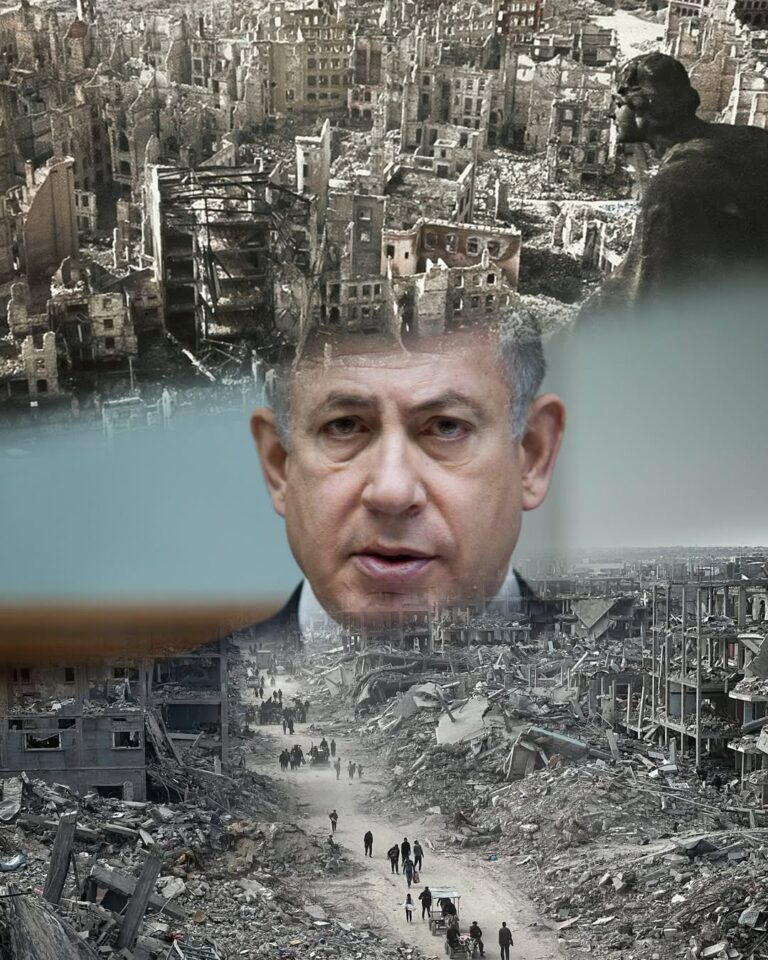
Israeli Prime Minister Benjamin Netanyahu affirms his commitment to the vision of a “Greater Israel” during a televised interview. Photo: @EyeonPalestine
August 18, 2025 Hour: 6:24 am
🔗 Comparte este artículo
Israeli Prime Minister Benjamin Netanyahu has openly endorsed the concept of a “Greater Israel,” provoking condemnation from Arab governments, Iran, and the Arab League, which describe the project as a threat to regional security and international law. His remarks come amid ongoing military operations in Gaza and broader tensions in the Middle East.
RELATED:
Argentine Groups Seek Arrest of Netanyahu During September Visit Over Alleged War Crimes
In a televised interview with i24news host and former right-wing politician Sharon Gal, Netanyahu accepted a talisman representing the “Promised Land” and confirmed his alignment with the concept.
“Do you connect with the vision?” Gal asked.
“Very much,” Netanyahu replied.
“Really?” Gal pressed.
“Very much,” he repeated.
“It’s Greater Israel,” Gal noted.
“If you ask me, we are here,” Netanyahu responded.
He described his mission as both “historic and spiritual,” linking the vision to occupied Palestinian territories and areas in neighboring Arab countries.
Arab and Muslim countries condemned Netanyahu’s statements. Iran’s Foreign Ministry spokesperson, Esmail Baqai, denounced the remarks as violations of the UN Charter and described them as evidence of genocidal intentions. The Arab League urged the UN Security Council to respond to what it called extremist rhetoric.
The vision of “Greater Israel” has long been associated with radical Zionist movements and encompasses not only Palestine but also Lebanon, Jordan, parts of Syria, Iraq, Egypt, and northern Saudi Arabia. In maximalist interpretations, the project stretches from the Nile to the Euphrates.
Netanyahu’s support for the idea is consistent with his previous statements. In Paris in 2023, he affirmed the concept, linking it to Israel’s foundational narratives. In July 2025, speaking before the Israeli parliament, he invoked biblical claims from the Jordan River to the Mediterranean and framed territorial expansion as both a historical right and a security necessity.
He told his cabinet that control over the occupied West Bank and southern Lebanon provided “strategic depth,” a formulation analysts interpret as part of a broader territorial agenda.
The “Greater Israel” concept originates in 19th- and early 20th-century Zionist thought. Ideologues such as Vladimir Jabotinsky and early revisionist Zionists articulated claims extending beyond the British Mandate borders, combining biblical narratives with European colonial frameworks. The movement influenced settlement expansions after 1967, the rise of Likud in 1977, and the integration of far-right figures into government by the 2020s.
Radical religious Zionists like rabbis Dov Lior and Yitzchak Ginsburgh mobilized youth around these claims, shaping electoral support and influencing contemporary political discourse. The movement’s maximalist interpretations envision territories in Lebanon south of the Litani River, southern Syria including the Golan Heights, western Jordan, the Sinai Peninsula, and northern Saudi Arabia. Some versions even extend to Iraq and occasionally Kuwait.
Today, Israeli settlements cover more than 40 percent of the West Bank, with over 700,000 settlers living under Israeli authority, in violation of international law. Areas such as Sheikh Jarrah and Silwan in Jerusalem have been targeted for settlement expansion based on disputed claims of “biblical ownership.”
Recent remarks by right-wing ministers, including Bezalel Smotrich, calling for annexation of southern Lebanon, illustrate how the ideological concept of “Greater Israel” continues to inform contemporary military and political strategies. Analysts note that Netanyahu’s rhetoric alternates between explicit biblical references and implicit security arguments, enabling both maximalist interpretation by hardline supporters and continued backing from Western allies.
Netanyahu’s public endorsement of the “Greater Israel” vision underscores the persistence of a territorial ideology that has shaped Israeli policy for decades. While framed as a historic and spiritual mission, the project raises significant concerns about the sovereignty of Palestinian and neighboring Arab populations and highlights the enduring tensions between expansionist ambitions and international norms.
Author: MK
Source: PressTV - HispanTV