







IKIAM University Identifies First Dinosaur Fossil in Ecuadorian Amazon
X/ @fmmundo
July 9, 2026 Hour: 2:12 pm
🔗 Comparte este artículo
The remains of ‘Wakrayampi’ were discovered in 2018 by residents of a community in the Napo province.
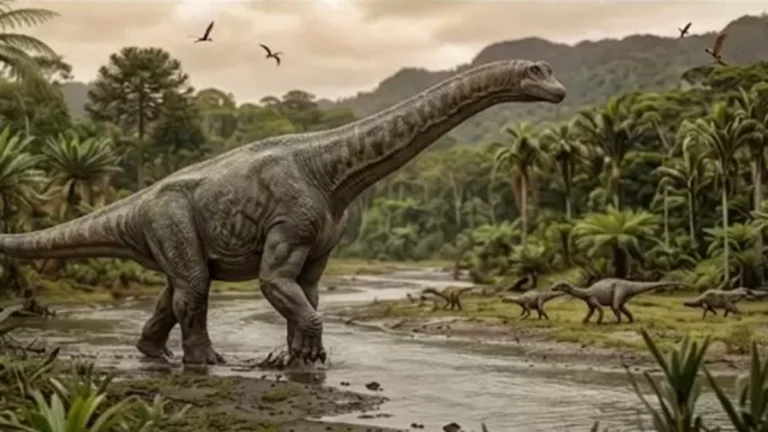
This week, IKIAM University announced that its researchers have identified the first dinosaur fossil ever recorded in the Ecuadorian Amazon, a titanosaur sauropod that lived in the region about 67 million years ago.
RELATED:
Extinction of Indigenous Languages and Climate Change Threaten the Amazon
The remains were originally discovered in 2018 by Robert Roman, Alvaro Roman and German Shiguango, three residents of a community in the Misahualli area of Napo province. At the time, however, they were unaware of the significance of their discovery.
Eight years later, the scientific study confirmed that the fossils belonged to a large herbivorous dinosaur that lived in the area for years, in what was then an Amazonian coastal plain.
It is the first record of a dinosaur in Ecuador’s Amazon Basin and the second dinosaur described in the country, following the dinosaur discovered in the Andean province of Loja.
“By reporting that dinosaurs existed in this formation and in these rocks, the idea is that we may also find other remains,” said Santiago Balcazar-Loaiza, one of the scientists behind the research.
The text reads, “Dinosaurs in Napo. Eight years after some residents found strange remains on the banks of the Napo River, science confirmed that they belong to a titanosaur sauropod, which inhabited this region 67 million years ago.”
The specimen was informally named “Wakrayampi,” a term taken from Kichwa that combines “wakra,” referring to its size, and “yampi,” referring to its shape.
“We sought to incorporate ancestral languages from Napo to raise awareness that fossil heritage, paleontological heritage, belongs to the local community; it is part of who we are,” Balcazar-Loaiza said, noting that researchers have not yet been able to determine the species but have estimated its approximate size.
“These animals measured between 6 and 30 meters. We could say that this specimen would be of intermediate size,” he said, recalling that the research was carried out by IKIAM researchers in collaboration with Argentina’s Azara Foundation and the Venecia-Misahualli community.
teleSUR/ JF
Source: EFE