







Extinction of Indigenous Languages and Climate Change Threaten the Amazon
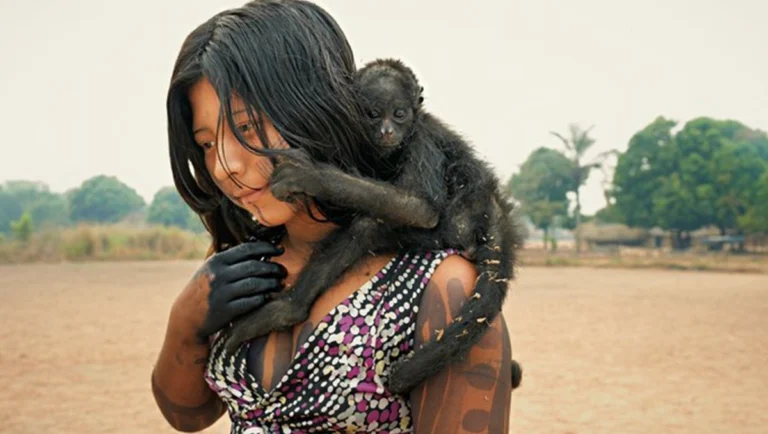
A Kayapo woman cares for an orphaned spider monkey in Kendjam, Brazil, X/ @2b10julio_l
July 9, 2026 Hour: 7:54 am
🔗 Comparte este artículo
A quarter of the documented knowledge about the Amazon could disappear by the end of the century.
On Wednesday, the journal Nature published “The Forest of Knowledge Under Global Change,” a study highlighting the threat climate change poses to the Amazon’s biocultural heritage.
RELATED:
Three Indigenous Shuar Killed in Military Confrontation in Ecuador’s Amazon
Amazonian societies use nearly 5,800 plant species, but climate change could reduce native plant species by one-third, posing a danger to their culture and knowledge, according to the study conducted by Rodrigo Camara-Leret and Jordi Bascompte of the University of Zurich and Patrick Roehrdanz of the Moore Center for Science.
The reduction in the availability of culturally important plants, together with the projected extinction of Indigenous languages, could lead to the loss of one-quarter of the documented knowledge related to the uses of Amazonian plant species by the end of the century.
The Amazon rainforest is a global center of both biological and cultural heritage, as it is home to more than 10% of the planet’s terrestrial biodiversity and more than 400 Indigenous groups.
The researchers compiled about 90,000 reports documenting the uses of Amazonian plants between 1504 and 2023, finding that these societies use nearly 5,800 plant species, twice as many as previous estimates. Using more than 76,000 reports on native plant species, they analyzed the languages in which they were written. It found that 57% came from 156 Indigenous languages, of which 56% are endangered.
The scientists also modeled the effects of climate change on species distributions between 2060 and 2080 under three scenarios: one in which climate targets are achieved by midcentury, one with minimal action against climate change and one with no policies, representing the worst-case scenario.
The models projected average local plant species extinction rates of 28%, 30% and 34% under the three scenarios, respectively. They also found that utilized species accounted for a greater proportion of declining species compared with those that are not used.
The study projects that losses of local services associated with these species, such as medicinal use, will range between 18% and 23% across the three scenarios. It also estimates that regions with endangered languages will experience greater losses of plant species and services than those without them.
The disappearance of endangered languages could result in a 26% reduction in the body of Amazonian knowledge, which, together with species loss, could lead to an enormous loss of cultural knowledge.
The researchers suggest that this situation will have fundamental consequences for Amazonian societies and that these findings should serve as a starting point for the conservation and restoration of the Amazon’s biological heritage.
Nearly 300 million hectares of the Amazon Basin have already been degraded or fragmented, and many Indigenous cultures and their languages are endangered, Victoria Reyes, a researcher at the Autonomous University of Barcelona, said in a commentary accompanying the study.
Rather than trying to restore past conditions, regeneration focuses on rebuilding reciprocal and care-based relationships between people and nature that sustain a place’s biocultural value. It also aligns with the principles of transformative change, including equity and justice, pluralism and inclusion, reciprocity, and adaptive learning, Reyes stated.
teleSUR/ JF
Sources: Nature – EFE