Drug Trafficking and Illegal Mining Merge in Peruvian Amazon
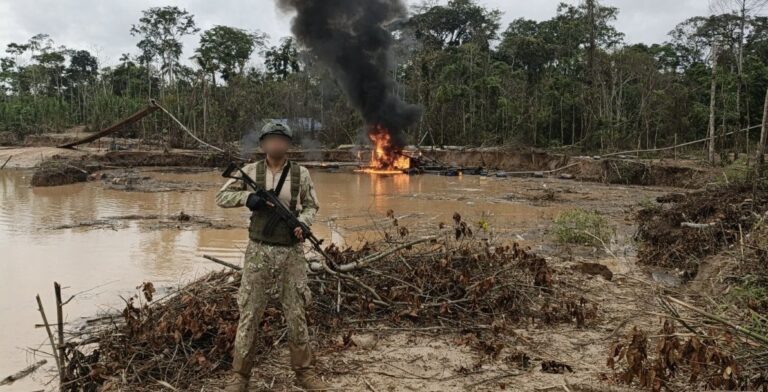
Photo: X/ @MindefPeru
May 21, 2026 Hour: 2:19 am
🔗 Comparte este artículo
Drug trafficking and illegal mining have consolidated into an interdependent criminal system across Peru’s Amazon region, sharing territories, weapons, roads, and logistics in a convergence that is reshaping local economies, undermining state authority, and threatening both human rights and environmental integrity, according to a report presented Wednesday to the Association of Foreign Press Correspondents in Peru.
The study, titled “The Amazon Crossroads: Urgent Decisions or Consolidation of Criminal Power in Peru,” was jointly produced by Amazon Watch, the Interethnic Association for the Development of the Peruvian Rainforest, the Institute for the Common Good, the Regional Organization of Aidesep in Ucayali, and ProPurús. Author Ivan Brehaut explained that illicit economies no longer operate in isolation but as a single structure that reconfigures vast territories.
RELATED: Election Results in Peru Confirm Runoff Between Fujimori and Sanchez
The investigation found that capital from drug trafficking finances illegal mining expansion, while illicit gold is used to launder drug proceeds. This convergence facilitates the installation of criminal governance regimes in areas with weak state presence, leading to institutional capture and control of local economies. Security forces, however, continue to combat both crimes from separate fronts without effective coordination.
The organizations dismissed the Peruvian government’s announced reduction in coca cultivation as false and out of touch with reality. The report details that 50% of the country’s coca-growing areas are located in the Amazon, with over 12,000 hectares planted inside indigenous community territories.
Co-author Ricardo Soberón, a Peruvian lawyer and professor, argued that measurements should not be limited to plantations, airstrips, and laboratories. When including communities and territories under narco-governance influence, the affected area rises to approximately 12 million hectares. Transnational criminal organizations operate along border zones, using Peru as a supply, regrouping, and storage point.
The report emphasizes that indigenous communities act as a critical barrier against illicit expansion and must be included in the design, implementation, and evaluation of public policies. Experts stressed the urgency of addressing the problem less than three weeks before the presidential runoff election, where Keiko Fujimori and Roberto Sánchez will face off.
Soberón called the silence of both campaigns on the issue “significant and not hopeful,” and announced that the report’s authors will share recommendations with the candidates for a strategy to be implemented during their first 100 days in office.
Author: Victor Miranda
Source: agencies