







De la Espriella Faces Backlash for Displaying Corpses After Military Operation in Colombia
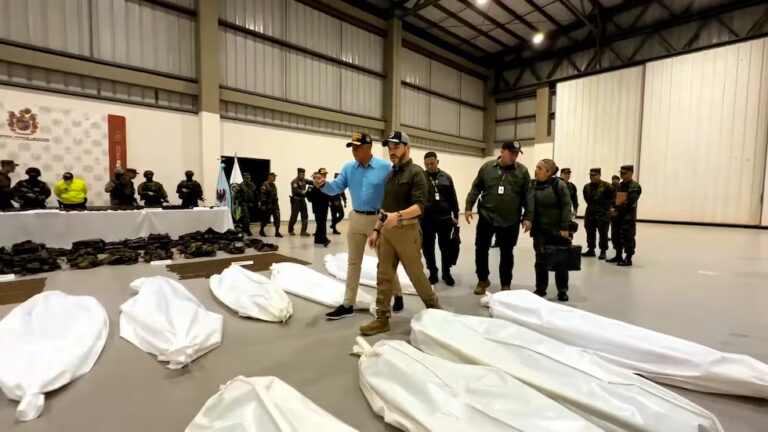
The images show the Colombian president surrounded by bodies alongside the seized weaponry, an action classified as a unnecessary show and qualified by critics as necropolitical. Photo: Video/ X/@ABDELAESPRIELLA.
September 3, 2026 Hour: 8:44 pm
🔗 Comparte este artículo
Colombia’s President Abelardo de la Espriella has sparked widespread criticism for his decision to walk among the bodies of alleged dissidents killed in a recent military operation, an action deemed by critics as necropolitical.
The controversy stems from a video shared on his social media profile following the so-called Operation “Azarías“, conducted on August 30 against dissident groups led by Néstor Gregorio Vera Fernández, alias Iván Mordisco, while critics warn that these actions undermine efforts toward reconciliation and demilitarization in the South American country.
The footage shows President Abelardo de la Espriella surrounded by corpses laid out on the ground alongside seized weapons, an act many have labeled as an unnecessary political spectacle.
RELATED: Colombia Prepares Anti-Terrorism Statute and Special Penal Regime
Similar operations in El Salvador under President Bukele have drawn both praise and condemnation, showcasing the polarized opinions on using force as a primary strategy against alleged criminal organizations.
During the presentation of the operation’s results in Guaviare, de la Espriella celebrated the operation as one of the most significant in 12 years, confirming the deaths of 23 alleged dissidents, including the leader of the Carolina Ramírez structure, alias “Tigre.” He also announced the capture of six individuals, the rescue of a minor, and the seizure of 28 rifles and four machine guns.
Text reads: “I promised them to face terrorism without contemplation and I am fulfilling it. I am not here to coexist with murderers, extortionists and child recruiters. I came to defeat them with all the legitimate force of the Republic’s weapons and the rule of law. (…) Our offensive does not stop tomorrow or next week. The order to our commanders is clear: take back every corner of the national territory and restore peace to the Colombians. Long live Christ the King! Stand with the Homeland!”
The President’s visit to Guaviare, his first to the Amazon region since taking office, coincides with a series of military actions. His government has ordered three bombings against armed groups, two of which were conducted in the Amazon region.
Despite local support from San José del Guaviare’s mayor, Willy Rodríguez, de la Espriella chose not to meet with local mayors during his visit, focusing public attention on the controversial event broadcast on official channels.
The current administration’s security strategy prioritizes military might over dialogue with armed groups. In this sense, De la Espriella has also announced the definitive cancellation of talks with two FARC-EP dissident groups and the Self-Defense Forces “Conquistadors of the Sierra Nevada” (ACSN).
Human Rights Criticisms
Critics have compared the visual style of the video to that used by former U.S. President Donald Trump, who often showcased aerial footage of attacks on supposed drug trafficking vessels in the Caribbean and Pacific Oceans. This comes just a week after the Colombian government adopted a similar aesthetic to that of Salvadoran President Nayib Bukele, sharing images of shaven prisoners during penal transfers.
The implications of such actions transcend mere political theatrics; they shape public perception of security measures and the government’s stance on Human Rights. In a nation grappling with a complex history of violence and conflict, the display of corpses raises ethical questions about the use of force and the dignity of life, as well as the portrayal of victims within the political narrative.
The actions of Colombian President De la Espriella have not only ignited a fierce debate on the ethics of military engagement but have also raised pivotal questions about the future of the country’s peace process. The visual representation of death and violence in political messaging can have lasting impacts on societal perceptions and the political landscape.
Author: Laura V. Mor
Source: Agencies