Argentinean Universities Announce New Week-Long Strike, Funding Crisis Deepens
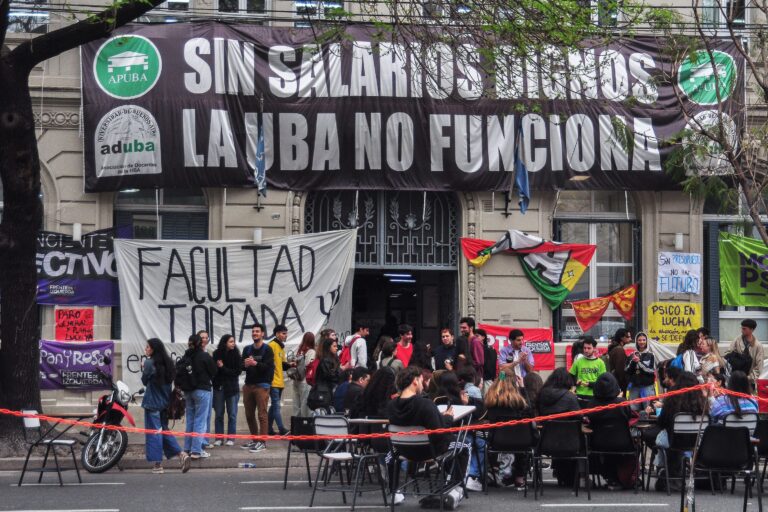
In the face of non-compliance with the University Finance Act, institutions report critical undersupply and infrastructure failures, while wages are below the poverty line. Photo: Hurlingham Post.
May 25, 2026 Hour: 6:36 pm
🔗 Comparte este artículo
Argentina’s university community will commence a week-long general strike this Tuesday after postponing its start due to the commemoration of the May Revolution and the establishment of the First National Government.
The decision to initiate the strike follows widespread discontent over the Javier Milei administration’s policies, which have severely impacted the public education system.
“After the massive mobilization in defense of public universities, the national government continues to disregard the University Financing Law and fails to call for salary negotiations“, denounced the Federation of University Teachers of Buenos Aires (FEDUBA, in Spanish). In response to this lack of engagement, the Union confirmed that they would intensify their struggle plan with a “national university strike“, uniting various sectors of the academic community in a concerted effort to pressure the Government.
RELATED: Argenitinian Government Slashes $56 Million from Education Budget
This action, involving teachers, non-teaching staff, technicians, and students, demands that President Javier Milei comply with University Financing Law (27.795) amidst critical underfunding.
The law 27.795, specifically designed to guarantee essential operational and salary resources for universities, faced significant political hurdles. It was sanctioned twice by the National Congress but subsequently vetoed by President Milei. Following these legislative actions, the national Executive then judicialized the legislation, arguing that the allocation of funds falls under the exclusive purview of the Ministry of Economy and the Ministry of Education.
This legal challenge fundamentally questions the established sources and mechanisms for university financing, placing the future of public education in a precarious state and intensifying the standoff between the legislative and executive branches.
Text reads: “We call for an appointment for the week of May 25…”
The call for the strike emerges after a series of four major “federal marches” across Argentina, which saw significant public participation. The most recent and notable demonstration attracted an estimated 1.5 million people in Buenos Aires City and its adjacent avenues, transforming the iconic square into a sea of protesters united in their demand for adequate university funding.
In the stark absence of official budgetary allocations, Argentinean university institutions are reporting a critical state of disinvestment and severe operational deficiencies. Institutions face widespread critical shortages of essential supplies, along with pervasive failures in infrastructure, which directly impede the delivery of quality education. Concurrently, the salaries of university staff have plummeted, now falling significantly below the poverty line. This dire financial situation threatens the very core functions of these vital public institutions, jeopardizing the academic future of thousands of students and the professional livelihood of dedicated educators and support staff.
According to a comprehensive report from the Center for Argentine Political Economy (CEPA, in Spanish), the university system is grappling with an alarming budgetary adjustment of 45.6% compared to 2023. The detailed document further indicates that salaries, which constitute 87% of the total university expenditure, have plummeted by 43.2%, while crucial operating expenses have suffered an even more drastic 57.1% cut. The report emphasizes that science and university development programs are among the most severely affected sectors, threatening Argentina’s capacity for innovation and long-term academic growth.
The cascading effect of these cuts has led to an estimated 10% abandonment of academic chairs, as faculty members find it increasingly unsustainable to continue their work under current conditions. Alarmingly, 7 out of 10 teachers maintain only a simple dedication to their roles, with a monthly take-home salary of approximately 250,000 Argentinean pesos (around 178 U.S. dollars), which is barely enough to cover basic living expenses.
The impending strike therefore seeks to guarantee the legal allocation of essential educational funds, aiming to restore stability and ensure the viability of public higher education as a fundamental right and a cornerstone of national development.
Author: Laura V. Mor
Source: Pagina 12/ Tiempo Argentino