







3 Defiant Actions Venezuelan Armed Forces Reject US Aggression and Uphold Constitutional Order

Venezuelan Defense Minister Vladimir Padrino López reaffirmed the FANB’s loyalty to Venezuela’s constitutional order and denounced the U.S. operation as a “cowardly kidnapping.”
January 4, 2026 Hour: 3:17 pm
🔗 Comparte este artículo
Venezuelan Armed Forces reject US aggression after Maduro’s alleged capture, vowing to defend sovereignty and uphold constitutional continuity under Delcy Rodríguez.
7 Defiant Actions Venezuelan Armed Forces Reject U.S. Aggression and Uphold Constitutional Order
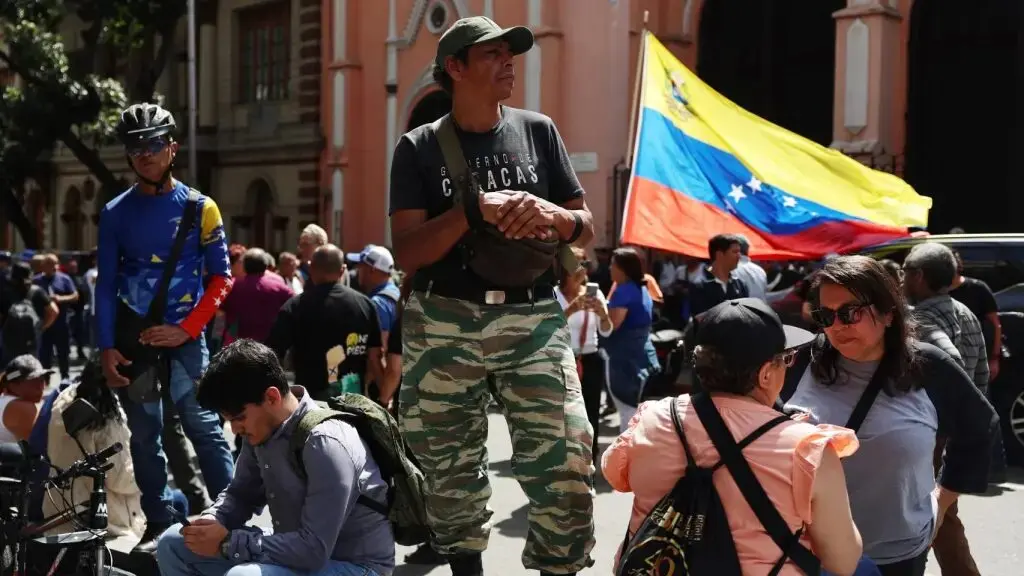
Venezuelan Armed Forces reject US aggression in the strongest institutional terms following reports of a U.S. military incursion that allegedly led to the capture of President Nicolás Maduro and First Lady Cilia Flores on January 3, 2026. In a nationally televised address, General-in-Chief Vladimir Padrino López, Vice President for Defense and Sovereignty, described the operation as a “cowardly kidnapping” carried out “after cold-bloodedly assassinating a large part of the president’s security detail, soldiers, and innocent civilians.”
Speaking on behalf of the Bolivarian National Armed Forces (FANB), Padrino López announced full military backing for the constitutional succession process initiated by Venezuela’s Supreme Court. “The homeland must return to its constitutional track,” he declared, urging citizens to resume economic, labor, and educational activities in the coming days while the armed forces guarantee national stability.
The FANB’s statement, read in a solemn chain broadcast, formally endorsed the January 3 ruling by the Constitutional Chamber of the Supreme Tribunal of Justice (TSJ), which designated Executive Vice President Delcy Rodríguez as Acting President with full powers and duties. This move, grounded in Venezuela’s Constitution and organic laws on states of emergency and national security, ensures institutional continuity in the face of what Caracas calls an “imperialist assault.”
Venezuelan Armed Forces Reject U.S. Aggression and Activate Full Operational Alert
The FANB’s communiqué leaves no room for ambiguity: Venezuela is in a state of “external commotion,” and the armed forces are fully mobilized to defend sovereignty. Padrino López announced the immediate activation of “Full Operational Readiness” across the entire national territory—a measure that integrates all elements of national power into what the statement calls “a single combat bloc” to confront foreign aggression.
This alert status empowers the military to carry out three core missions:
- Defend Venezuela’s territorial integrity against any foreign incursion.
- Maintain internal order amid potential destabilization attempts.
- Guarantee governability under the interim leadership of Delcy Rodríguez.
“We will employ all our capabilities,” Padrino López affirmed, emphasizing that the FANB’s loyalty lies not with any individual, but with the Constitution and the Venezuelan people. The statement explicitly rejects any foreign-imposed political transition, declaring that “Venezuela will not be administered by Washington.”
In a symbolic gesture of democratic continuity, the FANB confirmed its presence at the scheduled inauguration of the National Assembly on Monday, January 5—reaffirming its commitment to civilian institutions despite the military emergency.
This position aligns with Article 328 of Venezuela’s Constitution, which defines the Armed Forces as “non-deliberative” and subordinate to civilian authority—but also mandates their role in defending national independence and integrity. The current activation of emergency protocols falls within this legal framework, as certified by the TSJ.
Geopolitical Context: Sovereignty as the Last Red Line in Latin America
The FANB’s response must be understood within the broader context of Latin America’s decades-long struggle against foreign intervention. Since the 19th-century Monroe Doctrine, the region has endured countless coups, invasions, and economic blockades—often justified under shifting pretexts, from communism to drug trafficking to “humanitarian crises.”
Today, Venezuela stands as the frontline of resistance to what many Global South nations view as a renewed imperial push. The U.S. operation—reportedly involving the USS Gerald R. Ford, nuclear submarines, and thousands of troops—has unified a diverse coalition against unilateralism, including Serbia, China, Iran, India, and the Vatican. Even traditionally neutral actors are breaking silence.
Critically, Venezuela’s constitutional succession mechanism offers a legal and peaceful alternative to chaos. By swiftly installing Delcy Rodríguez—a democratically elected vice president—Caracas denies Washington the narrative of a “power vacuum” often used to justify occupation. The FANB’s public backing of this transition signals unity between civilian and military institutions, countering U.S. claims of a “failed state.”
Moreover, the activation of “Full Operational Readiness” serves as both a defensive posture and a deterrent. With strategic assets—including air defense systems, armored divisions, and coastal militias—Venezuela signals it will not be subdued without cost. In a multipolar world, such resolve reshapes risk calculations in Washington, Moscow, and Beijing alike.
Constitutional Continuity and National Unity in the Face of Crisis
The Supreme Court’s decision to appoint Delcy Rodríguez as Acting President draws from Articles 233 and 241 of Venezuela’s Constitution, which outline presidential succession in cases of “absolute absence” due to “abduction by foreign forces”—a scenario explicitly contemplated in legal doctrine after years of U.S. sanctions and regime-change threats.
Padrino López emphasized that this is not a political maneuver but a constitutional obligation. “The rule of law remains intact,” he stated, rejecting any notion that Venezuela is leaderless or vulnerable. On the contrary, the swift judicial-military-civilian coordination demonstrates institutional resilience.
The FANB also called on all sectors of society—workers, students, entrepreneurs, and community councils—to resume daily life “with discipline and patriotism.” This appeal aims to prevent economic paralysis and social panic, which could be exploited by external actors to justify further intervention.
Notably, the military’s language blends legal precision with revolutionary rhetoric. Phrases like “¡Independencia y Patria Socialista!” and “¡El Sol de Venezuela nace en el Esequibo!”—a reference to Venezuela’s territorial claim over the oil-rich Essequibo region—serve to rally national unity while asserting geopolitical defiance.
The Essequibo reference is particularly significant, as tensions with Guyana have recently escalated, with Caracas accusing foreign powers of using the dispute to encircle Venezuela. In this light, the FANB’s message is clear: internal cohesion is the first line of defense against external fragmentation.
Conclusion: A Nation Under Siege, But Not Broken
As Venezuela enters an uncertain chapter, the Venezuelan Armed Forces reject U.S. aggression not with empty bravado, but with constitutional authority, institutional coordination, and a call for national unity. Their stance reflects a hard-earned lesson from history: sovereignty is not granted—it is defended.
While the fate of President Maduro remains unclear, the Venezuelan state has activated its legal safeguards to prevent collapse. In doing so, it challenges the world to choose: will international law protect the weak, or will power dictate the rules?
For now, Caracas’ answer is unequivocal: Venezuela will not be erased. Its Constitution stands. Its people mobilize. And its armed forces remain on alert—not for war, but for peace with dignity.
https://www.oas.org/en/media_center/press_release.asp?sCodigo=E-046/23
Author: JMVR
Source: teleSUR