


8 Key Areas: Powerful Venezuela Suriname Cooperation Boosted
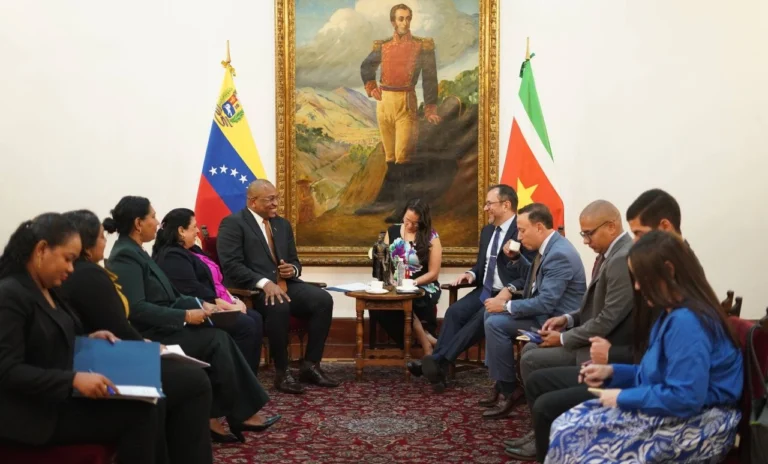
Venezuelan and Surinamese officials strengthen Venezuela Suriname cooperation in key strategic sectors.
May 16, 2026 Hour: 1:12 pm
🔗 Comparte este artículo
Venezuela and Suriname agreed to advance concrete projects in energy, environment, agriculture, fishing, trade, and more. The meeting between Foreign Ministers Yván Gil and Melvin Bouva strengthens bilateral ties and regional integration.
Related: Venezuela Hosts High-Level World Bank Delegation
Venezuela and Suriname Advance Bilateral Relations
Caracas, May 16, 2026 — Venezuelan Foreign Minister Yván Gil received his Surinamese counterpart Melvin Bouva in Caracas to review and strengthen bilateral cooperation. The high-level meeting focused on opening new avenues for Venezuela Suriname cooperation across multiple strategic sectors.
Both countries, which established diplomatic relations in 1975, reaffirmed their commitment to peace, regional stability, and respect for the self-determination of peoples. The discussions highlighted the economic complementarities between the two nations.
Venezuela emphasized its vast energy reserves and diversified portfolio in tourism and food production. Suriname, for its part, highlighted its strategic location providing access to the Caribbean and the Amazon region, along with its rich natural resources.
The delegations agreed to push forward concrete projects in energy, environmental protection, agriculture, fishing, trade, education, transportation, and technical cooperation.
Deepening Economic and Strategic Ties
The bilateral technical working meeting explored practical ways to leverage each country’s strengths. Officials identified energy cooperation as a priority area, given Venezuela’s position as holder of the world’s largest oil reserves and Suriname’s growing offshore potential.
Environmental protection and sustainable development also featured prominently. Both nations share responsibility for preserving sensitive ecosystems in the Amazon and Caribbean basins.
The ministers stressed the importance of increasing trade and investment flows. Cultural and educational exchanges were also discussed as essential tools to bring the peoples of both countries closer together.
Official Venezuelan Foreign Ministry statement on the meeting: cancilleria.gob.ve.
Venezuela Suriname Cooperation Strengthens Regional Integration
The recent high-level talks represent a significant step forward in Venezuela Suriname cooperation. By focusing on concrete projects rather than general declarations, both countries aim to deliver tangible benefits to their populations.
This partnership fits into broader efforts toward Latin American and Caribbean integration. Venezuela and Suriname maintain active roles in forums such as CELAC and maintain constructive dialogue with CARICOM nations.
The meeting also reflects a shared vision of South-South cooperation based on solidarity, mutual respect, and complementary development needs.
CARICOM reports on regional cooperation mechanisms: caricom.org.
Geopolitical Context and Broader Regional Implications
The strengthening of Venezuela Suriname cooperation takes place within a dynamic regional landscape where Latin American and Caribbean nations seek greater autonomy and diversified partnerships. In a context of global uncertainty and external pressures, initiatives like this contribute to building resilience through integration and solidarity among neighboring countries.
For the Caribbean and northern South America, enhanced bilateral ties between Venezuela and Suriname can help address shared challenges such as food security, energy transition, climate change adaptation, and sustainable use of the Amazon. This cooperation also sends a positive signal regarding the potential for peaceful development and dialogue among nations in the region, even amid differing political approaches.
On a wider scale, these efforts align with growing momentum toward multipolar diplomacy and South-South collaboration. They complement larger integration platforms and offer a model of pragmatic cooperation that prioritizes development needs over ideological differences. The success of projects emerging from this meeting could inspire similar initiatives across the continent, contributing to a more balanced and self-reliant Latin America and Caribbean.
Author: JMVR
Source: t.me/YvanGilPinto