


Venezuela Reshapes Ruling Party Structure Through Mass Neighborhood Assemblies
November 17, 2025 Hour: 9:40 am
🔗 Comparte este artículo
More than 3 million people elected new grassroots committees.
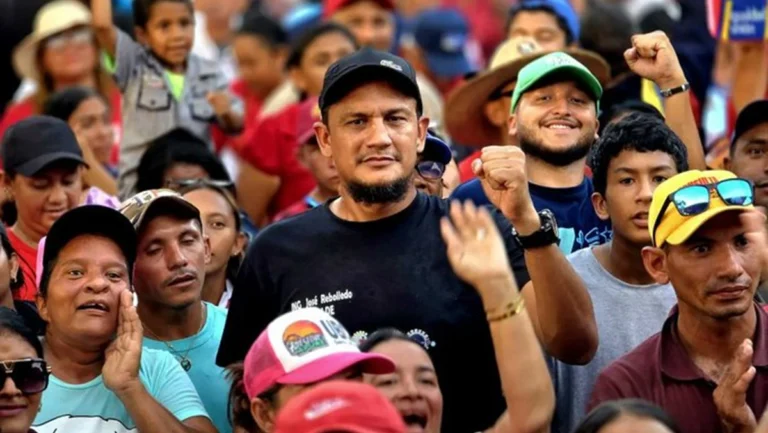
Between Nov. 8 and 9, Venezuela experienced an event unlikely to go unnoticed in the history of Latin American political organizations. During those two days, 145,465 neighborhood assemblies were held, with an average of 20 participants each. The result was that more than 3 million people elected Comprehensive Bolivarian Grassroots Committees (CBBI), which now serve as the primary structure of the United Socialist Party of Venezuela (PSUV).
RELATED:
Venezuela’s El Sistema Earns UNESCO Recognition for Highest Academic and Artistic Standards
“I have with me the first minutes that were prepared during your assemblies, handwritten, with fresh ink from the people. I don’t know of any organizing experience more powerful than this,” Venezuelan President Nicolas Maduro said during a meeting of the PSUV National Leadership.
While much of the continental left debates how to rebuild ties with grassroots communities, the Bolivarian Revolution opted to call for massive neighborhood assemblies — and people showed up.
A Collective Cell
At the PSUV’s 5th Congress, Venezuelan socialists decided to create a new party structure supported by three levels: the Comprehensive Bolivarian Grassroots Committees, the Comprehensive Bolivarian Community Commands, and the Chavez Battle Units (UBCH), which operate as territorial centers of the party.
The change in model is significant. Until now, each street had a single leader responsible for local mobilization. That role has been eliminated, replaced by an elected committee with defined responsibilities: political education, propaganda, community action, territorial planning and preparation for comprehensive defense. In this way, one-person leadership is replaced by a collegial direction with a direct popular mandate.
“When Commander Hugo Chavez called us to form the party’s promoting committees, he had absolute clarity about the strategic horizon: to build a great mass party but also a party with a Gramscian spirit capable of training the cadres of the Revolution,” PSUV Vice President Jorge Rodriguez said.
The reference to Antonio Gramsci is no coincidence. The Italian theorist argued that a revolutionary party should function as a “collective intellectual,” capable of training leaders while organizing the masses. That is precisely the goal in Venezuela, where the PSUV seeks to turn each neighborhood committee into a mobilization nucleus, political school and agent of social transformation.
Venezuela now presents a practical answer to a theoretical problem that the Latin American left has discussed for decades without fully resolving: How can effective popular power be built?
“The PSUV is the only party on this continent that has reached this higher level of popular organization in the 21st century. The Comprehensive Bolivarian Grassroots Committees will catapult the PSUV as a global reference,” Rodriguez said.
The text reads, “All of Venezuela must firmly commit to promoting the consolidation of the Comprehensive Bolivarian Grassroots Committees (CBBI). Blessed be the day we swore to grow and organize ourselves even further from the grassroots of the people. Long live the common people!”
Commander Hugo Chavez’s Doctrine
Venezuelan President Maduro insisted that this restructuring materializes a political vision laid out nearly two decades ago.
“One of the great strengths of our Revolution is its coherence between thought and action, between theory and practice, between what we write in our founding documents and what is lived in every community,” he stressed.
The Political Action Strategic Lines that Chavez drafted when founding the PSUV already included the idea that the fundamental support of the Bolivarian Revolution must be rooted in every neighborhood and parish.
This was based on the idea that grassroots urban and rural communities generate socialist and participatory actions that directly clash with the interests of the old capitalist culture. At the local level is where popular power exists — and where the social base of support is either won or lost. Today, this doctrine has 145,000 concrete implementation points.
PSUV Secretary Diosdado Cabello detailed the five directives of the 5th Congress that frame this restructuring. The first seeks to strengthen the popular movement, articulating 27 social sectors in an action plan spanning this year and the next.
The second aims to transform the old structures of state governments and municipalities through new governing methods: the Seven Transformations (7T), the Concrete Action Agenda, the Map of Dreams, and the Communal Government Rooms. From party leadership, and alongside all regional and territorial leaders, the structure supports, articulates and strengthens existing forms of popular organization.
The fourth directive addresses organization for comprehensive defense, raising the capacity to — if necessary — transition from unarmed struggle to armed struggle, and strengthening communication and international engagement. The fifth grants the PSUV president full authorization to make any decisions necessary to ensure compliance with those strategic tasks.
But it is the third directive that ties the organizational framework together through the creation of the Comprehensive Bolivarian Grassroots Committees as the foundation of the new party structure.
The text reads, “With overflowing joy and exemplary discipline, the people of Aragua took center stage in the Great March of Swearing-In of the Comprehensive Bolivarian Grassroots Committees, demonstrating their firm commitment to the defense of the Homeland and peace.”
Geopolitical Assessment
President Maduro outlined the balance of forces as follows: “The Bolivarian Revolution has reached a political, social and territorial strength that is unprecedented.”
He also listed its assets: the proven ability to win elections, defeat attempts at violent destabilization, resist blockades and economic sanctions, neutralize invasion attempts and confront hybrid aggression.
Maduro highlighted that socialist leadership emerging from the streets, a consolidated civic–military–police union and a broad segment of the country — economic, social, cultural, religious — converge in the National Council for Sovereignty and Peace, where even democratic opposition parties, business sectors and faith communities participate.
Maduro then posed a direct question: “What does the far right have?” He answered without hesitation: “What they once called ‘leadership’ dissolved. The Venezuelan far right has become a ghost, a figure without body, without territory, without people. They dissolved themselves politically, destroyed by their ambition, dependency on foreign money and absolute disconnection from national reality.”
While the far-right opposition bets on international pressure, the Bolivarian Revolution maintains tangible organizational structures and 145,000 committees operating in every quadrant of the country. It also plans to activate 4,000 communities during the communal elections scheduled for Nov. 23.
Additionally, 1.2 million farmers took part in the Peasant Congress, which led to the creation of the Ezequiel Zamora National Peasant Union.
Simon Bolivar as Ideological Axis
President Maduro emphasized: “Bolivar is the backbone of our identity because he embodies the processes of Indigenous resistance, Afro-descendant struggle, the emancipation led by our liberators, and republican construction. Bolivar was not just a man. He was a cause. And today that cause is ours.”
The reference to the Liberator is linked to concrete tasks. In the Bolivarian committees, members study foundational documents in the construction of a militant identity, including Simon Bolivar’s Jamaica Letter and Angostura Speech, as well as Commander Hugo Chavez’s Blue Book.
Ideological formation is part of the basic program. The committees are not just electoral machinery but also hubs of political thought. Thus, the Network of Comprehensive Bolivarian Grassroots Committees will evolve into Community Coordination Commands, forming a tiered structure rising from the street to the neighborhood, the parish and the municipality.
“To accompany and strengthen — with love, solidarity and selflessness — the communal councils and communes. The party and the communes do not compete; they complement each other. Popular power and the party must walk together,” President Maduro said.
In this way, the PSUV consolidates an organizational model that breaks with the traditional logic of Latin American political parties, where party structures often overshadow or replace social movements. In Venezuela, the strategy is the opposite: the PSUV accompanies, articulates and strengthens existing forms of popular organization.
teleSUR/ JF
Sources: teleSUR – PSUV