


Trump’s Carbon Agenda Fractures Fight Against Climate Change
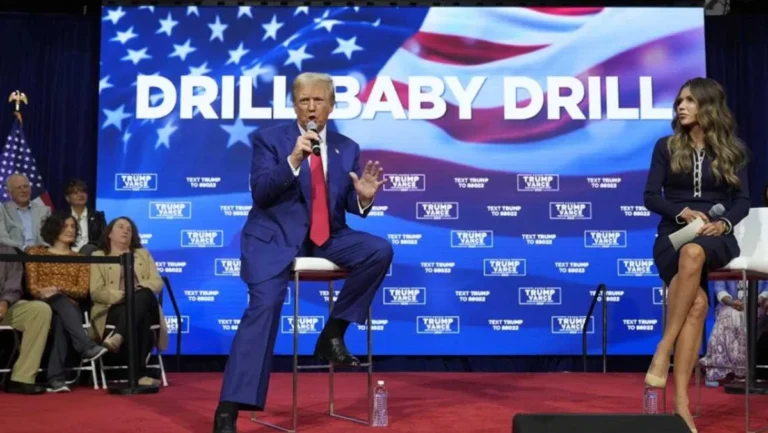
Donald Trump at the Greater Philadelphia Expo. Photo: Alex Brandon
February 11, 2026 Hour: 3:06 pm
🔗 Comparte este artículo
U.S. withdrawal from climate agreements damages global governance.
By early 2026, there will be a dramatic shift in global environmental diplomacy and energy policy. For nearly a decade, nations have been working to balance industrial growth with the goals of the Paris Agreement.
RELATED:
Experts Urge COP30 to Curb Fossil Fuel Disinformation on Climate Change
However, Donald Trump’s return to the White House in January 2025 has upset that fragile balance. Under the banner of “National Energy Dominance,” the Trump administration has not only paused the green transition; it has also launched an aggressive campaign to establish fossil fuels as the foundation of the U.S. and global economies once again.
This article examines the two-phase assault on environmental policy that defines Trump’s second term. From the 2017 wave of deregulation to the radical actions of 2026—including control over Venezuelan oil revenues and withdrawal from over 60 climate organizations—it demonstrates how fossil fuel production is being used as a tool of global power.
By redefining energy security as national supremacy, the U.S. is shaping a carbon-heavy world order that challenges scientific consensus and alters international relations.
The Rhetoric of Denial: Climate Change as a “Scam”
To understand this shift, it is important to trace the evolution of Trump’s stance on climate science. During his first term (2017–2021), he dismissed climate change as a “hoax” intended to benefit foreign competitors. By 2025, this rhetoric had become a core part of U.S. policy.
In his second term, he has turned the language of doubt into open hostility. Trump now attacks frameworks such as the Green New Deal, calling them a “scam” or “the biggest hoax in history.”
His administration claims that climate policies weaken U.S. industry and benefit global elites rather than American workers.
This argument justifies dismantling long-term environmental goals. By framing climate measures as foreign interference, Washington has redefined environmentalism as unpatriotic.
Within the federal government, officials have been instructed to remove terms such as “climate change” and “decarbonization” from the Department of Energy’s vocabulary, an attempt to erase the issue at its root.
Dismantling the Guardrails: A Two-Term Deregulatory Crusade
Trump’s Energy Dominance agenda relies on systematically rolling back environmental protections. This process began in 2017 and accelerated sharply in 2025 with a new wave of executive orders.
The first wave (2017–2021)
During his first term, Trump revoked over 100 environmental regulations. Among the most significant were:
- The Clean Power Plan: It was replaced by the weaker Affordable Clean Energy Rule, which eliminated federal limits on carbon emissions.
- The definition of protected waterways was narrowed, enabling more industrial dumping and pipeline expansion.
- NEPA Reform: Environmental reviews for major infrastructure projects were shortened, paving the way for projects like Keystone XL and Dakota Access.
The Second Wave (2025–2026):
Back in power, Trump transitioned from deregulation to dismantling entire institutions.
- Abolition of Environmental Justice Offices: Biden-era programs that defended vulnerable communities from pollution were defunded or closed.
- “10-for-1” Rule: For every new regulation, agencies must repeal ten old ones, crippling the Environmental Protection Agency’s response capacity.
- Climate Research Cuts: NASA’s Earth Science and NOAA’s monitoring programs were cut, creating what experts call a “scientific blackout” that stifles opposition to new drilling ventures.
“Drill, Baby, Drill”: The End of the Transition Era
What began as a campaign slogan has evolved into U.S. energy policy. In January 2025, Trump declared a national energy emergency, suspending key environmental protections to speed up the extraction of fossil fuels.
The administration now imposes a 28-day deadline for approving drilling permits on federal lands, drastically shortening environmental reviews.
This has unleashed new projects across the Arctic National Wildlife Refuge (ANWR) and the Gulf of Mexico.
The consequences extend globally:
- Market saturation: By oversupplying oil, the U.S. pushes prices down. Trump presents this as consumer relief, but it also undermines renewable energy, making it less competitive against cheap oil.
- Infrastructure Lock-In: The One Big Beautiful Bill of 2025 prioritizes pipelines and liquefied natural gas (LNG) terminals, which are long-term investments that bind economies to fossil fuels for decades and derail 2030 and 2050 climate goals.
The Venezuela Intervention: Oil as Geopolitical Trophy
The most controversial aspect of Trump’s 2026 energy strategy is the direct intervention in Venezuela. Following the collapse of the government, the U.S. transitioned from sanctions to control of Venezuelan oil revenues.
According to Executive Order 14373, all profits from Venezuelan crude oil are deposited into U.S. Treasury-controlled accounts. The president alone decides how and when the money is disbursed to interim authorities.
Trump has also invited major oil corporations to invest $100 billion to rebuild the production system of the Orinoco Belt, the world’s largest oil reserve. The goal is to establish Venezuela as a pillar of Western Hemisphere energy security and reduce dependence on OPEC+ and China.
Critics call this a new “Energy Monroe Doctrine.” Progressive networks warn that Venezuela’s environment is being treated as expendable. The extraction of heavy Merey 16 crude continues without proper environmental review, effectively turning the Orinoco region into a sacrifice zone.
The International Fallout: Isolation and Fragmentation
The U.S.’s withdrawal from the Paris Agreement in 2025 and subsequent withdrawal from the UNFCCC and IPCC have destabilized global climate cooperation. This is not viewed as a policy realignment, but rather as an attempt to dismantle the entire framework of international environmental governance.
- The Transatlantic Rift has emerged as European leaders openly criticize Washington’s stance. At the 2026 World Economic Forum in Davos, Trump clashed with Germany and France after calling wind farms “landscape destroyers,” while China promoted its renewable energy leadership.
- The Rise of “Electro-States”: While the U.S. doubles down on oil, China and the EU have formed a clean energy alliance. China now produces nearly 80 percent of the world’s solar and electric vehicle (EV) battery components, giving it a technological advantage as the U.S. retreats from green innovation.
The U.S. withdrawal from the Green Climate Fund has left developing nations without crucial adaptation funding, threatening to worsen migration and instability caused by extreme weather.
Resistance and the Search for Popular Alternatives
Despite Washington’s renewed push for fossil fuels, resistance is growing across the Americas. From Washington, D.C., to the Orinoco oil fields, citizens and social movements are contesting what they call the “carbon dictatorship.”
- Latin American Response: Colombian President Gustavo Petro has called for an “anti-fossil fuel bloc,” warning that U.S. intervention in Venezuela endangers the Amazon and regional sovereignty. Grassroots organizers in Venezuela continue to oppose the “Donroe Doctrine,” a new version of the Monroe Doctrine that treats Latin America’s natural resources as U.S. property.
- Domestic Legal Battles: In the U.S., coalitions of “green states” such as California and New York, along with indigenous communities, are fighting Trump’s energy bill in court.
- Energy Sovereignty as an Alternative: Across the hemisphere, local movements are promoting energy sovereignty, community-led solar cooperatives, decentralized power grids, and renewable energy projects designed to break free from fossil fuel dependence.
The years 2025–2026 may be remembered as either the dying breath of the fossil fuel era or the point when the global climate consensus finally collapsed.
While Trump’s government bets on short-term oil dominance, the rest of the world faces a defining choice: accept a carbon-heavy past or build a shared, sustainable future.
Sources: BBC – NYT – Federal Register – teleSUR – Al Jazeera – Democracy Now – Fox News – U.S. Council Foreign Relations – Global Americans – GreenPeace
Author: Silvana Solano
Source: teleSUR