







Trump Signs Bill Ending Record U.S. Government Shutdown After 43 Days
The U.S. government reopens after 43 days as Trump signs a Republican-backed funding package that restores public services but includes a disputed clause targeting the Justice Department.
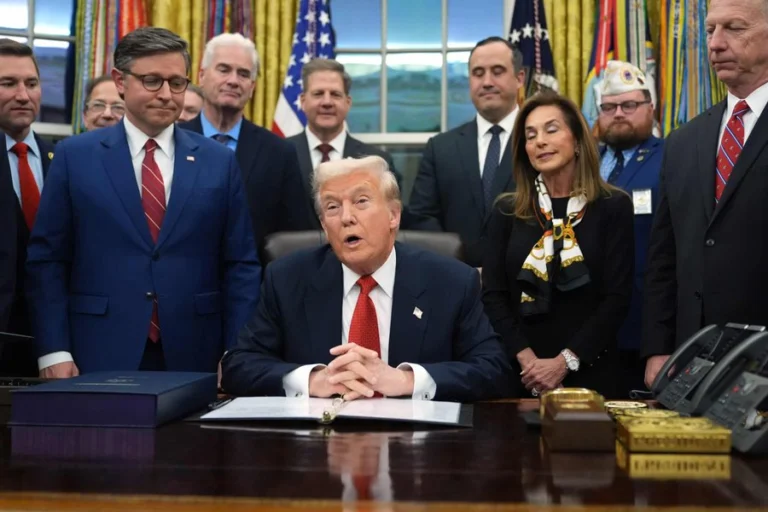
President Donald Trump signs the bill passed by Congress to end the 43-day government shutdown, restoring federal operations and funding. Photo: @inquirerdotnet
November 13, 2025 Hour: 5:52 am
🔗 Comparte este artículo
President Donald Trump has signed into law a bill passed by Congress to end the longest government shutdown in U.S. history—43 days of halted services, unpaid workers, and nationwide disruptions that exposed the country’s deep political divisions.
RELATED:
Trump Asks Israeli President to Pardon Netanyahu
The legislation restores funding for federal agencies and includes temporary budget extensions, but also adds a controversial clause allowing senators to sue the Department of Justice (DOJ) over alleged unauthorized access to their phone records during investigations into the January 6, 2021 Capitol attack.
Backed by Republicans and endorsed by Trump, the bill lifts the United States out of a prolonged political deadlock that had frozen air transport, suspended food aid, and left thousands of federal employees without pay. Democrats’ push to expand healthcare subsidies—one of the main sources of disagreement—was ultimately dropped from the final package.
Under the new law, most federal agencies will receive funding through January 30, 2026, offering temporary stability after more than six weeks of paralysis. The Trump administration had previously implemented major layoffs—affecting over 4,000 federal employees, including hundreds in public health—citing reduced budgets. The new measure reverses those cuts.
For strategic departments such as Defense and Veterans Affairs, funding is extended through September 30, 2026, ensuring full fiscal-year operations. The legislation allocates over $133 billion in discretionary spending for Veterans Affairs, in addition to funding for military construction and infrastructure maintenance. According to the Senate Appropriations Committee, these allocations “will allow greater certainty in planning infrastructure and medical services.”
The package also approves full-year funding for Agriculture, Rural Development, Veterans Affairs, and Military Construction, allowing annual planning for key programs in nutrition and infrastructure. House Speaker Mike Johnson said these allocations were “essential” to maintain basic government functions that had been suspended during the shutdown.
The most disputed element is the clause enabling senators to sue the DOJ if their communications were accessed without prior notice during the Capitol riot investigation. It authorizes compensation of up to $500,000—a measure inserted during final negotiations without broad congressional consultation, drawing criticism from both chambers.
The economic and social impact of the shutdown was severe. The Department of Transportation reported a 6% reduction in air traffic across 40 airports due to shortages of air traffic controllers and supervisors, leading to thousands of flight cancellations and estimated losses of $580 million per day. Around 42 million Americans also missed food assistance payments, prompting lawsuits from human rights organizations over the effects on low-income families.
Trump described the reopening as a victory against what he called “Democratic extortion,” emphasizing that the deal restored funding without concessions on health policy. He reaffirmed his plan to dismantle Obamacare after December and urged Republican lawmakers to eliminate what he referred to as “parliamentary obstruction” to avoid future shutdowns.
The political fallout for Republicans was immediate. The party suffered notable defeats in recent local elections, including the Virginia governor’s race—a state with a large concentration of federal workers directly affected by the shutdown.
Author: MK
Source: EFE