


Trade framework with the US, an unequal agreement for Argentina
The new trade framework would reinforce Argentina’s political and economic dependence on the U.S. at a time of strong internal instability and rejection of Milei’s chainsaw.
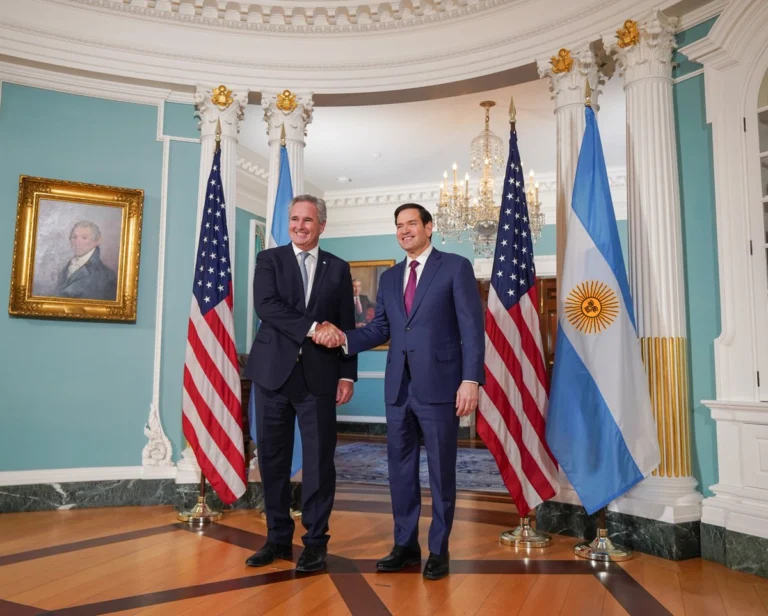
With the information available, the agreement is shaping up to be a process of profound transformations for the Argentine production model. In the image, Foreign Minister Pablo Quirno and Secretary of State Marco Rubio after the signing of the agreement. Photo: @SecRubio
November 14, 2025 Hour: 1:05 pm
🔗 Comparte este artículo
The government of Javier Milei celebrates the trade framework agreement with the United States, while politicians, economists and commentators warn today that it is a totally unequal pact and harmful to Argentine industry and economy.
The Buenos Aires Minister of Production, Augusto Costa, warned that the trade agreement hits the province of Buenos Aires hard. “It is added to the policy of adjustment and destruction of employment that we have been experiencing. It is very worrying, really, he stressed this Friday in statements to the press.
Costa asserted that the alignment “is going to greatly compromise the industry, technological development, the possibility of adding more value” to the country’s economy.
RELATED:
Milei, Trump’s Political Operator in Argentina
Buenos Aires Governor Axel Kicillof said that the agreement is part of the “ruinous strategy of subordination and surrender of sovereignty.”
In Washington, a smiling U.S. trade representative, Jamieson Greer, who participated in the negotiations, said the pact brings great benefits to U.S. producers.
For the political commentator and political leader from Córdoba Sergio Ortiz, “it is not an agreement of equals by any means, it is an agreement between the metropolis and the colony, between the empire and the viceroyalty, and it was even announced by the White House first.”
A first analysis indicates that the agreement, although it still needs to be finalized, “is very uneven, very unequal; The United States will be able to flood the Argentine market with cars, medicines, medical devices, machinery, chemical products and many other value-added goods, to the detriment of the industry and national producers.”
In addition, he believes that “it means a contradiction with Mercosur. In other words, Argentina, according to Mercosur, is obliged to respect the tariff rules, for example, set by the regional bloc that also includes Brazil, Bolivia, Paraguay and Uruguay, and, however, the United States agrees to lower tariffs and admits to reducing patent controls.
” Economist and former Secretary of Commerce Roberto Feletti said that the pact “will have a very negative impact” on Argentina, which hands over its domestic market to the U.S. industrial power, and Washington offers a primary market for its mineral products and a limited food production sector. “It’s very sad,” he said.
Feletti questions: “These people who come and propose these destructive import openings, now formalized, do they think they can transfer them to a country that is going to live without producing?
Who is going to finance the purchases? What is the Argentine population going to do, to provide personal services? What is the situation in which she is placed? Why don’t they defend their producers?
And he asks: What is the point of disengaging Argentina from the Mercosur bloc that had functioned and had provided economic, political and social stability for a long time? Where are they taking us?”, “Can you live in a country that does not produce?” he insisted.
Despite the euphoria in the Casa Rosada, the pact is not unique or exceptional for Argentina, the Trump administration sealed other almost identical frameworks with Guatemala, El Salvador and Ecuador, announced on the same Thursday afternoon, the newspaper Página12 noted.
The newspaper recalls that the agreement must be technically finalized and submitted to the analysis and approval of the National Congress.
Among several articles dedicated to the subject, the newspaper La Nación summarizes in one of them that “while both administrations will seek to accelerate the finalization of the text, the new announcements, which could come in tranches, will remain in the hands of the U.S. president.”
Author: HGV
Source: Telesur