







Spain’s Doctors Strike Over Statute Reform Continues
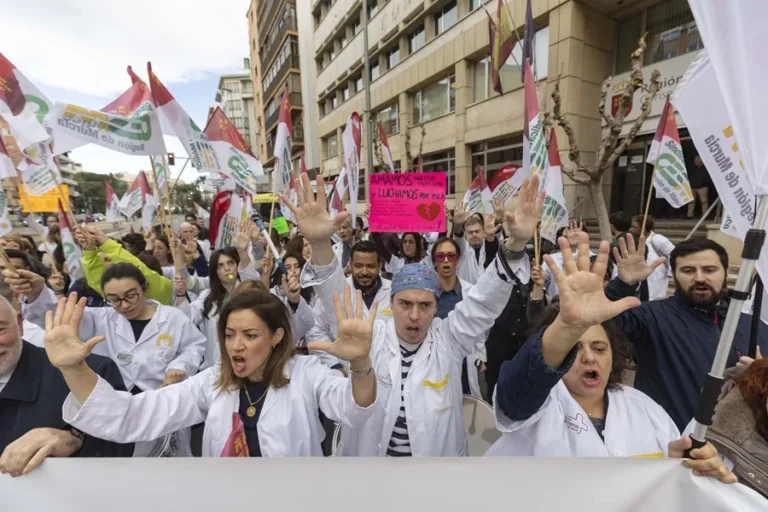
Doctors reject the Framework Statute and denounce that they continue to serve long guards who are not adequately paid or counted for retirement, and that the uniqueness of their profession is not recognized. Photo: EFE.
February 17, 2026 Hour: 7:47 pm
🔗 Comparte este artículo
Spanish medical unions continue their national strike, demanding better labor conditions and rejecting the Framework Statute reform that they claim fails to address their profession’s unique challenges.
Six professional healthcare organizations have initiated a national strike across Spain to protest the reform of the Framework Statute, a regulation governing medical personnel’s working conditions.
The striking unions, led by the Spanish Confederation of Medical Unions (CESM, in Spanish), together with the Andalusian Medical Union (SMA, in Spanish), Metges de Catalunya (MC), the Association of Doctors and Graduates from Madrid (AMYTS, in Spanish), the Basque Medical Union (SME) and the Independent Galician Physicians’ Union (O’Mega) announced monthly week-long walkouts from February to June.
RELATED: Argentinean Workers Announce a New General Strike for Next Thursday
Specific strike dates include February 16-20, March 16-20, April 27-30, May 18-22, and June 15-19, intensifying a conflict that highlights deep divisions within the country’s healthcare sector regarding the future of public health services.
This labor dispute escalated following the signing of an agreement on January 26 between the Ministry of Health and other major unions: SATSE-FSES, CCOO, UGT, and CSIF.
Proponents of this pact alleged significant advancements intended to stabilize staffing and improve efficiency, which include periodic competitive examinations for permanent positions, continuous transfer processes, and a reduction in the maximum weekly working hours to 45.
The agreement also seeks to limit workload overload, specifically reducing 24-hour shifts to 17 hours, and establishing mechanisms for redistributing resources in cases of excessive healthcare demand. These measures, according to the signatory unions, aim to enhance the legal security and cohesion of the healthcare system.
Text reads: “Framework Statute: calendar of mobilizations for the Medical Strike by autonomous communities. Trade unions call for demonstrations in hospitals and delegations across the country.”
However, the striking medical unions contend that, despite the purported improvements introduced by the Framework Statute reform, working conditions specific to their profession remain largely unaddressed and unjust.
They highlight that doctors continue to endure excessively long shifts that are often inadequately compensated and do not contribute appropriately to their retirement calculations. Furthermore, these unions argue that their representation in negotiations with the Ministry of Health is severely limited, leading to a failure to fully recognize the distinct nature of the medical profession through a dedicated statute.
The unions further demand salary equalization with European standards, advocating for the conversion of mandatory overtime into voluntary, better-compensated shifts. They also seek the possibility of combining leadership roles with private practice, a flexibility crucial for many healthcare professionals.
Text reads: “We are on National Strike! United for our profession! Today the doctors and physicians of the Balearic Islands raise their voices: We are not asking for privileges, we are asking for a Statute that recognizes the uniqueness of our work and guarantees quality health care for all. We are mobilizing to demand a legal framework that protects us and allows us to practice with the dignity our patients deserve. It’s time for real and necessary change.”
“The Ministry has only two options: either it negotiates dignified working conditions with doctors, or it allows public health to be left without doctors”, Spanish Confederation of Medical Unions’ Secretary General, Victor Pedrera, affirmed.
The reform broadens rights, streamlines labor conditions, and initiates new phases of negotiation at regional levels, suggesting that the ultimate resolution lies in strengthening dialogue and educating about the statute’s content.
From the Ministry of Health, said that the main points of disagreement with doctors are the claim of an exclusive status and demands that depend on the autonomous communities, such as remunerations and staffing.