







Peru’s Prime Minister Resigns After Three Weeks in Office
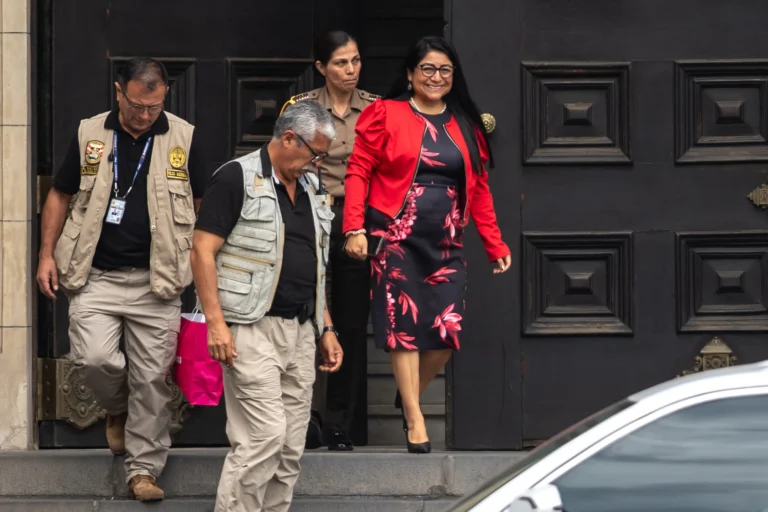
Prime Minister, Denisse Miralles resigns from office before its ratification. Photo: EFE.
March 17, 2026 Hour: 4:54 pm
🔗 Comparte este artículo
Denisse Miralles took office as Chief of Cabinet on last February, 24. The resignation is possibly due to lack of support within Peruvian Congress.
Peru’s Prime Minister Denisse Miralles resigned today, March 17, just three weeks after assuming office, ahead of a crucial congressional confidence vote.
Her swift departure, reportedly at interim President Jose Balcazar’s request, stems from significant political differences and an anticipated lack of parliamentary support, further exacerbating the nation’s profound institutional crisis.
RELATED: Peruvian Interim President Names New Health Minister
The Peruvian political landscape faced yet another jolt today as Prime Minister Denisse Miralles tendered her resignation, a mere three weeks after her appointment.
Miralles, who took office as Cabinet Chief on February 24, stepped down just one day before she was scheduled to appear before the full Congress to seek a vote of confidence for her Cabinet -a constitutional requirement for new administrations in Peru. This would have been the first such vote during the tenure of Interim President Jose Balcazar.
The Presidency of the Republic of Peru officially acknowledged her resignation without specifying the reasons. “The Presidency of the Republic of Peru thanks Mrs. Denisse Miralles for her services rendered to the nation as President of the Council of Ministers in an important context for the country, and wishes her success in her professional career and future challenges”, the official statement said across its social media platforms.
However, local media reports quickly emerged, suggesting that Miralles’s resignation was prompted by a request from Interim President Jose Balcazar, driven by alleged political disagreements with various parliamentary factions. Many of these blocs had already signaled their intent to withhold their backing, making the path to a successful confidence vote highly improbable.
Text reads: “The Presidency of the Republic of Peru thanks Mrs. Denisse Miralles for the services rendered to the nation as President of the Council of Ministers in an important context for the country, and wishes her success in her professional career and in her future challenges.”
This turn of events highlights the persistent political fragility that has plagued Peru for nearly a decade. President Jose Balcazar assumed the Interim Presidency through succession on February 18, following a congressional vote of no-confidence against the previous Interim President, Jose Jeri. This rapid succession of leadership figures underscores a deeply entrenched pattern of instability that has become a defining characteristic of Peruvian politics.
The anticipation of a rejected confidence vote for Miralles served as a stark reminder of this ongoing challenge, forcing her premature departure from the highest executive position within the Cabinet.
While various political parties vying for a role in the transitional government had already announced their refusal to support Miralles, the country’s main business associations had, just hours before, urged Congress to grant the vote of confidence. Their plea emphasized the critical need to prevent further escalation of political instability, underscoring the severe impact of continuous governmental upheaval on the nation’s economic and social fabric.
Since 2016, Peru has been mired in a period of severe institutional crisis. This turbulent era has seen eight presidents in fewer than ten years, marked by an alarming frequency of resignations, impeachments due to “permanent moral incapacity” and censures initiated by the Congress of the Republic.
This relentless cycle has fostered an environment of profound political fragility, directly translating into governance challenges and uncertainty for the populace.
Miralles’s brief stint in office, spanning merely 21 days, serves as another testament to the volatile nature of Peruvian politics and the formidable obstacles facing any leader attempting to navigate its fractured legislative landscape. Her departure further complicates efforts to establish a stable government capable of addressing the nation’s pressing issues.
Text reads: “Transitional cabinet for the stability and governance of Peru. In order to ensure the stability of the country, the President of the Republic, Jose Maria Balcazar, took oath to the new Ministerial Cabinet, headed by Luis Enrique Arroyo Sanchez. In its formation, national security and the State’s emergency response capacity have been prioritized, incorporating profiles with extensive experience to face the country’s challenges with firmness and effectiveness.
This transitional cabinet assumes the mission of leading a phase of governance focused on providing the full guarantees of transparency that the electoral process requires for the strengthening of our democracy. The commitment to safeguard the institutional order and promote the social welfare of all Peruvians is ratified by the Presidency of the Republic of Peru.”
Author: Laura V. Mor
Source: Agencies