


President Diaz-Canel Denounces New U.S. Sanctions on Cuban Officials
Díaz-Canel rejects new U.S. sanctions on Cuban officials and institutions, denouncing them as part of an intensified economic pressure campaign.
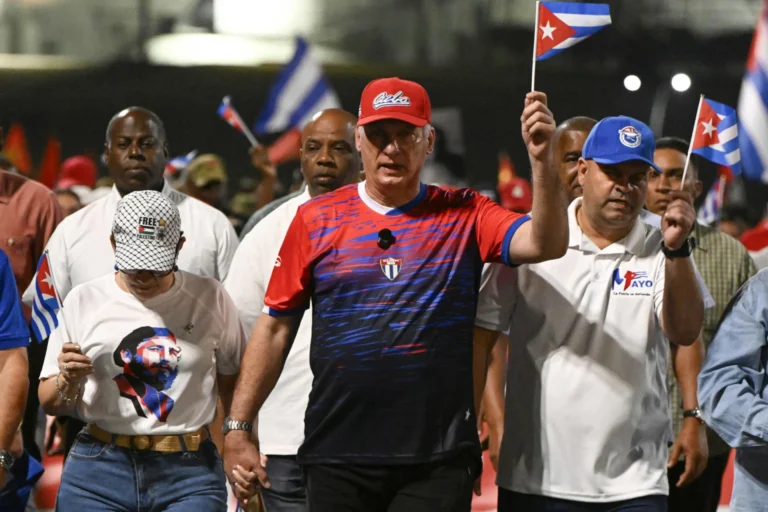
Cuban authorities respond to new U.S. sanctions targeting senior officials, institutions, and security bodies. Photo: EFE
May 19, 2026 Hour: 5:36 am
🔗 Comparte este artículo
Cuba’s president rejects new U.S. Treasury sanctions on officials and institutions, calling them part of an intensified economic and political pressure campaign.
Cuban President Miguel Díaz-Canel has condemned new measures announced by the United States targeting Cuban officials and institutions, following the inclusion of several political and security figures in the latest sanctions package issued by the U.S. Department of the Treasury.
RELATED: U.S. Expands Sanctions Against Cuban Officials
The sanctions, announced Monday, list senior Cuban officials including Juan Esteban Lazo, president of the National Assembly, and Roberto Morales Ojeda, Organization Secretary of the Communist Party of Cuba, along with other ministers and military personnel.
The measures also extend to key security and interior bodies, including the National Revolutionary Police (PNR), the Ministry of the Interior (MININT), and its Intelligence Directorate (DI).
Responding on social media platform X, Díaz-Canel said: “In the leadership of our Party, State, Government and military institutions, no one has assets or property to protect under U.S. jurisdiction.”
Text Reads: In the leadership of our Party, State, Government, and its military institutions, no one has any assets or property to protect under U.S. jurisdiction. / The U.S. government knows this perfectly well; so much so that it doesn’t even have evidence to present. The anti-Cuban rhetoric of hate tries to create the illusion of such assets to justify the escalation of its total economic war. /
He also rejected Washington’s framing of Cuba, stating: “The anti-Cuban rhetoric of hatred tries to make people believe that these entities exist in order to justify the escalation of its total economic war,” adding that there is no evidence to support the claims presented by U.S. authorities.
The Cuban president further criticized the impact of the U.S. blockade, which he said has intensified in recent weeks, particularly affecting Cuba’s ability to secure fuel due to sanctions imposed on third countries that may sell supplies to the island, as well as penalties on companies willing to invest or provide basic goods.
“Therefore, we will continue to denounce, in the strongest and most forceful manner, the genocidal siege that seeks to strangle our people,” Díaz-Canel said.
He also referred to a May 1 executive order as part of what Havana describes as a broader strategy of economic and political pressure aimed at forcing Cuba to align with U.S. interests. Díaz-Canel added that “the collective punishment inflicted on the Cuban people is an act of genocide that must be condemned by international organizations and prosecuted against its promoters.”
Cuba is currently facing a complex situation marked by fuel shortages that have disrupted services across the country, alongside sustained U.S. pressure measures.
The president also warned about the potential consequences of a possible U.S. intervention, describing a hypothetical military confrontation as a “bloodbath with incalculable consequences,” while reiterating that Cuba does not represent a threat to any country.
The latest sanctions deepen already strained relations between Havana and Washington amid ongoing economic restrictions and worsening fuel shortages in Cuba.
Source: diazcanelb