


New Evidence Links Trump to the Epstein Network
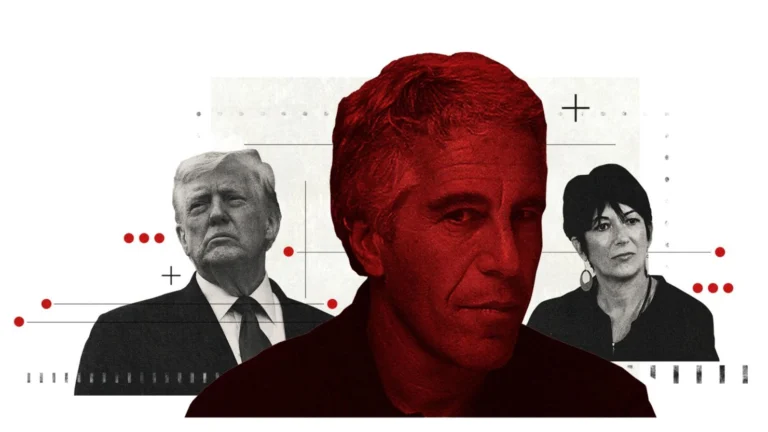
Visual Chronology. Photo: CNN
November 14, 2025 Hour: 10:09 am
🔗 Comparte este artículo
The ongoing fallout from the Jeffrey Epstein scandal is not a simple morality play about one depraved man. It is a searing indictment of the capitalist patriarchy at its highest altitude.
In this structure, wealth and political power shield perpetrators from justice and actively facilitate the commodification of vulnerable bodies.
Recently released documents confirm what survivors and advocates have long argued: this was a systemic network, and Donald Trump’s deep knowledge of and proximity to it were a feature, not a bug, of elite operation.
The emails and documents released by the House Committee on Oversight expose Donald Trump’s association with the sex trafficking network, revealing how the U.S. ruling class leverages its political and economic power to access vulnerable bodies and guarantee subsequent impunity through sophisticated class defense tactics. This requires not just political outrage, but a demand for structural accountability.
The Physical Evidence of Elite Complicity
The documents cut through partisan noise by offering concrete evidence of elite complicity, showing that the exploitation was rooted in shared social circles and physical spaces of power.
- The Ghislaine Maxwell Email: Proximity and Physical Infrastructure
In a 2011 email exchange, Epstein’s accomplice and convicted sex trafficker, Ghislaine Maxwell, explicitly discussed Trump as a figure whose silence was notable.
Epstein wrote that Trump was “the dog that hasn’t barked yet,” adding that a victim had “spent hours at my house with him.”
Maxwell’s houses, private, opulent spaces of the elite, served as the physical infrastructure for exploitation. Trump’s presence in that environment, as confirmed by this quote, materializes the direct, physical connection between high political power and the site of the crime.
His subsequent decades of public silence about the network were an active mechanism of shared elite secrecy and cover-up, reinforcing a “class pact” of mutual protection.
- Jeffrey Epstein’s Assertion: Knowledge as a Tacit Condition
Further weakening the alibi of ignorance is a 2019 exchange between Epstein and journalist Michael Wolff. Regarding his connections to Trump, Epstein claimed: “Of course, he knew about the girls as he asked Ghislaine to stop.”
This is a critical statement. It reframes knowledge of the abuse from a secret to a tacit condition within the ruling class’s social and economic circle. Whether Trump asked Maxwell to “stop” because of moral conviction or concern over his own reputation is secondary to the fact that, according to Epstein, he was aware of the criminal activities.
This knowledge, shared among powerful figures, reinforces that the complicity is not just personal; it is fundamentally class-based.
- Political Currency and Mutual Threat
The emails also reveal that knowledge of Epstein’s network was viewed by the elite as a strategic political tool.
In a 2015 conversation with Wolff, Epstein explained how a denial from Trump about time spent at Epstein’s properties would give the financier “valuable PR and political currency.”
This shows that the exploitation of women and girls was not merely a side effect of their lifestyle; the information surrounding it was actively used as a currency of exchange and mutual threat, capable of generating debts or leverage among the wealthiest figures in the world.
The Contested Birthday Card: The ‘Wonderful Secret’ and the Elite Gifting Economy
The release of documents included pages from a 2003 “birthday book” compiled for Jeffrey Epstein’s 50th birthday, which featured messages from numerous high-profile figures.
The message attributed to Donald Trump consisted of a note placed within the hand-drawn outline of a curvaceous woman.
The text allegedly included a line that read: “Happy Birthday, and may every day be another wonderful secret.”
This phrase, combined with the suggestive drawing, has been interpreted by critics and journalists as alluding to a shared knowledge of Epstein’s criminal activities, framed as a privileged “secret” shared among the elite.
The entire birthday book serves as a devastating piece of physical evidence, illustrating the social ecosystem of the elite.
The messages, many of which were sexually suggestive and crude (including drawings of breasts and references to women), demonstrate that Epstein’s predatory focus was an open secret or at least a pervasive topic of bawdy humor among his powerful peers.
Trump’s alleged card, therefore, is not an isolated piece of correspondence but a function of this “gifting economy” where shared secrets and inappropriate references reinforced group cohesion and complicity within the ruling class.
The U.S. president has consistently denied the note’s authenticity, stating that he did not write the message or create the drawing, and has referred to the report as a “hoax.”
This denial, however, is countered by the document’s release from Epstein’s own estate to the committee, reinforcing the controversy over the veracity and implications of the connection.
The Powerful Seek to Obscure What Happened
Faced with potentially explosive information, the U.S. ruling class immediately activated aggressive defense mechanisms designed to obscure the crime and prioritize political continuity.
- The Elite Disinformation Tactic
When the documents were released, the White House’s official response was immediate and calculated: labeling the emails a “fabricated hoax,” a “false narrative,” and “defamation” by Democrats.
This initial denial was followed by a flood of 23,000 unfiltered emails, released by Republicans on the committee.
This is a textbook example of elite disinformation tactics. The objective is to obscure the specific evidence of the crime by overwhelming the public debate with noise, reducing a horrific systemic failure to a mere partisan political scandal.
By drowning the key quotes in a sea of irrelevant correspondence, the focus is shifted from the victims’ justice to a political feud, prioritizing the stability of elite power over accountability.
- Manipulation of the Victim’s Narrative
The defense strategy employed by Trump’s allies cynically attempted to manipulate the narrative of victim Virginia Giuffre, who tragically died by suicide earlier this year.
White House spokespersons repeatedly cited her previous statements that Trump was “kind” and that she hadn’t accused him of wrongdoing.
This attempt to use a victim’s nuanced testimony as a shield for the alleged perpetrator is an act of patriarchal cynicism.
It prioritizes the elite man’s political capital and public image over the systemic violence Giuffre endured. It demands that the victim’s word be treated as pure affirmation of the perpetrator’s innocence, rather than understanding the complex psychological factors, coercion, and fear that often shape a survivor’s public statements.
- The Pursuit of Impunity and the Class Pact
The current allegations that Ghislaine Maxwell, who is serving a 20-year sentence, is seeking a commutation of her sentence from Trump are the final, stark piece of evidence of the class pact in action.
This suggests that the loyalty among elite perpetrators remains active, offering impunity as a non-monetary, yet supremely valuable, benefit of their shared social and political position.
The expectation that high office can undo a criminal conviction serves as a demonstration that, in their eyes, the law is merely a flexible instrument of class defense.
The Demand for Structural Accountability
The Epstein documents offer a devastating window into the modus operandi of capitalist patriarchy at its highest levels, confirming that wealth and political power are inextricably linked to sexual exploitation and cover-up. This scandal is not a distraction; it is the core issue of power.
The investigation must move beyond political theater and focus relentlessly on the human cost of this network.
For the justice system to regain any semblance of integrity, it must actively dismantle these structures of power that allow for the commodification and exploitation of women and girls.
Author: Silvana Solano
Source: teleSUR