







Maradona Never Forgot His Roots Despite Sporting Glory
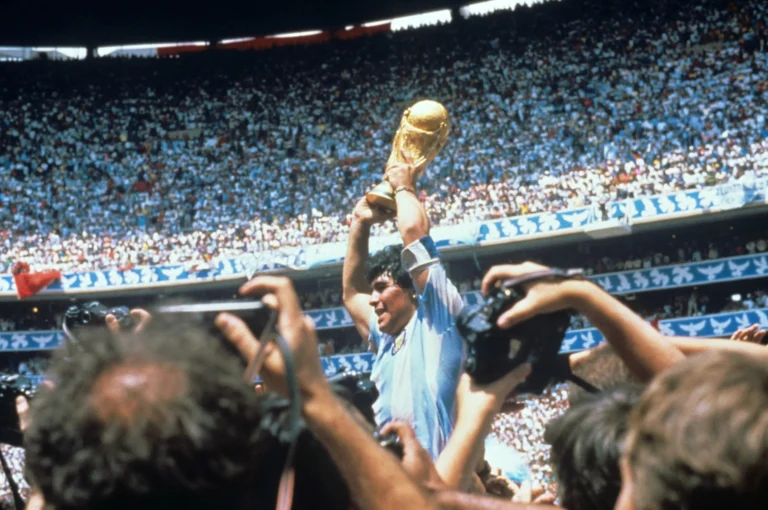
Diego Armando Maradona with the World Cup after defeating Germany on June 29, 1986, in Mexico. Photo:EFE
June 22, 2026 Hour: 1:03 pm
🔗 Comparte este artículo
His professional career was accompanied by displays of solidarity with the struggles of the people.
Diego Armando Maradona is widely regarded as one of the greatest football players in history, but his impact extended far beyond his athletic achievements. His life was deeply defined by the spaces he occupied.
RELATED:
Football and Malvinas: An Indestructible Connection
From the marginalized shantytowns of Buenos Aires to the politically tense stadiums of Europe, his movements mapped a lifelong defiance against institutional and colonial power structures.
This geographical profile examines how distinct territories shaped Maradona’s identity, his playing style, and his political worldview. By analyzing his journey through a progressive, anti-hegemonic lens, we can see how the Argentine icon transformed the football pitch into a theater of class struggle.
From his working-class roots to his explicit alliances with left-wing movements across the Global South, Maradona remained an organic voice for the dispossessed, refusing to sanitize his origins for the corporate sports machine.
How Geography Shaped a Football Icon
Diego Maradona was born on October 30, 1960, in Lanús, but he grew up in Villa Fiorito, a shantytown located on the southern outskirts of the Buenos Aires metropolitan area. Maradona often spoke in interviews about the material difficulties of his childhood, with a father working in a chemical factory, and his mother dedicated to eight children.
Villa Fiorito played an important role in developing Maradona’s early football skills. In these neighborhoods, dirt pitches known as potreros served as the primary recreational spaces for youth.
These conditions forced young players to develop precise ball control, quick reflexes, and physical resilience. It was in these fields that Maradona was discovered at age nine by Francisco Cornejo, a scout for Argentinos Juniors.
Maradona’s professional debut occurred on October 20, 1976, for Argentinos Juniors, just days before his sixteenth birthday. His rapid ascent within the domestic football structure led to his transfer to Boca Juniors in 1981.
This move marked a significant geographical shift within Buenos Aires, taking him from the western suburbs to the working-class, maritime neighborhood of La Boca. Boca Juniors possessed a massive, fiercely loyal fan base drawn largely from Argentina’s laboring classes.
By leading Boca Juniors to a league title in 1981, Maradona solidified his connection to the country’s popular sectors. The geographic reality of his youth in Villa Fiorito and his time in La Boca laid the foundation for working-class solidarity that defined his public persona for the remainder of his life.
Mexico 1986 and the South Atlantic Legacy
The 1986 FIFA World Cup in Mexico served as the geographic setting for a politically charged moment of Diego Maradona’s athletic career. On June 22, 1986, Argentina faced England in the quarter-finals at the Azteca Stadium in Mexico City.
This match took place just four years after the 1982 South Atlantic War, a brief but bloody armed conflict between Argentina and the United Kingdom over the sovereignty of the Malvinas Islands.
The war had resulted in the deaths of 649 Argentine military personnel, many of whom were young conscripts, leaving deep scars on the national psyche of Argentina.
Although FIFA and sports officials attempted to treat the match as a standard athletic competition, the geopolitical tensions of the era heavily influenced the atmosphere. Maradona scored two distinct goals in the second half of the match, both of which became historic milestones.
The first goal, later dubbed the “Hand of God,” and the second goal, known as the “Goal of the Century,” secured a 2-1 victory for Argentina. Maradona explicitly connected the sporting victory to the geopolitical conflict of 1982. He stated that while the players claimed before the match that sports and politics should not mix, the team was fully aware of the Argentine victims.
Maradona remarked that the victory felt like reclaiming a piece of national dignity, acting as a symbolic compensation for the losses suffered during the war. By framing the match in this manner, Maradona transformed the football pitch into a symbolic arena where a nation from the Global South could challenge and defeat a traditional European colonial power.
The Transformation of Naples
In 1984, Diego Maradona transferred from FC Barcelona to SSC Napoli, a move that represented a profound geographical and socio-economic shift.
At the time, Italian football was dominated by wealthy clubs from the industrialized northern region of the country, such as Juventus in Turin and AC Milan and Inter Milan in Lombardy.
Maradona’s arrival at SSC Napoli immediately altered the balance of power within Italian football. Under his leadership, Napoli won its first-ever league titles and a UEFA Cup, breaking the North’s sporting hegemony.
These victories marked the first time a team from the Italian South had broken the sporting hegemony of the North. For the population of Naples, Maradona became more than an elite athlete; he was viewed as a social savior who gave visibility and pride to a historically marginalized community.
The geographical tension reached its peak during Italy’s 1990 World Cup. The semi-final match between Argentina and Italy was scheduled to take place at the San Paolo Stadium in Naples.
Before the match, Maradona publicly addressed the Neapolitan population, reminding them of how the rest of Italy treated them during the rest of the year and asking for their support against their own national team.
With a significant portion of the Neapolitan crowd cheering for Maradona, Argentina defeated Italy on penalty, an outcome that solidified Maradona’s complex, anti-hegemonic status within European sports geography.
The Global Activism of Maradona
Beyond his club career, Diego Maradona used his visibility to form explicit political alliances with left-wing movements and leaders across the Global South. This geographic network of relationships stood in direct opposition to the corporate and Western-aligned structures of international sports.
Maradona developed personal ties with prominent Latin American heads of state, most notably Fidel Castro of Cuba, Hugo Chávez of Venezuela, and Evo Morales of Bolivia. These relationships were built on shared anti-imperialist views and a mutual rejection of neoliberal economic policies in the Americas.
Maradona’s connection to Cuba began in the late 1980s and deepened in 2000, when he relocated to Havana to undergo medical treatment for substance abuse. During his years on the island, he frequently met with Fidel Castro, whom he described as a second father.
In November 2005, Maradona actively participated in the historic Third People’s Summit in Mar del Plata, Argentina. Traveling with Hugo Chávez on the train “Alba Express,” Maradona wore a T-shirt labeled “Stop Bush” to protest the proposed Free Trade Area of the Americas (FTAA), a trade agreement backed by the United States.
Concurrently, Maradona maintained a public confrontation with FIFA. Throughout the 1980s and 1990s, he routinely criticized FIFA officials, including João Havelange and Sepp Blatter, accusing them of running a corrupt cartel that exploited athletes for corporate profit.
In 2014, he teamed up with the progressive Latin American network TeleSUR to host the World Cup commentary show De Zurda (From the Left), utilizing an independent media platform to analyze the tournament through a critical, regional perspective.
The Enduring Legacy of an Uncompromising Figure
Diego Maradona’s trajectory establishes a clear geographical profile that links his marginalized origins to his political actions. His journey from the under-resourced Villa Fiorito to the stadium elite of Europe was characterized by a refusal to separate his athletic success from his working-class roots.
By consistently aligning himself with southern territories, whether it was the neighborhood of La Boca, the neglected city of Naples, or the broader geopolitical sphere of Latin America, Maradona challenged the traditional power centers of modern sports.
Maradona did not adopt the sanitized, media-trained persona expected of modern corporate athletes. Instead, he utilized his athletic capital to vocalize the frustrations and aspirations of marginalized populations across the globe.
Ultimately, Maradona remains a unique phenomenon in sports history due to the geographic consistency of his identity. His choices on and off the pitch demonstrated that he viewed football as a vehicle for popular representation rather than simple financial advancement.
By embedding himself within the political movements of the Global South and maintaining an adversarial stance against institutional power, Maradona secured a legacy that transcends sports, making him a permanent cultural symbol of resistance for the international working class.
Sources: teleSUR – Goal – La Gaceta – ESPN – BBC – Cuba Si – Página 12 – Resumen Latinoamericano – El Confidencial – LA Times
Author: Silvana Solano
Source: teleSUR