







Lavrov UN Multilateralism Speech: 7 Strong Warnings Against Western Escalation
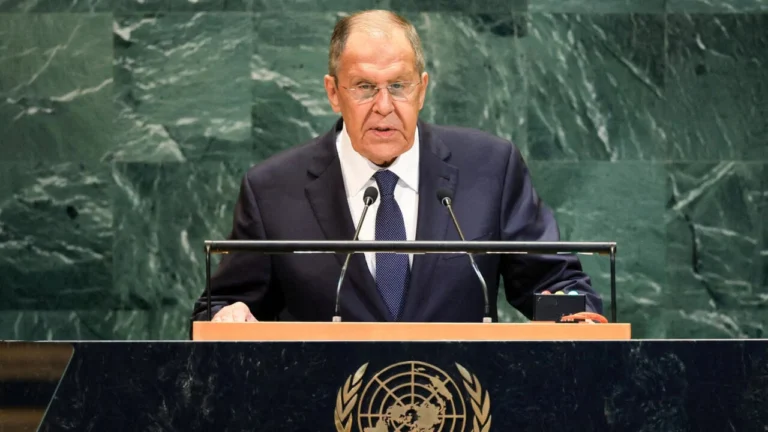
Russian Foreign Minister Sergey Lavrov criticized Western military interventionism at the 81st UN General Assembly and called for stronger BRICS cooperation, broader Global South representation, and a multipolar security system.
September 26, 2026 Hour: 3:28 pm
🔗 Comparte este artículo
Lavrov UN multilateralism speech condemns Western interventionism, backs BRICS and Global South representation, and calls for a more balanced world order.
Related: Cuba energy blockade: Bruno Rodríguez condemns U.S. fuel restrictions
Lavrov UN Multilateralism Speech Condemns Western Interventionism
The Lavrov UN multilateralism speech became one of the most confrontational addresses of the 81st United Nations General Assembly after Russian Foreign Minister Sergey Lavrov accused Western powers of weakening international law, expanding military influence, and undermining the UN-centered system.
Speaking in New York on Saturday, September 26, Lavrov described the U.S. military operation in Venezuela on January 3 and the capture of President Nicolás Maduro as among the recent actions that have damaged global peace and security.
He demanded the immediate return of Maduro and his wife, Cilia Flores, to Venezuela. Moscow has described their detention in the United States as unacceptable and called for guarantees that similar actions will not happen again.
Lavrov also criticized the U.S.-Israeli military campaign against Iran, the situation in Palestine, and the continued economic pressure against Cuba.
He urged the parties involved in the Middle East conflicts to reduce tensions and avoid what he called a broader global crisis.
The Russian foreign minister presented Moscow’s position as a defense of international law, sovereignty, and multipolarity.
He argued that Western governments claim to support a rules-based order while using force, sanctions, and military pressure outside the framework of the United Nations.
“It is unacceptable to forget historical responsibility and allow dangerous ideologies to re-emerge,” Lavrov said, according to the Russian account of his speech.
The address came amid growing tensions between Russia and European governments, including Germany. Lavrov accused Western countries of rewriting the history of the Second World War and minimizing the resurgence of what he described as neo-Nazi ideology in Ukraine.
He recalled postwar documents signed by former Axis states and argued that Europe must not abandon the lessons of the conflict that devastated the continent.
The Russian minister directly challenged German Chancellor Friedrich Merz over his stated goal of turning Germany into Europe’s leading military power.
“A new remilitarization process in Berlin would have serious historical consequences,” Lavrov warned.
He said the word “again” carried particular importance because Germany’s past military expansion had contributed to catastrophic wars.
Germany has rejected Moscow’s accusations and says its defense policy is responding to the security environment created by Russia’s military operation in Ukraine.
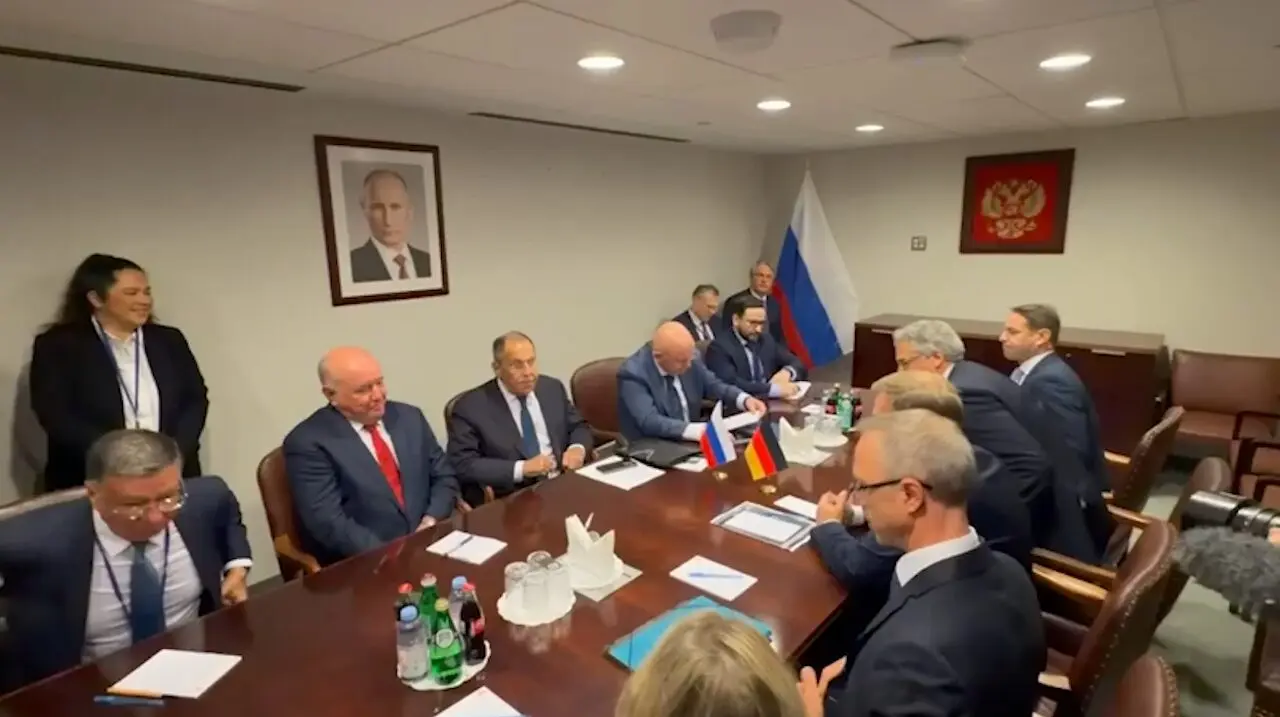
German Foreign Minister Johann Wadephul met Lavrov on the sidelines of the General Assembly, in what was described as one of the first direct meetings between the two countries’ foreign ministers since the 2022 escalation.
The meeting did not produce a breakthrough. Wadephul urged Russia to abandon what he called a dangerous course toward Germany, Europe, and NATO. Lavrov later said nothing new had emerged from the conversation.[usnews][aa.com]
Lavrov also criticized European governments over policies affecting the use of the Russian language and the status of the Ukrainian Orthodox Church.
He accused the European Union of remaining silent in the face of what he described as violations of freedom of expression, religion, and fundamental rights protected by the UN Charter.
Russia says language and cultural restrictions in Ukraine discriminate against Russian-speaking communities. Ukraine and its allies reject Moscow’s characterization, saying language and church policies are connected to national security and the consequences of Russian aggression.
The dispute over language rights forms part of Russia’s broader justification for its military policy in Ukraine. Kyiv argues that Moscow uses the issue to legitimize territorial claims and military intervention.
Lavrov UN Multilateralism Speech Defends BRICS and Global South
Watch the UN webcast of Sergey Lavrov’s press conference.
The Lavrov UN multilateralism speech strongly defended BRICS and other platforms associated with the Global South.
Lavrov said Russia would continue what it calls a mission to protect the population of Donbas and Novorossiya until threats to Russian national security are eliminated and peace is restored.
“Our mission is clear: to protect our citizens and guarantee peace and stability in the region,” he said.
Ukraine and Western governments reject Russia’s claim that its military operation is intended primarily to protect civilians. They describe it as an unlawful invasion and demand the withdrawal of Russian forces from Ukrainian territory.
Lavrov used the UN platform to present a different interpretation of the international order. He said BRICS offers a framework for cooperation based on mutual benefit, equality, and respect for national sovereignty.
He argued that emerging powers should have a greater role in shaping global rules and rejected what he described as Western attempts to preserve political privileges.
The Russian minister also addressed the expected selection of a new UN secretary-general at the end of the year.
He called for the next UN leadership to uphold strict neutrality, impartiality, and intergovernmentalism.
“The UN must be a platform for dialogue and cooperation, not an instrument of the foreign policy of certain countries,” Lavrov said.
His comments reflect Moscow’s long-standing criticism of the UN Secretariat and Western governments. Russia says the organization must serve all member states rather than reflect the priorities of the United States and its allies.
Western governments, by contrast, accuse Russia of using the language of sovereignty and multipolarity to defend violations of the UN Charter, particularly in Ukraine.
Lavrov rejected the possible creation of permanent Security Council seats for Germany and Japan, saying both countries were following militaristic and revanchist paths.
He explicitly backed permanent seats for India and Brazil and supported greater representation for Africa, Asia, and Latin America.
Russia has consistently supported India’s bid for a permanent seat. Moscow says any reform must reflect present-day geopolitical and economic realities rather than preserve Western dominance.
“Security Council reform cannot involve allocating additional seats to Western countries, especially Germany and Japan,” Lavrov said.[news18][timesofindia.indiatimes][aninews]
He also invoked the Ezulwini Consensus and the Sirte Declaration, which call for greater African representation in the Security Council.
The demand is shared by many African governments, which argue that the current structure reflects the world of 1945 rather than the political and demographic realities of the 21st century.
The debate over Security Council reform remains blocked by disagreements among the permanent members. Any amendment to the UN Charter would require the approval of the existing permanent members and a significant number of UN member states.
Lavrov also highlighted Moscow’s role in advancing the UN Convention against Cybercrime.
He called for the creation of an equitable and inclusive system of global governance for artificial intelligence.
“Cybercrime and AI governance are global challenges that require a coordinated and equitable response,” he said.
Russia’s support for the UN cybercrime convention reflects its effort to promote international rules for digital activity through a UN framework.
The United States and several civil-society groups have raised concerns about the convention’s potential effect on privacy, human rights, and cross-border investigations.
The issue reflects a broader disagreement over who should set the rules for cyberspace and artificial intelligence. Western governments often favor partnerships involving technology companies and democratic states, while Russia and other countries seek a stronger role for intergovernmental institutions.
Lavrov also referred to the International Day against Colonialism and announced that Russia would host a World Assembly of an international interparty movement for the freedom of nations.
He said colonialism remains an open wound in human history and that all peoples should have the right to freedom and self-determination.
Russia Calls for a Eurasian Security Architecture
Read the Russian Foreign Ministry’s statements and speeches by Sergey Lavrov.
The Lavrov UN multilateralism speech concluded with a call to end what Russia describes as NATO’s unilateral dominance and expansion into the Asia-Pacific region.
Lavrov said NATO’s activities were no longer limited to the North Atlantic and represented an attempt to extend Western military influence across Eurasia.
He promoted an initiative associated with President Vladimir Putin to create a continental security system based on a Eurasian Charter of Diversity and Multipolarity for the 21st Century.
The proposed framework would seek to establish what Moscow calls an indivisible and balanced security architecture across Europe and Asia.
Russia argues that security cannot be built by one military alliance at the expense of others. It says every country’s security must be considered and that NATO expansion creates instability.
NATO members argue that countries have the sovereign right to choose their alliances and that the organization’s expansion has been driven by requests from states seeking protection from Russian pressure.
The dispute over security architecture is central to the conflict in Ukraine. Moscow demands limits on NATO expansion and military infrastructure near its borders, while Ukraine and its supporters reject any arrangement that would restrict sovereign choices.
Lavrov’s call for a Eurasian system also reflects Russia’s growing emphasis on relations with China, India, Iran, Central Asia, and other non-Western partners.
The Kremlin has promoted the idea of a broader continental network involving BRICS, the Shanghai Cooperation Organisation, and other regional institutions.
Such a system would not necessarily replace the United Nations, but Moscow wants it to reduce Western influence and offer alternatives to NATO-centered security structures.
The proposal also has an economic dimension. Russia wants stronger transport, energy, financial, and technological links across Eurasia.
China’s Belt and Road Initiative, the International North-South Transport Corridor, and regional energy projects could become part of a wider network connecting Russia with Asia, the Middle East, and Africa.
However, the countries involved do not share identical interests. China maintains a cautious relationship with Russia, India preserves strategic ties with the United States, and Central Asian governments seek to avoid becoming dependent on any single power.
The future of the proposed architecture will therefore depend on whether Moscow can transform its diplomatic language into practical agreements.
The Lavrov UN multilateralism speech also echoed demands made by other countries of the Global South. Cuba has denounced U.S. sanctions as an act of war, Iran has criticized Western military intervention, and China has called for greater respect for sovereignty and an end to unilateral coercive measures.
Russia’s diplomatic message is part of this broader challenge to a U.S.-dominated international system.
Geopolitical Context: Russia, BRICS, and a Divided UN
The Lavrov UN multilateralism speech illustrates the widening divide over the future of global governance.
Russia is seeking to use the UN, BRICS, and other international platforms to challenge Western sanctions, military alliances, and interpretations of international law.
The United States and European governments argue that Russia’s position is weakened by its military actions in Ukraine and its rejection of accountability for violations of sovereignty.
The dispute has created competing visions of multilateralism. Western governments emphasize rules, democratic institutions, and territorial integrity. Russia and several BRICS members emphasize sovereignty, non-interference, and opposition to unilateral sanctions.
Both sides use the language of international law, but they interpret its principles differently.
The issue of Venezuela illustrates the conflict. Lavrov described the January operation and the detention of Maduro as a violation of sovereignty and demanded his return.
The United States says Maduro faces criminal charges and that the operation was connected to allegations involving drug trafficking. Venezuela and Russia reject that justification.
The dispute over Maduro could become another point of confrontation at the UN, particularly if Caracas seeks international action or compensation.
The speech also had implications for the Middle East. Lavrov supported calls to end the war in Gaza, opposed the U.S.-Israeli attacks on Iran, and urged de-escalation.
Russia is attempting to position itself as a diplomatic actor capable of challenging U.S. policy in several regions at once.
The approach may appeal to governments that oppose sanctions and foreign intervention, but it also risks deepening polarization between Moscow and Western capitals.
The debate over UN reform will remain central. India and Brazil have strong support from Russia and many developing countries, while Germany and Japan retain support from the United States and other allies.
Africa’s demand for permanent representation is increasingly difficult to ignore, but agreement on which countries should receive seats remains unresolved.
The future of the international system may depend on whether these competing positions can be reconciled through institutional reform or continue to produce parallel blocs.
Lavrov’s final message was clear: Moscow rejects unilateral Western dominance and sees multipolarity as the future of international politics.
“Multipolarity is the future, and we must work together to build a fairer and more balanced world,” he said.
Whether that vision gains broader support will depend on Russia’s ability to persuade countries that its model represents genuine equality rather than a new contest among great powers.
Author: JMVR
Source: Agencias