


Latin America Blends Faith and Culture in Holy Week
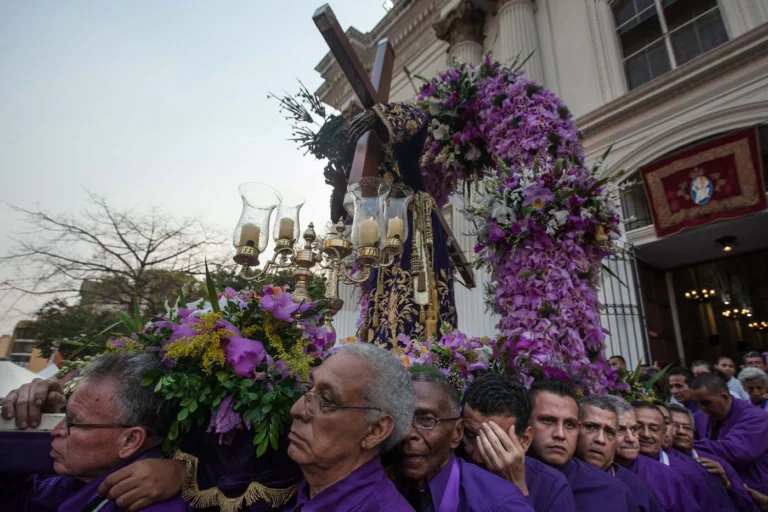
Penitents take part in the procession of the Nazarene of San Pablo. Photo: El Universal
April 1, 2026 Hour: 1:12 pm
🔗 Comparte este artículo
A journey through rituals, flavors, and resilience across the region.
Holy Week, known across Spanish-speaking countries as Semana Santa, is an important cultural and religious event in the Western Hemisphere.
RELATED:
Cuba’s UN Resolutions on Food, Culture Adopted Globally
Although rooted in Catholic tradition, in Latin America this week has become more than just a commemoration of biblical events. It is a living expression of identity, history, and collective resilience.
From the purple-clad processions in Caracas to the intricate sawdust carpets of Guatemala, this “Major Week” transforms public spaces into open-air museums of faith and memory.
This In-Depth article explores the traditions, social meanings, and unique flavors that give Holy Week in Latin America, and particularly in Venezuela, its distinctive character.
A Fusion of Faith and Culture
In Latin America, Holy Week is not simply a date on the religious calendar; it is a sensory and emotional experience. The air fills with incense, the echo of funeral marches, and the unmistakable aroma of traditional dishes like coconut rice and salted fish.
Although the week recalls the Passion, Death, and Resurrection of Jesus Christ, its practice in the region stands out for its syncretism, the blending of Catholic rites with Indigenous and Afro-descendant beliefs over centuries. The result is a celebration that unites the sacred and the ancestral in a single communal act.
Today, Holy Week functions as a collective pause. For some, it is a time of solemn personal vows. For others, it is a homecoming, an opportunity to reconnect with family, memory, and territory
What Is Celebrated? The Core of the Commemoration
At its theological center, Holy Week follows the final days of Jesus’s life. Yet in Latin America, the commemoration goes beyond doctrine; it embodies centuries of social reflection and popular spirituality.
The Theological Journey
The week’s rhythm moves through four key milestones:
- Palm Sunday: The triumphal entrance into Jerusalem.
- Maundy Thursday: The Last Supper and the washing of the feet.
- Good Friday: The Crucifixion, remembered with silence and mourning.
- Easter Sunday: The Resurrection, symbolizing renewal and the victory of life over death.
The Social and “Human” Christ
In many Latin American communities, the image of the suffering Christ mirrors the struggles of the people themselves. Religious leaders across the region, especially in Central America, often speak of the “Crucified Christ” who appears today in the faces of the poor, the migrant, and the excluded.
This vision turns ritual into reflection. The processions are not only religious reenactments but also acts of collective hope. In them, communities express their desire for their own kind of resurrection: that of dignity, justice, and inclusion.
During Holy Week, the sacred narrative meets the social one, making ancient symbols resonate with modern realities.
Culinary Sovereignty
In Latin America, the kitchen becomes an altar of its own during Holy Week. Because Catholic tradition prohibits red meat on these days, communities have historically turned to fish, grains, and native crops, creating a form of culinary sovereignty where ancestral wisdom converges with faith.
Venezuela’s Traditional Table
Venezuela’s Holy Week menu changes from region to region. In the central plains, known as Los Llanos, it is still possible to find Turtle or capybara pie. Both were once declared “acceptable fish” by the colonial church because of their semi-aquatic nature.
In most other areas, however, salted fish reigns supreme. Often prepared as a thick stew or served alongside a mix of boiled yuca, yams, and plantain. Salted fish became essential in a time before refrigeration, allowing families to preserve protein throughout the week.
The Sweet Side of Devotion
No Venezuelan Holy Week would be complete without Dulcería Criolla, the traditional desserts that mark the season.
- Arroz con Coco: A creamy rice pudding with coconut milk and cinnamon.
- Majarete: A custard-like delight made with cornflour, coconut, and papelón (raw cane sugar).
- Dulce de Lechosa: Green papaya cooked slowly in spiced syrup until it turns golden and translucent.
Regional Icons: Fanesca and Chipa
Across Latin America, each country contributes its own “sacred dish.”
- Ecuador’s Fanesca: A thick, symbolic soup made with 12 grains to represent the apostles, with salt cod as its central ingredient.
- Paraguay’s Chipa: A small, ring-shaped bread made from cassava starch, cheese, and eggs, whose preparation is often a family and communal event.
These foods are much more than seasonal specialties, they preserve memory, identity, and the connection between people and land.
The Resurrection of Hope
Holy Week in Latin America, and especially in Venezuela, is far more than a religious performance. It is a living tapestry woven from Indigenous traditions, African spirituality, and European influence.
Throughout the week, the public square becomes a sacred space. The solemn processions, the collective chants, and the shared meals all serve to strengthen social bonds.
By identifying their own challenges, economic, social, or personal, with the story of the Passion, people reaffirm their sense of shared history and resilience.
The week does not end with the sorrow of Good Friday. It culminates on Easter Sunday, the day of resurrection, as a celebration of renewal and hope.
In a region that has faced colonization, inequality, and crisis, this symbolism carries deep weight; it speaks of the enduring belief that after suffering, new beginnings are always possible.
As the scent of incense fades and the last plate of coconut rice is shared, communities return to ordinary life with renewed strength.
Holy Week is not only about remembering the past; it is about reaffirming who the people are and where they come from, a collective act of memory and hope that continues to define Latin American identity.
Sources: La Iguana – Por Una Venezuela Posible – Primicia – Televen – Curiara – El Nacional – Vatican News – AlmaPlusTv – IberCocinas
Author: Silvana Solano
Source: teleSUR