







Large Wildfires Are Spreading Across the Western United States
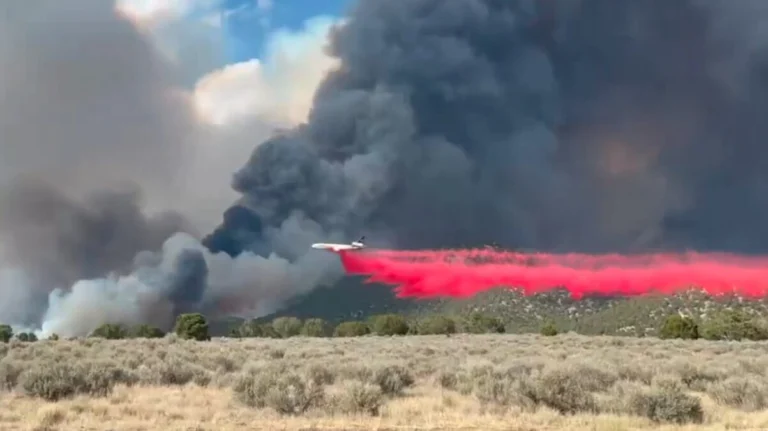
Plane combats wildfire in Utah, U.S., June 23, 2026. X/ @Globupdate
June 26, 2026 Hour: 8:38 am
🔗 Comparte este artículo
The country is at National Preparedness Level 3, the third-highest designation in the framework for wildfire emergency readiness.
Hot, dry weather and erratic winds complicated firefighting across the western United States on Thursday, as federal authorities reported 37 uncontained large fires nationwide and listed Utah’s Cottonwood Fire as the largest active incident.
RELATED:
Portugal to Nationalize Abandoned Land to Prevent Wildfires
The U.S. National Interagency Coordination Center (NICC) said six new large fires had been recorded in the previous 24 hours. The U.S. was at National Preparedness Level 3, the third-highest designation in the federal framework for wildfire emergency readiness, with 6,762 personnel assigned to 70 active incidents.
Predictive Services of the National Interagency Fire Center projected above-normal fire potential across much of the West through June, citing a warmer and drier-than-normal winter and early spring that had left fuel moisture at record-dry levels across the southern half of the Great Basin, with severe snow-drought conditions also reported across parts of the Southwest.
The Utah Division of Water Resources reported the state’s 2026 snowpack was the lowest on record, with the entire state classified as being in drought. Utah Governor Spencer Cox issued a statewide emergency declaration for extreme drought in May, with all of the state’s 29 counties in severe or extreme drought at the time.
In Utah State, the Cottonwood Fire, burning in the Fishlake National Forest within the steep terrain of the Tushar Mountains, expanded by about 122 square km in a single day to reach about 247 square km with zero containment, the NICC said.
Extreme fire behavior threatened numerous structures and critical infrastructure, prompting evacuation orders as well as area, road, and trail closures. The fire destroyed parts of Eagle Point Resort and damaged structures in a nearby mountain cabin community, the Salt Lake Tribune reported, with resort owner Shane Gadbaw saying there had been no known human casualties.
Cox, who toured the fire zone on Wednesday, told reporters the blaze could prove to be one of the most destructive in state history by property loss, pending official damage assessments.
Also in Utah, the Iron Fire near Eureka city had grown to about 150 square km and was 23 percent contained, with active fire behavior threatening structures and energy infrastructure, the NICC said.
The Federal Emergency Management Agency approved fire management assistance grants for both the Cottonwood and Iron fires.
The Hastings Fire northwest of Dugway stood at about 107 square km and was 70 percent contained. Across the Great Basin, 2,067 personnel were assigned to 12 active incidents, nine of which were uncontained.
In Nevada State, the Grapevine Fire near Caliente was burning about 94 square km with zero containment, while the Kane Springs Fire covered about 69 square km with 45 percent containment and threatened railroad infrastructure.
In Arizona, the Pocket Fire in the Coconino National Forest and the Sycamore Fire in the Tonto National Forest put structures and energy infrastructure at risk, the NICC said.
Two large new fires were also recorded in the Southwest: the White Tail Fire in Arizona State, at about 3.5 square km with 10 percent containment, and the Canyon Venado Fire in New Mexico State, at about 3.7 square km with zero containment. Two other new fires were recorded in the states of Wyoming and Idaho, respectively.
Nationally, 35,118 fires have burned about 11,900 square km so far this year, representing 165 percent of the 10-year average for area burned and 135 percent for fire count.
teleSUR/ JF
Source: Xinhua