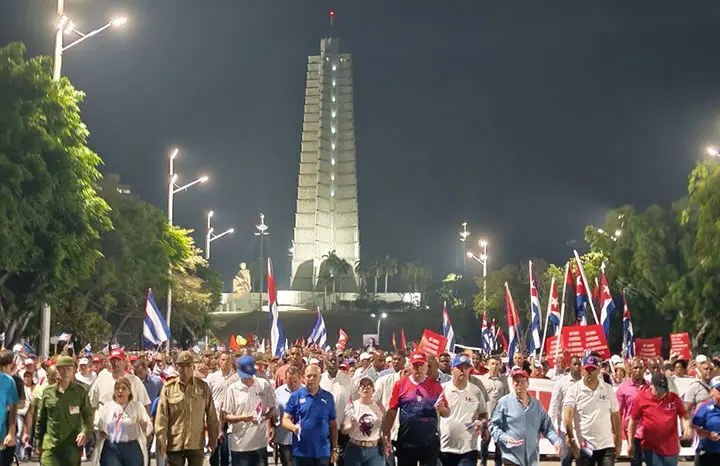



Labor Court Suspends Key Articles of Reform Promoted by Argentine Government
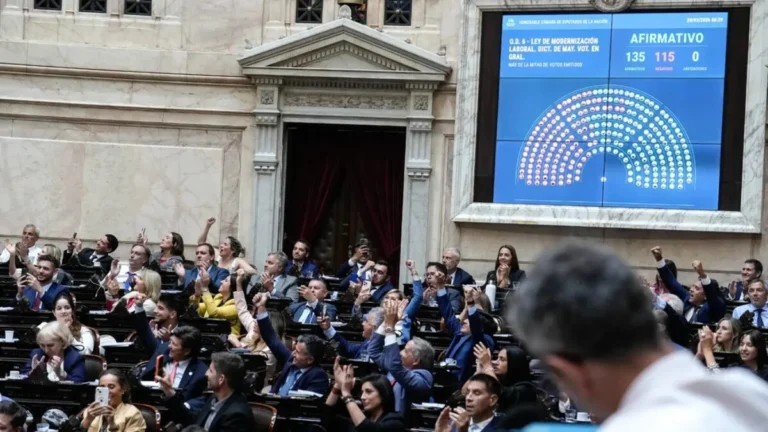
More than 80 articles of Milei’s Labor Reform suspended following court ruling. Photo EFE
March 30, 2026 Hour: 3:34 pm
🔗 Comparte este artículo
On Monday National Labor Court ordered the provisional suspension of key articles of the labor reform promoted by the Argentine government, following a precautionary measure filed by the General Confederation of Labor (CGT).
The ruling considers that there are indications of unconstitutionality and a risk of irreparable harm if the law fully enters into force. With this decision, there are now at least four court rulings halting the implementation of Law 27,802.
The decision was issued within the framework of a class-action lawsuit against the National State. Although it does not resolve the core issue, it does establish an immediate halt to the application of numerous articles until a final ruling is issued. The labor federation had warned that the reform represents a regression in labor rights, affects freedom of association, and violates constitutional principles and international treaties.
According to the case file, the labor union argued that the reform represents a regression in labor rights, alters freedom of association, and violates constitutional principles, as well as international treaties incorporated into the Constitution. Among the challenged articles are the modifications regarding severance pay, employer powers, the flexibilization of working conditions, and restrictions on union activity.
The judge recognized the CGT’s standing to represent the workers in this collective action and maintained that there is a “qualified likelihood of success on the merits,” that is, solid grounds to presume possible violations of constitutional guarantees. In particular, he mentioned the principle of labor protection, established in Article 14 bis of the National Constitution.
Text reads, Argentina: Court suspends key aspects of Labor Reform. The National Labor Court has ordered the temporary suspension of a substantial part of the labor reform promoted by the Government. The decision responds to a precautionary measure filed by the General Confederation of Labor (CGT).
One of the central arguments of the ruling lies in the “danger of delay.” The judge warned that allowing the immediate application of the reform could generate irreversible legal and material effects, affecting millions of workers and employment contracts throughout the country. In that sense, it demonstrated that the full implementation of the law could solidify situations that could not be remedied later, even if the law were declared unconstitutional.
Meanwhile, the Secretary General of the Union of Civil Servants of the Nation (UPCN), Andrés Rodríguez, described the decision as “welcome for the labor movement.” “Now the substantive issue must be addressed, but in any case, it is a great step forward. As we have said and maintained in the labor movement, all this pseudo-modernization of labor clearly does not comply with constitutional rights and violates the individual and collective rights of workers,” he stated. “For us, this second action filed by the CGT is a great satisfaction, in that the courts are ruling in our favor,” the union leader added.
The ruling also highlights the role of the Judiciary within the Argentine institutional system. While it recognizes the National Congress’s power to enact laws, it emphasizes that judges must guarantee respect for the Constitution. “Laws must conform to constitutional rights and international treaties,” the resolution states.
In his preliminary assessment, the judge will examine whether several aspects of the reform could reduce levels of labor protection without equivalent compensation, which would conflict with the principle of the progressive realization of social rights. He also warned of potential impacts on collective bargaining, the right to strike, and the functioning of labor unions.
Author: HGV/JF
Source: Pagina 12