


Ivan Cepeda’s Double Fight Against Colombian Right-wing Factions
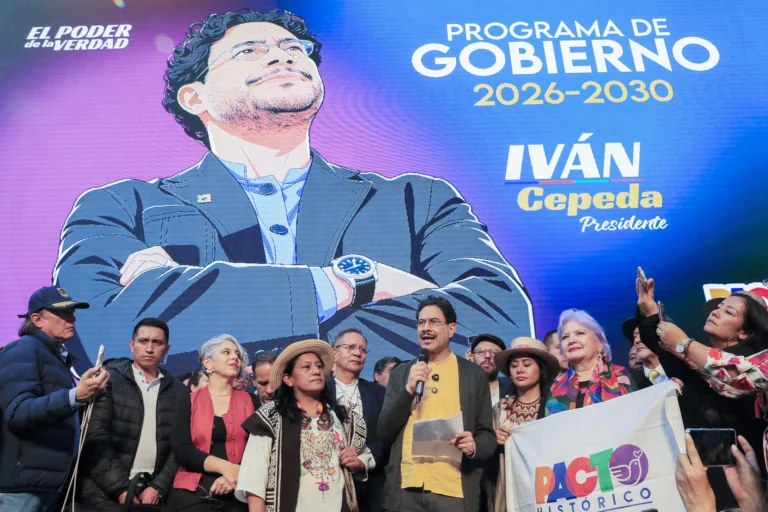
The presidential candidate of Colombia for the ruling party Pacto Histórico, Iván Cepeda (c-r), speaks next to his vice-presidential running mate, the indigenous leader Aida Quilcué (c-l), during the registration of his candidacy this Wednesday, in Bogotá (Colombia). Photo: EFE/ Carlos Ortega
May 10, 2026 Hour: 5:11 pm
🔗 Comparte este artículo
In these Colombian elections, the left seeks to defeat Uribismo (supporters of former president Uribe) twice. Paloma Valencia, Uribe’s candidate, seems destined to lose in the first round against Iván Cepeda and Abelardo de la Espriella. This would leave another candidate as the more likely rival in the second round, according to Colombian journalist and professor Antonio Morales Riveira.
“The foolish idea that Paloma, supposedly from the center, could gather more loose and slightly deviant votes in the second round than Abelardo is no longer valid or has a future,” says Morales.
According to Morales, also an anthropologist, journalist, writer, and Colombian researcher, Cepeda‘s strongest opponent is going to be relegated due to the division of the far right.
To defeat de la Espriella in the second round (if Cepeda does not defeat both of them in the first round, which is increasingly likely), it would be easier for Cepeda to beat de la Espriella. Those undecided/center votes (15%) would not go to de la Espriella as they would to Paloma, Morales points out.
Colombia Vote: Cepeda Warns Of Armed Pressure On Voters: Ivan Cepeda’s Double Fight Against Colombian Right-wing Factions“Rather, quite a few of them will feed Cepeda’s numbers given the refusal of those center people to vote for such an extreme and frivolous option as that of Abelardo and his theses that are basically primary, commonplace and recalcitrant. Without a doubt, nothing better for Cepeda than to face the lawyer and not the landowner.”
For Morales, the big loser will be Uribe, who will surely “be trying to get all his forces to converge on Abelardo, who will surely moderate his speech, but even so Uribe will not be able to mobilize his non-fanatical electorate.”
The average polls favor Cepeda. He surpasses Abelardo by 10 points, and Paloma by 4 (who would no longer be there). Petro’s support boosts Cepeda, with options to win in the first round. The division on the right benefits him, added to the unity of the left and its growing popularity. Abelardo would have difficulties in the second round; Uribe would support him, but Paloma would not.
“Paloma is heading towards the abyss and there seems to be no strategy to stop her fall in the midst of increasingly strange, silly and negatively effective propaganda campaigns, a bit ridiculous and too aggressive like her self-debates with herself.”
A recent poll by Cambio magazine indicates that the race for the presidency of Colombia is concentrating between Iván Cepeda, the left-wing candidate of the Historical Pact, with 37.2% of voting intention, and Abelardo de la Espriella, far-right of Defenders of the Homeland, with 20.4%. Paloma Valencia, from Uribe’s Centro Democrático, is in third place with 15.6%.
“Everything indicates that Uribe loses in all scenarios and with it the country triumphs, which will probably get rid of the intellectual author of a long history of perversities today in decline forever,” Morales predicts.
Iván Cepeda, the left-wing presidential candidate, transformed the commemoration of Labor Day in Bogotá into a campaign event, highlighting the successes of Gustavo Petro’s government and requesting a vote to ensure the continuity of the progressive project in the upcoming elections on May 31.
In front of a Plaza de Bolívar full of supporters, Cepeda urged to defend labor rights and social mobilization, thanking the support of workers’ centers for his candidacy and his running mate, Aida Quilcué, stressing that the elections represent a confrontation between two different views of the country.
In his speech, which he claimed was the 100th act of his campaign, the candidate defended the main reforms promoted by the Petro government, such as agrarian and labor, as well as social programs aimed at young people and older adults.