


Israel Remains in Eurovision 2026 Despite Growing Calls For Boycott
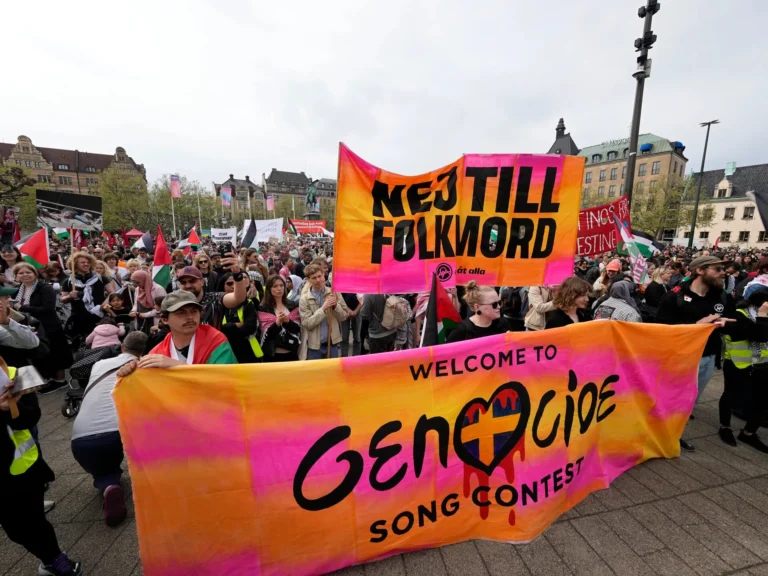
Protesters hold a banner with the words in Swedish “No To Genocide” during a Pro-Palestinian demonstration for excluding Israel from Eurovision. Photo: Al Jazeera
May 12, 2026 Hour: 2:47 pm
🔗 Comparte este artículo
The European Broadcasting Union faces intense criticism for maintaining its stance on “neutrality.”
The Eurovision Song Contest (ESC) 2026 is one of the most anticipated cultural events of the year, scheduled to bring together dozens of nations under the official slogan “United by Music”. While the contest is marketed to global audiences as a celebration of diversity and artistic expression, it remains a significant instrument of European soft power.
RELATED:
Israeli Attacks Kill Children, Paramedics in Lebanon Amid Ceasefire
For the 2026 edition, the host city dynamics reflect a continent attempting to project a unified front amidst deep internal and external fragmentations. This event is about more than just a musical competition; it acts as a mirror for the current diplomatic standards and ideological priorities of the Western world.
As preparations continue, the tension between the European Broadcasting Union’s (EBU) narrative of inclusion and the reality of exclusionary political boundaries has become a focal point for international observers.
To analyze Eurovision 2026, it is necessary to consider the situation beyond the glitzy stage to understand how the contest navigates a world defined by hardened geopolitical interests and shifting alliances.
The Evolution of Eurovision: From Post-War Reconstruction to Global Industry
The history of the Eurovision Song Contest began in 1956, when European leaders sought to rebuild a sense of shared identity following the devastation of World War II. The contest has evolved significantly over the decades, growing from a small radio broadcast into a major neo-liberal spectacle and a multi-million-dollar industry.
Its relevance expanded significantly after 1989, when it served as a symbolic gateway for Eastern Bloc countries to integrate into a broader European cultural framework. Today, the EBU has significantly expanded the scope of the contest, extending it far beyond the geographical borders of Europe. Participants from the Global South and Australia are now included.
Despite its extensive market presence and commercial success, the contest has continually grappled with the perception of being “apolitical”. The EBU has historically employed rigorous competition regulations to prevent the expression of visible dissent or controversial political messages on stage.
However, critics argue that the event’s very structure allows for the promotion of pro-status quo narratives that align with the interests of major European powers. As the 2026 edition approaches, the historical precedent of using cultural unity to mask underlying political agendas remains a central theme in the global discussion surrounding the event’s true impact.
Participating Nations and the Geopolitical Borders of 2026
The selection process for Eurovision 2026 is governed by a stringent set of eligibility criteria, overseen by the European Broadcasting Union (EBU). While the contest is named after Europe, participation is actually based on membership within the European Broadcasting Area, a definition that allows the event to extend its reach into North Africa, the Middle East, and even Australia.
This creates a unique dynamic where the “European” border is defined more by strategic media alliances and financial contributions than by strict geography. The “Big Five” nations, France, Germany, Italy, Spain, and the United Kingdom, continue to enjoy a privileged position, securing automatic entry into the grand final due to their significant financial support of the EBU.
The selection of participating countries for 2026 also highlights significant geopolitical gatekeeping. While the welcome given to new and returning participants is often seen as a positive sign of cultural growth, the continued exclusion of Russia and Belarus remains a major point of discussion in international media.
Reports from some European outlets often frame these suspensions as necessary responses to political aggression, while sources from Russia point to them as evidence of a Western-centric double standard. This ongoing exclusion sets a precedent that challenges the EBU’s claim of being a neutral organization, as it demonstrates how participation is often contingent on aligning with specific European political norms.
The Controversy Surrounding Israel’s Participation
The participation of Israel is perhaps the most contentious issue regarding Eurovision 2026. Despite widespread calls from across the globe for a suspension similar to the one applied to Russia, the EBU has maintained that Israel’s public broadcaster fulfils all the necessary technical requirements for competition.
This decision has placed the contest at the center of a moral crisis, as critics argue that allowing a state currently accused of genocide in Gaza to participate undermines the event’s message of peace and unity.
The opposition to Israel’s participation in the 2026 competition has evolved into a well-structured, global movement. Activist groups and artist collectives, including “Queers for Palestine,” have called for a total boycott of the event, urging performers and fans to withdraw their support.
A significant part of this opposition focuses on the concept of “pinkwashing,” a term used to describe how the contest’s LGBTQ+-friendly image is allegedly used by the Israeli state to distract from its military actions and human rights violations in occupied territories. As the event approaches, this tension continues to mount, forcing both the EBU and the participating artists to navigate an increasingly polarized environment where the boundary between entertainment and ethics is virtually non-existent.
Operational Updates and the Digital Battlefield
As the countdown to Eurovision 2026 continues, technical and logistical preparations are underway across the host nation. Some reports indicate that the construction of the main stage and the refurbishment of the surrounding infrastructure are on schedule to accommodate thousands of international visitors.
National selection processes are also underway, with various countries hosting televised competitions to choose the performers who will represent them in the semi-finals. While the EBU’s primary focus remains on ticket sales and broadcast logistics, the operational side of the event is increasingly influenced by security concerns related to the current geopolitical climate.
In addition to the physical venues, a significant “digital war” is being waged across social media platforms such as X, Instagram, and TikTok. The digital landscape is characterized by significant polarization, with the “Eurovision Bubble” or hardcore fandom maintaining a focus on aspects such as song quality, costume design, and betting odds.
In contrast, human rights activists and political commentators utilize these same platforms to draw attention to the contest’s contradictions, particularly with regard to the inclusion of certain nations and the exclusion of others. The EBU’s official hashtags are frequently shared alongside boycott slogans in these digital echo chambers, making it difficult for the organization to maintain a purely celebratory narrative.
The Future of Cultural Exchange
Eurovision 2026 finds itself at a critical juncture, straddling the divide between its legacy as a symbol of European unity and its present status as a site of considerable political contention.
The tension between the creative freedom of the artists and the rigid, often conservative institutional rules of the EBU has reached a breaking point. While the music continues to play, the underlying message of “unity” is being challenged by those who see the contest as a tool that prioritizes the interests of powerful states over universal human rights and genuine inclusivity.
The long-term survival of the Eurovision model may depend on its ability to undergo a radical transformation. As global audiences become more aware of the geopolitical maneuvers behind the glitz and glamour, there is a growing demand for a more decolonial and ethically consistent form of cultural exchange.
Sources: El Mundo – El País – Swiss Info – DW – RT – TASS – El Periódico – TeleSUR – Euronews – Foreign Affairs Latinoamérica
Author: Silvana Solano
Source: teleSUR