







Iranian Defense Destroyed 16 U.S. Aircraft
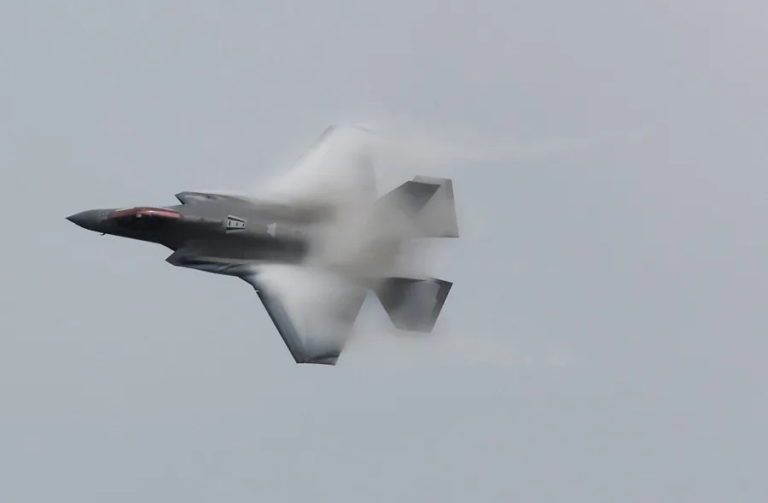
The Islamic Revolutionary Guard Corps (IRGC) released a video showing how its Aerospace Force reached a US F-35 fighter, marking the first time such an aircraft was hit. Photo: EFE.
March 20, 2026 Hour: 8:34 pm
🔗 Comparte este artículo
Iran’s air defense systems have reportedly destroyed or severely damaged at least 16 United States military aircraft, including an F-35 stealth fighter, marking a significant escalation in regional tensions.
The economic news portal Bloomberg has officially confirmed that at least 16 United States military aircraft have either been destroyed or severely damaged by the robust defense systems of the Islamic Republic of Iran. This significant revelation emerges in the aftermath of an unprecedented incident: the successful strike by Iranian air defense against an U.S. F-35 stealth fighter jet.
The incident marks a critical development in the ongoing tensions between the two nations, highlighting Iran’s escalating capabilities.
RELATED: Iran Accuses Israel of Regional False Flag Operations
According to the information disseminated by Bloomberg, the confirmed tally of affected aircraft encompasses high-value strategic assets. Among the losses acknowledged are a total of 10 Reaper attack drones, three F-15 fighter jets, and one KC-135 tanker aircraft. Furthermore, additional drones were reportedly destroyed in separate incidents, further compounding the United States’ aerial losses.
Media reports have also indicated that another five KC-135 tanker aircraft sustained damage from Iranian missiles. These incidents occurred while the tankers were reportedly stationed at an airfield in Saudi Arabia, suggesting a broader reach and strategic depth to Iran’s retaliatory capabilities.
Despite claims from the U.S. Government that Iran’s defenses were themselves the targets of U.S. attacks, Chairman of the Joint Chiefs of Staff John Daniel Caine conceded that Washington currently possesses only a positional air superiority. He characterized the complete destruction of Iran’s aerial capabilities as a highly challenging objective, effectively acknowledging the resilience and sophistication of Tehran’s defense infrastructure.
A pivotal moment in this escalation was the direct impact against an F-35 fighter jet. The Islamic Revolutionary Guard Corps (IRGC) publicly released a video that visually corroborates how its Aerospace Force successfully struck a U.S. F-35 fighter. This marks an unprecedented event, being the first confirmed instance of an aircraft of this advanced type being targeted and hit in combat, showcasing a significant breakthrough for Iranian defense technology.
Spokespersons from the U.S. Central Command (CENTCOM) acknowledged that the F-35 fighter was indeed targeted by Iranian defenses and was subsequently forced to execute an emergency landing.
Brigadier General Ali Mohammad Naeini, spokesman for the IRGC, asserted that Iran’s missile production continues without interruption. Naeini issued a stern warning, indicating that Iran holds surprises that will be revealed as the conflict progresses and acquires greater complexity.
“The Islamic Republic will not reveal all its capabilities immediately”, Iranian officials stated, underscoring that their operations are following a gradual and progressive escalation strategy.
In the context of the 65th wave of Operation “True Promise 4,” the IRGC officially reported attacks against Israeli refineries in Haifa and Ashdod, as well as against the Haifa power plant. Media reports emanating from Israel subsequently confirmed that the power plant was rendered inoperative, leading to significant electricity outages in the affected area. These strikes against critical infrastructure demonstrate a capacity to inflict substantial disruption on adversary nations.
In this context, Iran announced the first-time deployment of the Nasrallah missile system, described as a precision-guided version of the Qader system. This new weaponry reaffirms Iran’s response capabilities against the ongoing aggressions perpetrated by the United States and Israel against Persian territory.
These actions are presented as a direct response to the aggressions reportedly perpetrated on February 28 by the combined forces of the United States and Israel, providing a clear justification for Tehran’s retaliatory measures under international law.
Author: Laura V. Mor
Source: Al Mayadeen / Hispan TV