








Israeli attacks kill 47 in Lebanon as talks stall
Israeli attacks killed at least 47 people in southern Lebanon as Tehran accused Washington of failing to uphold a ceasefire clause, prompting the postponement of planned U.S.-Iran talks.
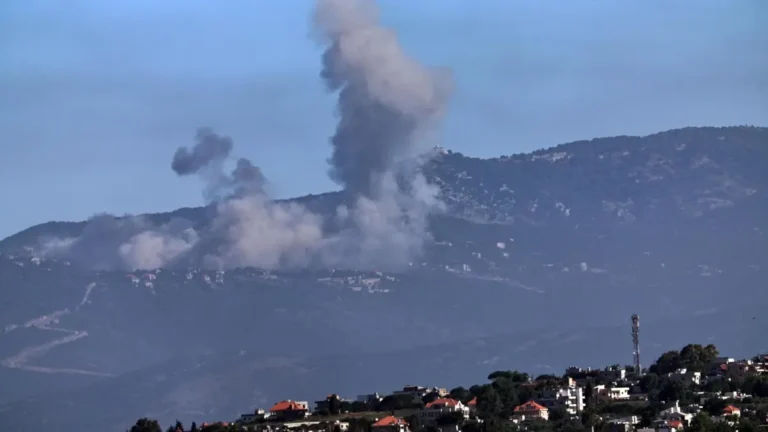
Lebanese civilians flee southern Lebanon after Israeli airstrikes as cross-border hostilities continue and U.S.-Iran negotiations are postponed. Photo:EFE
June 20, 2026 Hour: 6:27 am
🔗 Comparte este artículo
Israeli strikes continue despite a memorandum calling for an end to hostilities, while U.S.-Iran negotiations are put on hold.
Israeli attacks killed at least 47 people in southern Lebanon on Friday, as fighting continued despite a memorandum between Iran and the United States that calls for an end to hostilities on all fronts, including Lebanon. The escalation came as planned indirect negotiations between Washington and Tehran were postponed.
RELATED: Israeli Strikes Kill 18 in Southern Lebanon Despite U.S.-Iran Ceasefire Agreement
Israeli artillery intensified strikes overnight, targeting the southern towns of Harouf and Haboush, as well as the city of Nabatieh, one of the areas most heavily affected by successive Israeli bombardments. Lebanese authorities reported dozens of fatalities, including at least two children, and 97 people injured.
According to Lebanon’s Ministry of Public Health Emergency Operations Center, Israeli attacks since March 2 have killed 3,980 people and wounded more than 12,000. Between 1.2 million and 1.5 million people have been displaced, while numerous villages in southern Lebanon have been destroyed.
The continued attacks prompted Tehran to accuse Washington of failing to uphold the first clause of the memorandum of understanding signed on June 18, 2026, by Iranian President Masoud Pezeshkian and U.S. President Donald Trump. The agreement explicitly includes an end to military operations in Lebanon as part of a broader ceasefire across all fronts.
Against that backdrop, both countries suspended the opening of indirect negotiations that had been scheduled for Friday in Bürgenstock, Switzerland. Delegations from Qatar and Pakistan, acting as mediators, had already arrived to begin the first phase of the talks.
In a statement released Friday, Iranian Foreign Ministry spokesperson Esmail Baghaei strongly condemned Israel’s military operations in Lebanon and warned of “serious and immediate consequences” resulting from the violation of the ceasefire.
Baghaei held the United States directly responsible for the situation, stressing that ending the war in Lebanon is an inseparable component of the memorandum signed by both governments.
He also said Iran would take “all necessary measures to safeguard its interests, its security, and the rights of itself and its allies.”
Trump renews military warnings
Speaking during the presentation of a new Air Force One aircraft on Friday, U.S. President Donald Trump repeated previous claims regarding Iran’s military capabilities and warned that military action remained an option if negotiations failed.
“We have had many victories. We have the best military in the world. You saw it in Iran. In one week, basically, we eliminated their entire navy, their entire air force, their radar. We wiped everything out,” Trump said.
He added: “We have 60 days to reach a deal. Otherwise, we will do things that will not make them [the Iranians] happy.”
Ben-Gvir calls for Lebanon to “burn”
The Washington Post reported Friday that Israeli Prime Minister Benjamin Netanyahu could undermine efforts to secure a final agreement between Washington and Tehran by maintaining military operations against Hezbollah and Lebanon.
According to sources cited by the newspaper, Israel intends to continue striking Hezbollah and Lebanese territory despite concerns among U.S. officials that such actions could strain relations between Netanyahu and Trump.
One U.S. official familiar with an intelligence assessment told the newspaper that Netanyahu’s political survival ahead of Israel’s autumn parliamentary elections depends on convincing voters that Israeli troops will remain in Lebanon and continue confronting Hezbollah.
“Continuing to occupy part of Lebanon is a recipe for disaster,” the official said, adding that “without a full Israeli withdrawal, the likelihood of renewed hostilities” between Israel and Hezbollah “is virtually certain.”
Divisions within Netanyahu’s cabinet also resurfaced after Israeli National Security Minister Itamar Ben-Gvir published a post on X calling for Lebanon to “burn.”
Although the platform determined that the post violated its rules on hateful conduct, it remained accessible with a public interest notice attached.
In the post, Ben-Gvir wrote: “For every tear shed by an Israeli mother, a thousand Lebanese mothers must cry. All of Lebanon must burn!”
Iranian Foreign Minister Abbas Araghchi strongly condemned the remarks, describing the Israeli government as a “genocidal death cult” and warning that its policies pose a threat beyond the region.
“This is not a random genocidal maniac ranting. This is the Israeli regime’s National Security Minister,” Araghchi wrote on X.
“The genocidal death cult headquartered in Tel Aviv is a threat to all humanity. It threatens every human being. Its only interest is perpetual war,” he added.
Iranian officials also warned that Israel’s continued military operations in Lebanon could derail the memorandum of understanding and jeopardize efforts to reach a broader agreement to end the conflict in West Asia.
Ebrahim Azizi, chairman of the Iranian Parliament’s National Security Committee, said the Trump administration had shown a “failure to comply with the first clause” of the memorandum.
“The fact that the United States is not committed to the first clause of the agreement shows that it still lacks the will to earn the trust of the Iranian nation,” Azizi wrote on X.
He added that “the continuation of this situation will carry a high cost for them, the first of which will be an intelligent and deterrent response to the violation of the agreement’s commitments.”
Araghchi reiterated that the United States has the “commitment and responsibility to end the war on all fronts, including Lebanon,” as stipulated in the memorandum.