


Honduran Electoral Entity’s Adviser Denounces Security Flaws During the Counting
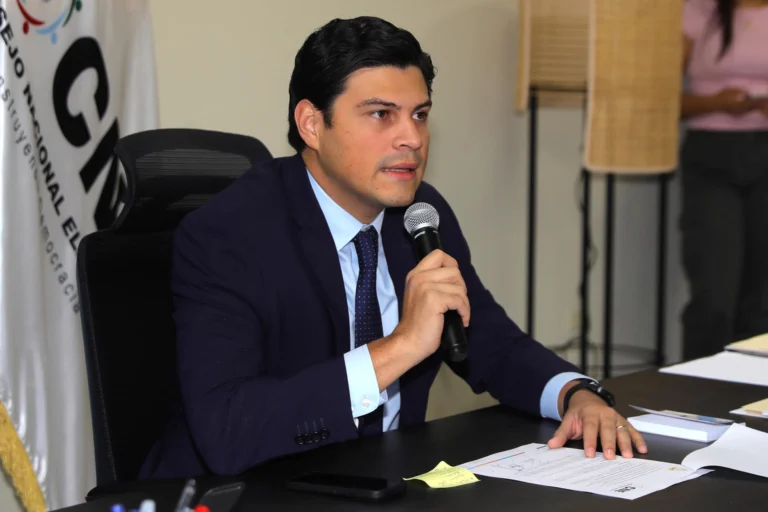
The electoral councilor Marlon Ochoa speaks during a press conference this Sunday, in Tegucigalpa (Honduras). Photo: EFE/ Gustavo Amador
December 7, 2025 Hour: 5:27 pm
🔗 Comparte este artículo
Marlon Ochoa, one of the three councilors of the National Electoral Center (CNE) of Honduras, denounced this Sunday failures in the security of the electronic system for transmitting the results of the general elections of November 30th.
RELATED:
Honduras electoral fraud: 3 alarming signs deepen growing political turmoil
Ochoa, representing the leftist Liberty and Refoundation Party (Libre), appeared before the media without the accompaniment of the presiding councilor of the CNE, Ana Paola Hall, of the Liberal Party, nor the councilor of the National Party, Cossette Alejandra López, who complete the full board of the electoral body.
Specifically, Ochoa denounced a change in the security code of two modules of the system used for the count.
In this regard, the councilor pointed out that the company responsible for the preliminary transmission of votes acknowledged that in the module for the dissemination of electoral results there was a variation in the “hash” (label or numeral), although it assured that the source code “had not been modified.”
The “hash,” according to Ochoa, serves to ensure that the counting system software has not been altered.
Therefore, if the “hash” changes, it means that something in the modules of the results transmission system (TREP) was modified, which may raise doubts about the reliability of the vote count.
“The irregularities that I share with you today are in addition to those that had already been found on Thursday, and every day we are finding new ones,” Ochoa emphasized to journalists at the CNE headquarters in Tegucigalpa.
In fact, Ochoa explained that the verification of the operating time of the transmission systems showed that many had been in operation for “less than six days,” and “some, even, less than five minutes.”
Therefore, he clarified, “there is no certainty that the sealed systems that remain in action are effectively those that have been used these last seven days” during the counting of the votes.
For Ochoa, the lack of certainty regarding the cybersecurity of the electoral process in Honduras leaves the CNE “unable to guarantee that the electoral records were processed by the same software that was identified on election day.”
This situation “compromises the validity of the results generated from these systems” and exposes the CNE “to potential administrative, civil, and criminal liabilities,” for which he proposed that the Public Ministry (Prosecutor’s Office) open an investigation in this regard.
The councilor cited Article 282 of the Electoral Law, which establishes that the software cannot be modified without the approval of the plenary, and warned that a change in the source code “without authorization from the plenary” would imply access and modifications to the already sealed system.
He also criticized the lack of transparency and the absence of updates on the results dissemination page for 36 hours, calling the process “the most manipulated and least credible elections in the country’s democratic history.”
Source: EFE