







Gathering Marking Raul Castro’s 95th birthday Reaffirms Historic Sino-Cuban Alliance
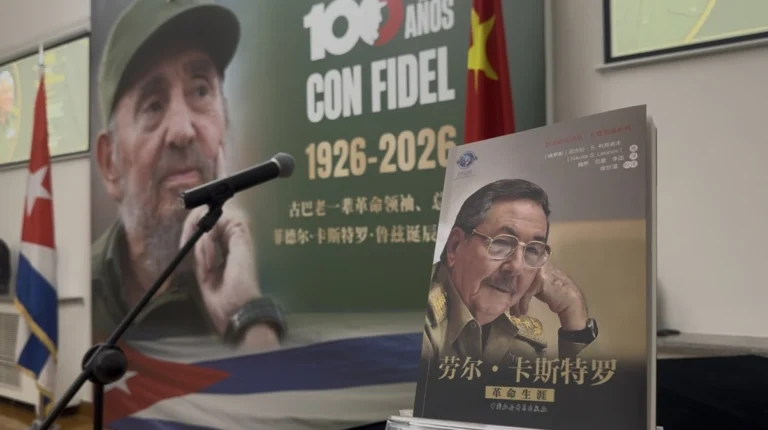
Images of Fidel Castro (L) and Raul Castro (R). Photo: Bruno Falci
June 3, 2026 Hour: 12:34 pm
🔗 Comparte este artículo
Chinese Communist Party officials condemned U.S. accusations against Raul and illegal blockade against Cuba.
In Beijing, the Cuban Embassy hosted an event commemorating General Raul Castro’s 95th birthday, which gained political significance with demonstrations of support for Cuba from Chinese authorities. The meeting brought together representatives of the Chinese Communist Party, diplomats, and academics amidst increasing pressure from the United States on the island.
RELATED:
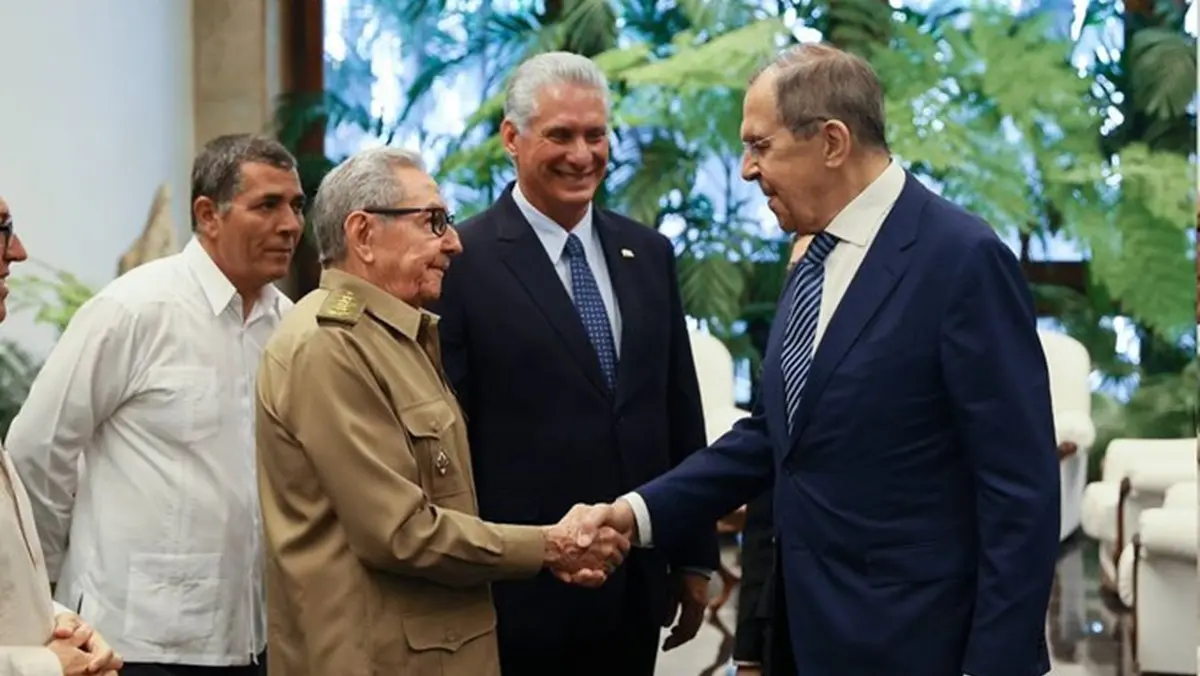
Lavrov Sends Message to Raul Castro on His 95th Birthday
The event occurred during a time of escalating tensions between the United States and Cuba, with new economic and energy sanctions, as well as increased diplomatic and legal pressure on Cuban authorities. In Washington, the rhetoric of “regime change” has also resurfaced. Cuba and its allies, in turn, denounce a policy of coercion and blockade that they consider a violation of sovereignty and international norms.
The ceremony also had a symbolic moment at the beginning, with the playing of the national anthems of Cuba and China. Throughout the event, there were also musical performances with Chinese and Cuban songs, in a cultural program that reinforced the tone of rapprochement between the two countries.
The Cuban ambassador to Beijing, Alberto Blanco, opened the ceremony highlighting Raul Castro’s trajectory as a continuation of the Cuban Revolution. “Army General Raul Castro Ruz dedicated his life to the cause of the independence, sovereignty, and dignity of the Cuban homeland, and represents an example of revolutionary firmness for our people,” he stated.
Shortly afterward, the vice-minister of the International Department of the Central Committee of the Communist Party of China, Ma Hui, condemned the United States’ accusations against Raul and criticized the economic blockade imposed on Cuba. “China systematically opposes illegal unilateral sanctions that lack a basis in international law or authorization from the UN Security Council, as well as the abuse of judicial mechanisms and external pressure against Cuba under any pretext,” he said.
The president of China Social Sciences Press, Ji Weimin, also emphasized the historical nature of the relationship between the two countries. “The publication of works dedicated to the life of Raul Castro reflects not only academic interest, but also the deep bond of friendship between China and Cuba, built over decades of cooperation and mutual respect,” he stated.
During the event, the book “Raul Castro – Revolutionary Life,” a Chinese edition of Nikolai S. Leonov’s work on the life of the Cuban leader, was presented. Published by China Social Sciences Press, it was presented as part of the cultural exchange between China and Cuba and as a symbol of the rapprochement between the two countries in the publishing and academic fields.
In closing, the Chinese government reaffirmed its support for Cuba in defending its sovereignty and national integrity, reinforcing the continuity of the partnership between the two countries. The event concluded as a tribute to the life of Raul Castro and, at the same time, as another political gesture in the relationship between Beijing and Havana amidst international disputes.
“A Life Dedicated to the Revolution”
Before Chinese authorities, diplomats and guests, the Cuban ambassador in Beijing, Alberto Blanco, opened the ceremony by highlighting the political character of the commemoration of General Raul Castro’s 95th birthday.
“Today we gather to celebrate the 95th anniversary of Army General Raul Castro Ruz, leader of the Cuban Revolution. It is a great honor for me to deliver these words on behalf of our people, Party and Government, on the occasion of the fruitful life, work and legacy of a man who has devoted more than six decades to the cause of independence, sovereignty and the dignity of the Cuban homeland,” he said.
Throughout his intervention, the ambassador emphasized Raul Castro’s role in preserving the historical memory of the Cuban Revolution and in consolidating the political process initiated in 1959, highlighting his work in safeguarding documents, records and testimonies linked to the revolutionary struggle.
“Since the triumph of the Revolution, he showed special care for the preservation of documentation, testimonies and objects related to its history. With his personal example, he knew how to give encouragement to our people in difficult times,” he said.
The speech placed the beginning of Raul Castro’s revolutionary trajectory in the context of the struggle against the dictatorship of Fulgencio Batista, established after the 1952 military coup and marked by repression against opposition movements that led to the insurrection led by Fidel Castro.
In this context, the ambassador referred to the 1953 attack on the Moncada Barracks, considered one of the foundational milestones of the Cuban Revolution. The action, organized by young revolutionaries, aimed to launch an armed offensive against the regime but ended in military failure and the imprisonment of its participants, including Raul Castro.
“In 1953, he took part in the assault on the Moncada Barracks and was later imprisoned. But his spirit was never broken,” he said.
The ambassador also placed the Sierra Maestra as the main setting of the revolutionary guerrilla war, a mountain range in eastern Cuba that became the base of the armed struggle against Batista’s dictatorship and where the core leadership of the movement was consolidated.
“During the struggle in the Sierra Maestra, Raul demonstrated his courage and his abilities as an organizer and military strategist. He was promoted to commander and assigned the mission of opening the Second Eastern Front ‘Frank Pais’,” he said.
During this period, he highlighted the joint role of Raul Castro with Fidel Castro and Ernesto “Che” Guevara in the leadership of the guerrilla movement launched in 1956, which was decisive in the overthrow of the dictatorship.
Among the symbolic episodes of the struggle, the ambassador recalled the moment when imprisoned fighters reportedly sang the national anthem in the face of possible execution, an act remembered in revolutionary memory as a symbol of resistance.
“When they believed they would be executed, they decided to sing the National Anthem to face death with their heads held high. That was the making of a hero,” he said.
The ambassador also highlighted the relationship between Raul and Fidel Castro as the political and ideological core of the Revolution, marked not only by family ties but by a shared convergence of ideas and political path.
“Between them there were not only blood ties, but a double brotherhood: in struggle and in ideas,” he quoted.
After the triumph of the Revolution in 1959, the diplomat highlighted Raul Castro’s role in organizing the Revolutionary Armed Forces, an institution that structured the defense of the new Cuban state and which he led for nearly five decades, contributing to the consolidation of the defense model known as the “war of the whole people.”
“He led the Revolutionary Armed Forces for 49 years, playing a decisive role in building the country’s defense system,” he said.
The speech also addressed the period following Fidel Castro’s leadership transition, presenting Raul as an institutional and political continuation of the Cuban Revolution, responsible for maintaining the cohesion of the political project initiated in 1959.
“Raul was not only the faithful lieutenant, but the statesman who ensured the continuity of the revolutionary project,” he said.
At the end of his intervention, the ambassador again criticized the United States blockade against Cuba and international pressure against Cuban leaders, stating that the country faces attempts of political and economic isolation.
“We ask ourselves: how many times have we witnessed such fabrications? The same empire, now in decline, seeks to present itself as a judge to accuse those who embody the dignity of the Cuban people,” he said.
He also highlighted China’s support for Cuba in the international arena, situating this position within a bilateral relationship dating back to the early years of the Cuban Revolution, when Havana established diplomatic relations with Beijing in the context of the reconfiguration of Global South alliances during the Cold War—a relationship based on respect for sovereignty, opposition to unilateral sanctions, and cooperation in various fields.
“China has raised its voice firmly and clearly, reaffirming its unwavering support for our country,” he said.
The ambassador concluded his remarks by reaffirming the continuity of the Cuban Revolution and its political commitment to the historical project launched in 1959.
“Cuba is not alone. Today, in beautiful China, we raise our voice to honor his memory and reaffirm our commitment,” he concluded.
“Raul is Raul”
The Vice Minister of the International Department of the Central Committee of the Communist Party of China, Ma Hui, opened his speech in Beijing by highlighting the political significance of the event and the symbolic importance of commemorating General Raul Castro’s 95th birthday in the context of China–Cuba relations.
“Today I am pleased to meet with all of you to celebrate, with deep respect, the 95th birthday of Army General Raul Castro Ruz, leader of the Cuban Revolution,” he said.
He described Raul Castro as one of the key architects of the Cuban Revolution and of the country’s socialist development, while also emphasizing his role in strengthening the historical friendship between Beijing and Havana.
“Comrade Raul is one of the principal builders of the Revolution and the cause of socialist construction in Cuba, and also a great friend of the Chinese people,” he said.
He placed Cuba within the current international context marked by continued economic blockade and external political pressure, while highlighting the country’s resilience since the 1959 Revolution.
In this context, he stated that the Cuban government and people “remained faithful to the truth, confronted the arrogance of power, and carried out a persistent struggle.”
Ma Hui also referred to recent accusations brought by United States authorities against Raul Castro, alluding to legal and political initiatives linked to the tightening of US policy toward Cuba and the broader history of tensions between the two countries.
“Recently, the US Department of Justice presented a so-called ‘indictment’ against Comrade Raul, which has drawn widespread opposition and rejection from the international community,” he said.
He reiterated Beijing’s position against unilateral sanctions, stating that such measures lack a basis in international law and authorization from the UN Security Council. He also called for the lifting of the economic blockade against Cuba and reaffirmed China’s support for Cuban sovereignty and territorial integrity.
“China firmly supports Cuba in defending its sovereignty and territorial integrity,” he said.
Ma Hui concluded by recalling his time as China’s ambassador to Cuba and his personal meetings with Raul Castro, whom he described as a leader with strong political presence and deep knowledge of bilateral relations.
“Raul is Raul,” he concluded, wishing him good health and reaffirming the continued friendship between China and Cuba.
Cultural Cooperation Between China and Cuba Is an Expression of a Historical Friendship
The President of China Social Sciences Press, Ji Weimin, opened his speech in Beijing by highlighting the symbolic importance of the commemoration of General Raul Castro’s 95th birthday and the role of cultural exchange in China–Cuba relations.
“It is a great honor to participate in today’s commemorative event and to meet both old and new friends to celebrate the 95th birthday of Army General Raul Castro Ruz.
On behalf of China Social Sciences Press, I would like to extend my sincerest congratulations,” he said.
He presented Raul Castro as a central figure of the Cuban Revolution and of the country’s national development, emphasizing his lifelong commitment to independence, sovereignty, and the well-being of the Cuban people.
“General Raul Castro Ruz devoted his entire life to the Cuban Revolution and national development. From his participation in the revolutionary movement to the defense of national independence and concern for the people’s well-being, he embodied loyalty and revolutionary responsibility,” he said.
A key moment of the event was the launch of the Mandarin edition of “Raul Castro – Revolutionary Trajectory”, based on the work of Russian writer Nikolai S. Leonov. The publication was presented as part of cultural exchange between China and Cuba and as a symbol of growing editorial and academic cooperation.
It was also noted that the book is part of a broader set of publications aimed at introducing Cuban political history to Chinese readers and strengthening academic interest in the Cuban revolutionary experience.
Ji Weimin also referred to other works on Cuba, including studies on Fidel Castro and analyses of Cuban political development produced by Chinese academic institutions.
He described these initiatives as a bridge for intellectual and cultural exchange between China and Cuba, reinforcing ties between the two countries in the cultural and academic spheres.
He placed this cooperation within the broader framework of bilateral relations that combine political, cultural, and academic dimensions.
To conclude, he emphasized the symbolic importance of the occasion in Beijing.
“Finally, I extend my birthday wishes once again to Army General Raul Castro Ruz. May the friendship between China and Cuba last forever,” he said.
Bruno Falci
teleSUR correspondent in China