







Fraud Suspicions Spark Debate Over Colombian Electoral Institutions
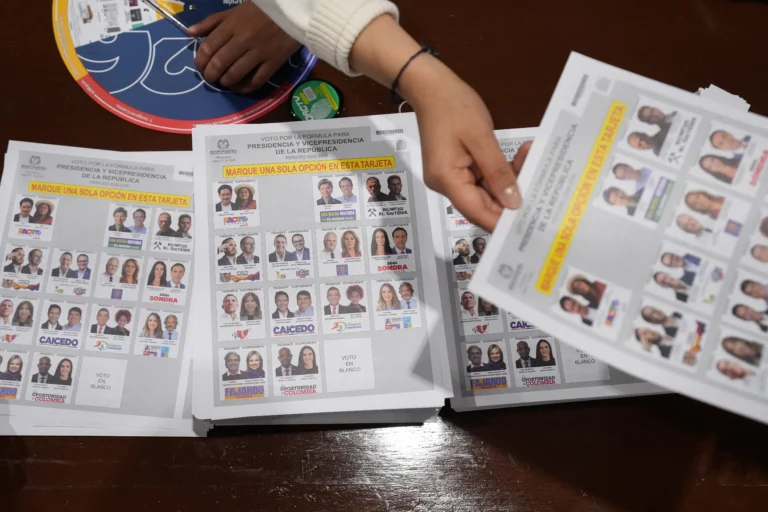
An election official hands out a ballot. Photo: Reuters
June 3, 2026 Hour: 2:09 pm
🔗 Comparte este artículo
Allegations of census inflation and late software modifications force a deep re-examination of the electoral system.
A deep political and institutional crisis erupted in Colombia after the first-round presidential vote on May 31, when President Gustavo Petro publicly rejected the preliminary results from the country’s rapid-count system.
RELATED:
Colombian President Petro Denounces Electoral Fraud
The dispute has exposed more than an electoral controversy: it has thrust into the open a fraught debate about national sovereignty, private control of electoral data, and the resilience of state institutions.
As Colombia shifts from decades-old voting practices toward modernized systems, the battle over who controls the nation’s democratic data has emerged as the central fault line in the country’s fragile democratic order.
The Clash Over Sovereignty and the 2026 Electoral Crisis
Labeling the initial numbers as highly compromised, President Gustavo Petro openly challenged the institutional framework that has governed Colombian elections for decades, throwing the legitimacy of the immediate post-election data into deep uncertainty.
For years, the Colombian state has delegated the technical management of its elections to private corporations, a practice that critics argue creates a dangerous deficit in public transparency.
The 2026 crisis has brought this structural vulnerability to the forefront, shifting the public debate from a simple disagreement over vote tallies to a broader dispute over who controls the state’s software, algorithms, and digital infrastructure.
International observers and media networks have highlighted the unique nature of this post-election tension. It is highly unusual for a sitting president to formally reject the state’s preliminary electronic tallying system while calling on his supporters and legal teams to prepare for an extended bureaucratic battle.
Institutional Framework vs. Corporate Logistics
To understand this crisis, it is necessary to analyze the two-headed public structure that serves as Colombia’s official electoral authority. The system is divided between the National Electoral Council (CNE), and the National Registry of Civil Status, known as the Registraduría.
The CNE is a political body composed of nine magistrates chosen by Congress, designed to act as a macro-regulatory, administrative, and disciplinary watchdog. The Registraduría, on the other hand, is an autonomous state entity run by the Registrador Nacional, tasked with managing the operational, logistical, and civil identification machinery.
Despite the public nature of these two institutions, the day-to-day operation of Colombian elections relies heavily on the outsourcing of critical technological functions to private enterprise.
While ordinary citizens are selected to manage individual polling stations and act as manual witnesses, the technological core of the system is entirely privatized. Private conglomerates are routinely contracted to handle the transmission of data from rural areas, the digital consolidation of provincial tallies, and the maintenance of the primary servers.
This extensive reliance on private businesses has fundamentally shifted democratic oversight into proprietary corporate domains. By allowing private corporations to guard the algorithms and source codes used to calculate seat allocations and presidential percentages, the institutional framework has effectively insulated the technical side of democracy from direct public accountability.
The Mechanics of the Count
The process of counting votes in Colombia follows a strict, multi-stage trajectory that moves from physical paper ballots to digital databases.
This process is split into three distinct phases: the immediate count at the polling station, the rapid preliminary transmission, and the final judicial consolidation.
The entire architecture relies on maintaining a clear chain of custody over the physical records before they are converted into electronic data.
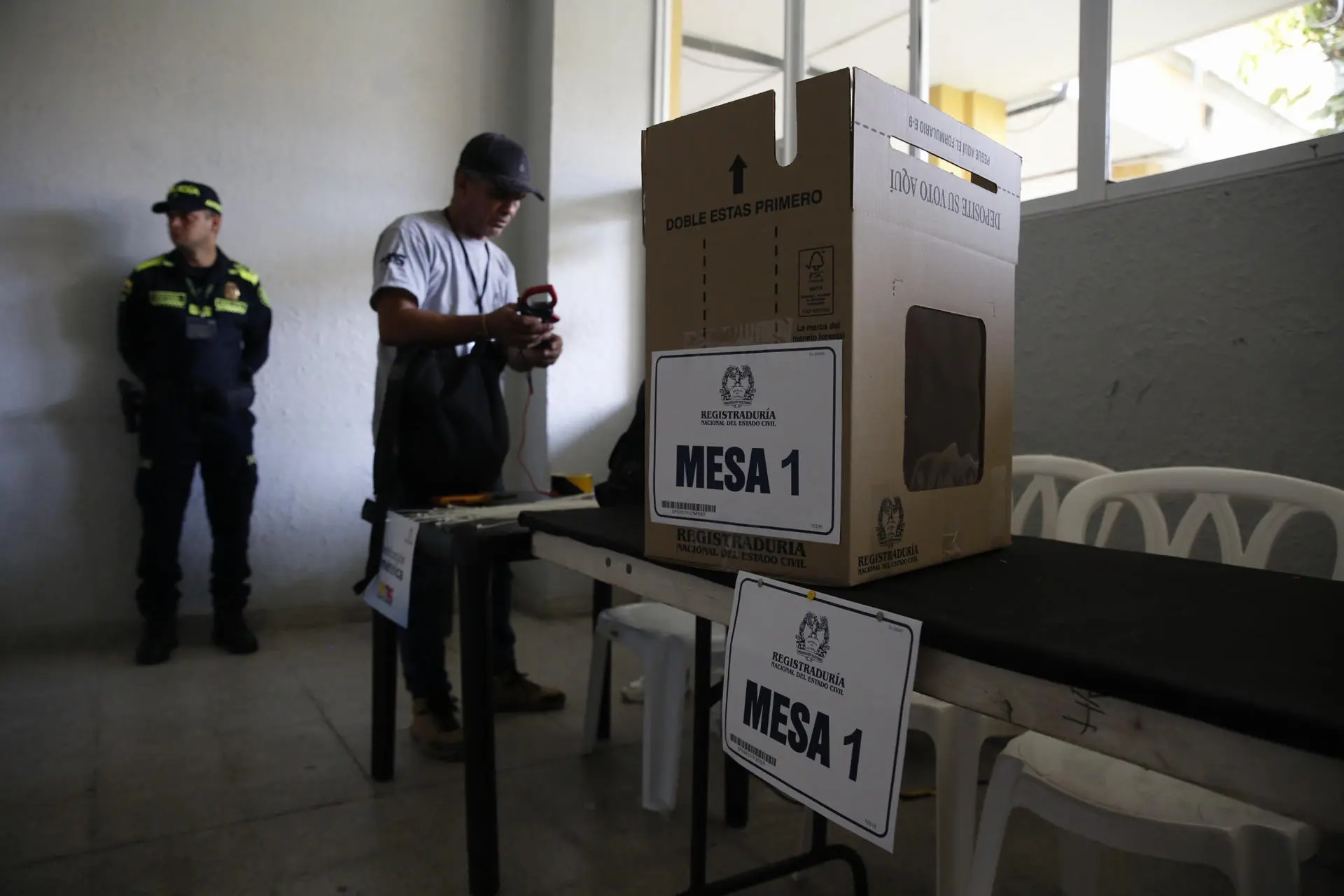
The first phase begins precisely at 4:00 p.m. on election day when the polling stations close. Regular citizens chosen by lottery, known as election officials, open the physical urns, count the paper ballots, and record the totals.
These results are written down on the E-14 form, which is the foundational document of the entire election. The jurors must fill out three separate copies of this form by hand to ensure that the physical record cannot be easily altered.
One copy is sealed in a secure envelope for judicial authorities, another goes to the Registraduría, and the third is used for the immediate digital broadcast.
The second phase is the preconteo, or preliminary count, which provides the rapid results broadcast on television on election night. This phase is operated almost entirely by private contractors who receive information from the third copy of the E-14 form.
They use digital imaging and voice transmission to quickly aggregate numbers at a national level. The final and legally binding phase is the escrutinio, or official scrutiny, which starts concurrently with the closing of the polls.
This process is conducted by formal judicial commissions made up of local judges, notaries, and official registrars. These commissions manually open the secure envelopes containing the first copy of the E-14 forms to verify that the numbers match the physical reality.
The data from these forms is then typed into a database software to generate the E-24 results grid and the E-26 final total form. This intersection, where manual paper records are typed into private software systems, represents the exact boundary where open public visibility ends and automated corporate processing begins.
Anatomy of the 2026 Fraud Allegations
The political landscape changed dramatically when President Gustavo Petro formally contested the preliminary results of the May 31, 2026, election. The core of the president’s argument rests on a specific and massive numerical discrepancy: he claims that the private software systems inflated the national electoral census by adding 800,000 irregular identification cards, or cédulas.
This discrepancy, according to the presidency, allowed phantom votes to be injected into the system to alter the outcome of the first round. To understand this, the experts point to systemic vulnerabilities in the digital management of the census.
The primary method involves the manipulation of migration data. Millions of Colombian citizens living permanently abroad rarely return to the country to vote, yet their identification numbers remain active in the national registry.
If a private software infrastructure lacks strict independent oversight, automated systems can utilize these inactive identification profiles to generate artificial votes at specific polling stations without requiring physical voters to appear.
Furthermore, President Petro revealed a critical timeline regarding the software infrastructure itself, stating that the private contractors modified the source code of the consolidation system three times during the single week leading up to the election.
In a digital election system, altering a program’s source code right before a vote prevents independent experts from auditing the algorithms. This allows the system to establish hidden data pathways, which can create digital duplicates of specific polling tables or inject artificial results directly into the central servers during the evening transmission.
The Petro administration submitted a formal investigative file to the National Intelligence Directorate, known as the DNI, detailing anomalous patterns and numerical mismatches across more than 5,300 specific voting tables.
This file specifically connects the logistics company Thomas Greg & Sons with right-wing opposition candidate Abelardo de la Espriella. The presidency argues that this relationship presents an unacceptable conflict of interest, as a private entity with close ties to a political faction maintains exclusive control over the very servers that calculate the national vote.
Why the State Failed to Reclaim the Software
The inability of the Petro administration to reform the electoral system before the 2026 crisis stems from Colombia’s rigid separation of powers and autonomous institutional design.
Under constitutional law, the president cannot alter statutes by decree, meaning any democratic reform requires extensive congressional approval. While President Petro backed a comprehensive New Electoral Code to modernize voting rules and introduce mandatory technological audits, the legislation ultimately failed.
Because electoral laws require automatic vetting by the Constitutional Court, the High Court struck down the entire project due to procedural flaws and technicalities, forcing the 2026 elections to take place under outdated 1986 regulations.
Furthermore, severe political and institutional constraints blocked alternative paths to reform. The ruling coalition, the Pacto Histórico, lacked an absolute majority in Congress, forcing the administration to prioritize its limited legislative leverage on highly contested social reforms in healthcare, pensions, and labor markets.
Crucially, the Registraduría remains an independent state organ entirely insulated from presidential authority. The executive branch holds no legal power to dictate procurement policies, cancel contracts, or seize digital infrastructure belonging to this autonomous entity, leaving the technical management of the vote completely beyond the president’s reach.
The Monopoly of Thomas Greg & Sons and the Sovereign Deficit
The primary reason the private logistics giant Thomas Greg & Sons continues to manage the digital backbone of Colombian elections is an entrenched system of restrictive bidding processes and immense legal leverage.
For years, the executive branch has pointed out that procurement contracts issued by the Registraduría utilized highly specific parameters known as pliegos sastre, or tailor-made specifications.
These public tenders demanded historic levels of specialized domestic experience that no other technology firm or state agency could realistically meet, consistently disqualifying competing bids.
Furthermore, when the Petro administration attempted to disrupt this monopoly in passport and identification contracts, the corporation responded with massive lawsuits seeking hundreds of billions of pesos in damages, forcing state tribunals to maintain the corporate contracts to avoid an administrative shutdown.
This ongoing corporate dominance directly defies a landmark ruling by the Council of State, which explicitly ordered that electoral software must be owned and operated exclusively by the Colombian state rather than leased from private vendors.
The Registraduría’s non-compliance highlights a profound deficit in state sovereignty, where private proprietary rights and commercial secrecy take precedence over public accountability. Ultimately, the 2026 crisis demonstrates that the defense of Colombian democracy has split away from the institutional machinery.
Sources: teleSUR – Al Jazeera – Radio Nacional Colombia – RTVC – Official Colombian pages – France24 – El País
Author: Silvana Solano
Source: teleSUR