







Feb. 27 Marks the Roots of Venezuela’s Bolivarian Revolution
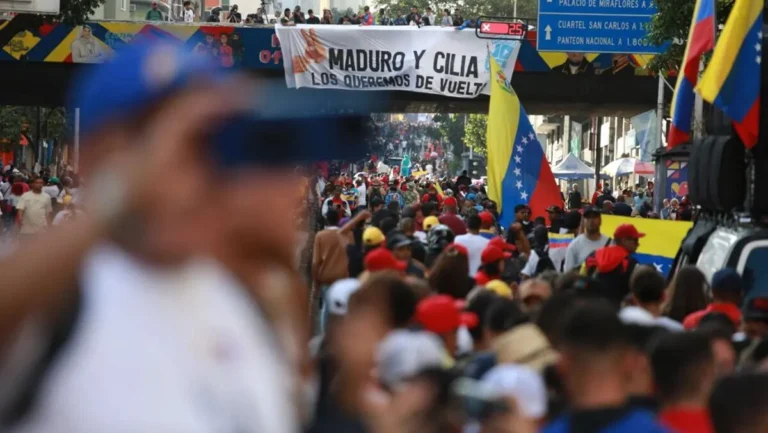
Venezuelans take to the streets in Caracas to demand the release of President Nicolas Maduro, 2026. Photo: teleSUR
February 27, 2026 Hour: 2:40 pm
🔗 Comparte este artículo
Since 1989, Venezuelans frame resistance as a continuous struggle against foreign intervention.
On Feb. 27, Venezuelans commemorate milestones that shaped the country’s history and the social transformation project known as the Bolivarian Revolution.
RELATED:
Acting President Delcy Rodriguez Demands U.S. Sanctions Lifted, Warns of Impact on Venezuelan Youth
The year 1989 marked a turning point in contemporary political history. As the Berlin Wall fell — and with it much of the framework sustaining Eastern European socialism — the world witnessed the collapse of one model and the accelerated imposition of another.
United States Refines Its Strategies of Domination
The loss of Soviet influence unleashed secessionist wars and independence movements in Czechoslovakia, Poland, Hungary and Yugoslavia, clearing the way for a new economic and military doctrine that would soon assert itself.
That doctrine was neoliberalism, programmatically expressed in what became known as “the Washington Consensus,” a package of 10 recommendations formulated by economist John Williamson for Latin American countries in crisis.
Fiscal discipline, privatizations, trade liberalization and deregulation formed the IMF and World Bank-backed prescription that promised growth through free markets.
On the military front, the U.S. abandoned the National Security Doctrine and adopted the strategy of “Low-Intensity Conflicts,” outlined in the Santa Fe I (1982) and Santa Fe II (1988) meetings.
The logic remained the same — national armies as instruments of internal order — but without the political costs of traditional coups. The 1989 invasion of Panama and the capture of President Manuel Noriega was the first practical demonstration of the new doctrine.
Paradoxically, while some proclaimed the end of history and ideology, Latin America told a different story: the left won for the first time in Montevideo, apartheid in South Africa began to crumble, the dictatorship of Augusto Pinochet entered its final phase, Central America remained volatile. And in Venezuela, the “Caracazo” erupted.
The Popular Uprising in Caracas
On Feb. 27, 1989, protests began in Guarenas after public transportation users learned of a sharp fare increase, a direct consequence of the economic adjustment program imposed by Carlos Andres Perez during his second presidency, popularly known as “El Paquetazo” or “the Great Turnaround.”
Within hours, what began as a protest over bus fares spread to Caracas, Valencia and Maracay, taking on the character of a popular insurrection that lasted until March 8.
The “Paquetazo” measures included lifting price controls, privatizations and fuel hikes — a direct application of the Washington Consensus on the country’s most vulnerable sectors.
Perez had promised to ease the crisis that had accumulated since the fall in oil prices in the 1970s, but his pledges were conditioned by an agreement with the International Monetary Fund (IMF). The public knew it, or sensed it with the clarity of those who bear the cost.
Commander Hugo Chavez summarized the meaning of those days with an unmatched precision.
“While the Berlin Wall was falling, the people of Caracas were rising up. While the world began to accept, silently and helplessly, the thesis of the only possible alternative — neoliberalism — thousands upon thousands of Venezuelans took to the streets to protest precisely against that package of measures. That popular rebellion was a rebellion against that thesis that was beginning to envelop the world.”
The right-wing government responded by declaring a state of emergency and deploying military forces in the streets. The crackdown left nearly 3,000 people dead. The Perez administration, however, only acknowledged 276.
Extrajudicial executions, forced disappearances and systematic human rights violations were documented and carried out with total impunity. The violence irreparably fractured the relationship between the Venezuelan state and society and buried the legitimacy of the two-party system known as “Puntofijismo.”
The Seed of the Bolivarian Revolution
Latin America’s revolutionary movements had a searing precedent: the 1969 Cordobazo. When Argentine workers and students took control of the city of Cordoba for three days — under a dictatorship implementing an economic model designed for the oligarchy — they demonstrated that an organized people could control their own territory.
That insurrection, the largest of its kind up to that point, not only forced the removal of Gen. Juan Carlos Ongania; it entered the theoretical texts of the continental left as an archetype of possibility, a moment when history changes direction from below.
In that lineage of popular rebellions, the Caracazo was Venezuela’s chapter, with its own geography and explosion.
“If one had to look for a birth date of the Bolivarian Revolution, one would have to look in the streets of Caracas, of Guarenas and then of Venezuela, on Feb. 27 and 28,” Chavez said.
Three years later, on Feb. 4, 1992, the civil-military uprising he led found its direct precedent in the Caracazo: it “served as a trigger for what would occur in these same streets, in this same Caracas, under this same sky.”
A second rebellion followed on Nov. 27, 1992, with the participation of civilians and military officers, including Hernan Grüber, Francisco Visconti and Luis Reyes. Chavez was imprisoned at the time but expressed his support.
The cycle closed through institutional means when President Rafael Caldera dismissed the case against Chavez in 1994. Restored to his political rights, Chavez won the 1998 election and formally began the Bolivarian Revolution.
Its root, however, remained the February 1989 insurrection: the moment when the Venezuelan people said NO to neoliberalism before the world knew how to name it.
Jan. 3: Bolivarian Resistance Against a ‘Reverse Caracazo’
For 28 years, the Bolivarian Revolution withstood coups, street protests known as “guarimbas,” terrorist attacks, economic sanctions and various forms of external pressure.
But the offensive culminating Jan. 3, 2026, represented an unprecedented escalation: the kidnapping of President Nicolas Maduro and first lady Cilia Flores, bombings on Venezuelan territory and a death toll of nearly 100 people.
The Venezuelan far right’s strategy, articulated with the Trump administration and Secretary of State Marco Rubio, sought to reproduce conditions of collapse: a paralyzed society, an overwhelmed state and a leaderless population.
Historically speaking, they sought a “reverse Caracazo” — that the Bolivarian popular base itself would fracture under the weight of aggression.
They committed the same mistake as their predecessors: underestimating what 28 years of revolution built in popular consciousness.
The response was the opposite. A majority of Venezuela’s political spectrum converged in what was perceived, across party lines, as an attack on Venezuelan sovereignty — much as the 1989 repression unified public rejection of the Perez administration.
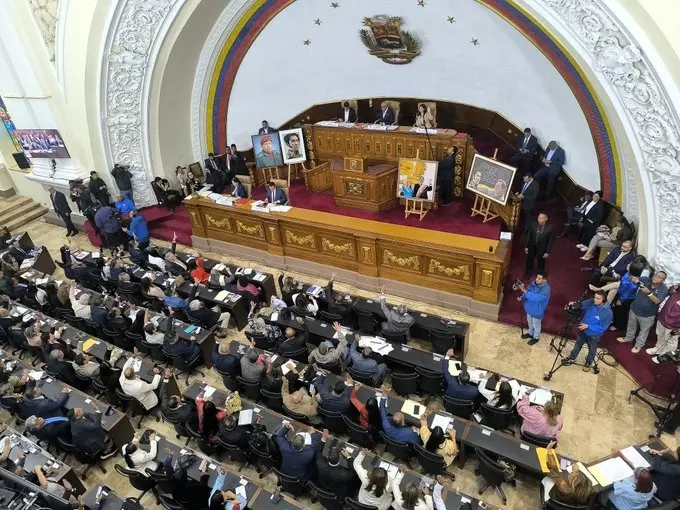
Within that framework, the Bolivarian government advanced consensus reforms such as the Hydrocarbons Law and adopted legislative measures aimed at political coexistence, including the release of some prisoners involved in attacks against the constitutional order.
The same people who rose up against neoliberalism in February 1989 now sustain the Bolivarian process in the face of foreign aggression. That continuous thread, that active memory, is what supporters say turns the Caracazo and Jan. 3 into two moments in a single history. Chavez anticipated it 21 years after the Caracazo.
“One laughs when hearing some counterrevolutionary analysts repeat that today the conditions exist for a new Caracazo. In 21 years we have taken a direction, and the Venezuelan people know they have a government that belongs to them, a project they are building and a president who will never allow the bourgeoisie to unleash its hatred against the bare chests of the heroic Venezuelan people. Never again will that happen.”
It did not happen. Transnational far-right forces expected a “Reverse Caracazo” on Jan. 3, 2026. It did not occur, marking their latest defeat.
teleSUR/ JF
Sources: VN – teleSUR