







‘Devuelta’: A Rebellion Against Consumer Society
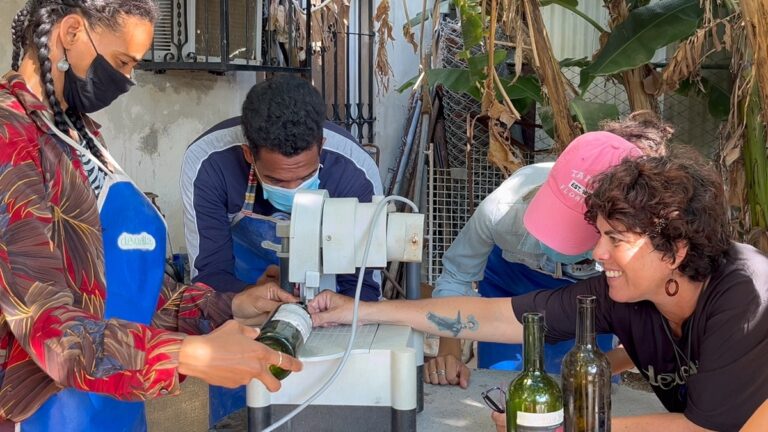
Devuelta recycling project in Havana, Cuba. Sept. 2025. Photo: teleSUR
September 18, 2025 Hour: 12:30 pm
🔗 Comparte este artículo
teleSUR’s The Cuban Way series portrays the Caribbean nation through its participatory, innovative, and grassroots projects.
We arrive at Anibex Abreu’s house with the help of her neighbors, who show us the way to her door in the middle of El Cerro neighborhood, in southern Havana. Her front yard gives us a glimpse of how everything here is the result of collective effort: glass bottles are stacked at the entrance. They are the silent donations of neighbors who save their containers so that they can become a new treasure here, at Devuelta.
RELATED:
Cuba Urges International Action to Prevent U.S. Aggression Against Venezuela
“Devuelta”, spanish for coming back around, is the name of the recycling project that Anibex runs from her home. Nurse and actress by training, she found in glass recycling a creative way to raise awareness about the harmful environmental impact that consumist society has on our planet. Those who participate in her workshops bring their empty bottles them and learn how to work the glass to turn them into new objects: glasses, cups, decorative items, or jewelry—anything their creativity can dream of.
Anibex’s commitment to recycling began at a very young age. “I used to collect bottles when I was a child,” she tells us. “I had a position in the Committee for the Defense of the Revolution that involved recovering raw materials. I would go around with a wheelbarrow knocking on doors and asking people not to throw away their bottles, so that I could recover them. My love for that, for recycling, for the environment, has always been there. It’s a latent concern and commitment.”
For Anibex, recycling has always been a community task. This conviction is reflected in her courses, where, in addition to specific techniques for cutting and polishing glass, she addresses collective consumer responsibility, the value of different materials, and the importance of salvaging objects that would otherwise end up in the trash.
“We live in a culture that normalizes consumerism: when we think that something is no longer useful it goes away. But you can transform things into something else, give them another use,” says Cuban entrepreneur Mario Calit, a participant in one of Devuelta’s workshops.
For him, the experience allows for a new relationship with the objects that surround us and fosters awareness of the impact of discarding them.
“This way, you feel that the object is a little more yours. When you start to see everything that can be done with glass, you have a little more respect when it comes to throwing it away or not.” In this sense, Anibex is categorical: “It’s a rebellion against consumer society.”
The need for higher awareness regarding the resources we use on a daily basis is present in every part of the process here. All the techniques implemented are designed to avoid not only the disposal of glass containers, but also the waste of water or electricity: nothing is squandered, everything finds a new function.
The cutting machines use residual heat to maximize energy use, and the polishing process uses a closed water circuit, recovered from the condensation produced by the AC. This logic, which runs through every moment of the workshop, is then passed on to the participants, who are responsible for continuing to build awareness in their own communities.
But Anibex is not alone in her commitment to the planet. Young people come to her workshops with their own ecological initiatives, eager to learn new techniques that enable them to continue expanding a more environmentally friendly way of life.
“What excited us most was coming here to learn this technique and then going home to give new life to everything we have collected,” says Taybel Balmaceda, a workshop participant and leader of another ecological initiative based in Havana. In this way, joint efforts help build an ever growing network, driven by a generation that was raised in a time of climate crisis and is therefore more eager to be part of the solution.
This is how Betsy Claudia Santos, another young workshop participant, explains it: “I want to learn this technique to add to the construction of my home. And also to pass on the idea to people who might be interested, so they know that you don’t need to buy one of these beautiful skylights in the store, that they can be made with bottles.”
While Anibex helps some of the girls polish their pieces, Betsy makes progress cutting her bottle, under the watchful gaze and encouragement of her peers. When she returns with her piece, a clean cut through the glass, everyone stops to celebrate her skill: it’s her first time using the cutting machine and the result is excellent.
Encouraging collaboration among all participants is one of Devuelta’s key objectives: building a space for shared creation, as a symbol of the joint effort that must be made to face the problems of today’s world.
“I emphasize this a lot here. The need to come together, to do something together. It’s important that I care about what you’re doing and get involved so that you can do better. In the end, glass is just a pretext for doing something together,” says Anibex.
teleSUR/ Belen de los Santos
Source: teleSUR