


Cuba Denounces U.S. Energy Blockade at UN, Warns of Humanitarian Catastrophe
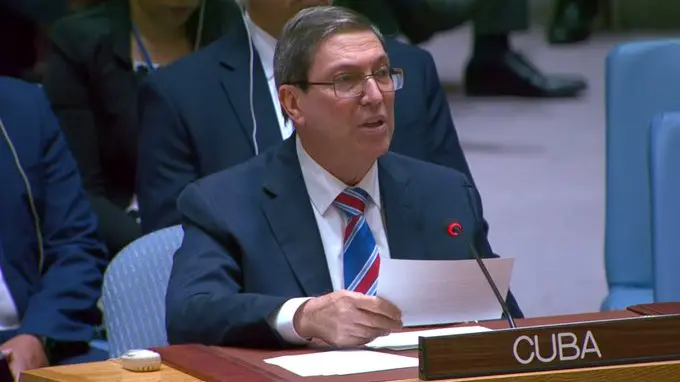
Cuban FM Bruno Rodríguez criticized that a “corrupt and immoral plutocracy” uses the Cuban Government’s “legend of incompetence and alleged corruption” to justify foreign intervention against the Caribbean country. Photo: X/@BrunoRguezP.
May 26, 2026 Hour: 8:57 pm
🔗 Comparte este artículo
Cuba’s Foreign Minister on tuesday issued a stark warning before the UN Security Council in New York, cautioning about the potential for a humanitarian catastrophe on the island if the United States persists in its aggressive policies.
During his impassioned intervention, FM Rodríguez urgently implored the international community to mobilize and intervene to prevent such a devastating outcome. He vehemently emphasized that the U.S. coercive measures “kill and cause suffering” to people, directly linking these policies to severe human cost and widespread hardship.
Speaking within the debate on “the defense of the purposes and principles of the United Nations Charter and the strengthening of the international system centered on the UN“, the Cuban Foreign Minister issued a grave warning: should the United States order a military attack against Cuba, they would “go down in history as war criminals.” This strong language highlights Havana’s deep concern over potential military intervention and its commitment to defending its sovereignty by all means.
RELATED: Cuba Questions European Union’s Lack of Objectivity Regarding U.S. Sanctions
Bruno Rodríguez’s address underscored the profound and escalating risks faced by the Caribbean nation due to sustained unilateral coercive measures, which he argued directly undermine the well-being of the Cuban people.
Continuing in this vein, FM Rodríguez unequivocally asserted that “no justification whatsoever can be wielded for aggression or inhumane coercive acts.” He directly appealed to the United States, demanding “leave Cuba to live in peace.”
The Foreign Minister adamantly dismissed the U.S. argument that the Caribbean country poses a national security threat to the “nuclear superpower“, categorizing such a claim as both “absurd and mendacious.” This rejection of Washington’s rationale underscores Cuba’s consistent position that it harbors no hostile intentions towards its northern neighbor, despite the historical and ongoing political tensions that have defined their relationship.
Rodríguez further reinforced Cuba’s peaceful stance by quoting the President Miguel Díaz-Canel, who has repeatedly affirmed that “Cuba is not and cannot be a threat” and that it “is not an enemy of the United States nor does it wish to be one“, notwithstanding the profound ideological and political differences that exist between their respective Governments. This reiteration from the highest levels of the Cuban Government serves to project an image of a nation seeking respectful coexistence, despite enduring decades of hostile policies and an economic blockade.
The consistent message from Havana aims to counter narratives of aggression and to foster an environment where bilateral issues can be addressed through diplomatic, rather than confrontational, means.
Oil Sanctions As Act of Genocide
Furthermore, FM Bruno Rodríguez denounced the energy blockade imposed by the United States, characterizing it as an “act of war and genocide”, arguing that this blockade subjects the Cuban people to conditions that severely threaten their existence.
The devastating human cost of this policy was starkly illustrated with precise figures: the infant mortality rate has reportedly doubled from 4 to 9.2 per 1,000 live births, while the life expectancy for children suffering from cancer has dramatically reduced from 85 to 65%. These harrowing statistics paint a grim picture of the humanitarian impact, directly linking U.S. sanctions to tragic health outcomes and underscoring Cuba’s assertion that the blockade constitutes a grave violation of Human Rights and international humanitarian law.
The focus on these specific health metrics provides concrete evidence of the blockade’s severe and life-threatening consequences for the most vulnerable segments of the Cuban people, especially its children.
Cuban Sovereignty to Be Defended
Reaffirming the critical importance of respecting international law and basic norms in international relations as a means to prevent new conflicts, Rodríguez issued a dire warning. He cautioned that a “military aggression against Cuba” would “provoke a bloodbath,” leading to thousands of Cubans dying in defense of their homeland.
“Let no one doubt that at a moment we hope never occurs, the people of Cuba will fight to the ultimate consequences“, Rodríguez declared, echoing a profound national resolve and determination to defend its socialist project and sovereignty against any external threat.
Simultaneously, he predicted that such an aggression would drag thousands of young U.S. people into violence, driven by what he termed an “imperialist, neo-fascist policy of domination, plunder, and conquest.” This stark warning underscores Cuba’s determination to defend its sovereignty at any cost, while simultaneously appealing to a sense of shared humanity and a rejection of militarism, particularly among U.S. citizens who might be impacted by such an intervention.
In a special appeal, FM Rodríguez addressed U.S. citizens, particularly their youth, invoking their human values and pacifist sentiments. He urged them to seek the truth and resist manipulation by what he described as an “elitist, corrupted and powerful clique in Miami.” According to the Cuban diplomat, this faction does not represent the U.S. people nor the majority of Cubans residing in the United States, many of whom reportedly oppose the “barbarity of war and the blockade.”
People-to-People Seeked
Despite the U.S. Government policies, the head of the Ministry of Foreign Affairs underscored the “deep and fraternal ties with the U.S. people and culture“, distinguishing between the policies of the U.S. Government and the genuine sentiments of its citizens. He affirmed that Cuba would continue to warmly receive U.S. travelers and businesspeople, regardless of the restrictive measures imposed by their own Government. This commitment to maintaining people-to-people connections illustrates Cuba’s enduring belief in the power of cultural exchange and direct engagement to bridge political divides.
Bruno Rodríguez launched a scathing critique, condemning what he termed a “corrupt and immoral plutocracy” for exploiting the “legend of the incompetence and supposed corruption” of the Cuban Government to justify foreign intervention. He denounced the “executioner” for inflicting “devastating effects” through its actions, directly attributing the suffering of the Cuban people to U.S. policies. This powerful accusation challenges the moral authority of the U.S. to dictate terms or intervene in Cuba’s internal affairs, framing the ongoing blockade as a deliberate act of cruelty rather than a legitimate foreign policy tool.
Despite the documented lack of progress and good faith exhibited by the United States, Cuba maintains its unwavering willingness to continue conversations aimed at addressing bilateral problems without any interference in its internal affairs.
The Foreign Minister specifically highlighted several areas of potential cooperation between the two nations, including the critical fight against terrorism, drug trafficking, organized transnational crime, and other shared challenges, prioritizing regional stability and collective security over ideological rigidity, provided its sovereignty is respected.
Author: Laura V. Mor