


Correa: The Oligarchy And the U.S. Prop Up Noboa While Voters Say ‘NO’
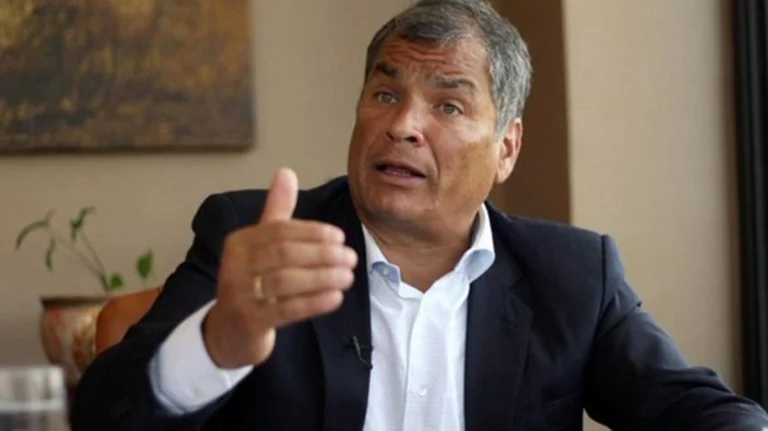
Rafael Correa. X/ @brasil247
November 17, 2025 Hour: 2:45 pm
🔗 Comparte este artículo
In an interview with teleSUR on Monday, Ecuadorian former President Rafael Correa interpreted the result of the popular consultation held on November 16 as an unequivocal sign of public rejection of Daniel Noboa’s administration.
RELATED:
Ecuador’s Noboa Accepts Defeat in Referendum, All Proposes Were Denied
For the leader of the Citizen Revolution movement, the verdict at the polls represents a turning point that calls into question the political legitimacy of the Noboa administration and reshapes the balance of forces in the months ahead.
A plebiscite read as a rejection of the government’s agenda
Correa framed the consultation as a referendum on the administration’s performance and priorities. In his view, the electorate “became the staunchest opponent” of what he describes as “privatizing and giveaway schemes.”
“How do you explain that, after an ‘overwhelming’ presidential victory, you then suffer an overwhelming defeat in a popular consultation?” he asked, alluding to an alleged dissonance between previous electoral results and Sunday’s outcome.
According to the former head of state, the citizens’ verdict not only disavows the Executive’s initiatives, but also lays bare the president’s political erosion less than a year after taking office.
Fraud and pillars of power
Correa also argued that the result of the popular consultation reinforces the thesis that the current president was elected through a fraudulent process in 2024.
“How can you explain that, seven months after having ‘won overwhelmingly’ the presidential election, you then lose overwhelmingly—and without quotes—a popular consultation? It’s obvious he never had the percentage shown by the official results on April 13 and that it was all a fraud. Everybody knows there was fraud. The debate is how they did it,” he stressed.
He also accused the oligarchy, “certain leadership circles—military and religious,” and the United States of being the pillars that, in his view, keep Daniel Noboa’s government afloat.
Correa warned that, in a context of manipulation and dishonesty on the part of the current government, citizens responded at the polls with a punishment vote.
“When you’re in those circumstances, even when faced with obvious questions, the answer is no, because the manipulative government is being rejected,” he said.
The 2008 Constitution, “the big winner”
Another focus of his remarks was the defense of the 2008 Constitution. Correa maintained that the consultation ultimately reaffirmed that constitutional framework, approved 17 years ago, which he described as “one of the most advanced charters” and “a framework for Buen Vivir.”
“The big winner is the 2008 Constitution,” he emphasized, attributing the result to a rejection of attempts to “privatize and auction off the country,” he added.
The former president recalled that Ecuador has gone through a history of institutional instability with “more than 20 constitutions in 200 years,” but noted that the Montecristi Constitution remains the prevailing point of reference.
Recall of the mandate: an option on the table
Correa also proposed the recall of the mandate as a legitimate institutional path if the government’s deterioration deepens.
“Our Constitution allows it,” he stressed, while acknowledging that any such process would face the influence of “the media, economic power,” and international backing.
He described the current government as “a disaster” and argued that there is fraud “when the governing program is betrayed.”
Political implications and immediate outlook
Correa’s assessment suggests three immediate effects: political weakening of the Executive, strengthening of the bloc that supports the 2008 Constitution, and a reactivation of the debate over mechanisms of democratic oversight, including recall.
In the short term, a battle of narratives is anticipated over the meaning of the result and the legislative agenda that flows from it.
Correa’s reading frames the referendum as a watershed for Daniel Noboa’s government: a setback that calls his political capital into question and rekindles discussion about the legitimacy of his mandate.
In parallel, it reasserts the centrality of the 2008 Constitution as an overarching framework of consensus. The focus now shifts to the Executive’s response, the ability of political actors to process the message from the ballot box, and the evolution of social pressures regarding the Noboa government’s neoliberal bent, which could shape Ecuador’s political trajectory.
Author: Manuel F. Díaz
Source: teleSUR