







Brazil and China Reinforced Support for the Global South
Foreign Minister of Brazil, Mauro Vieira, met with the vice president and the commerce minister to discuss WTO reform and bilateral partnership.
teleSUR.
June 3, 2026 Hour: 2:13 pm
🔗 Comparte este artículo
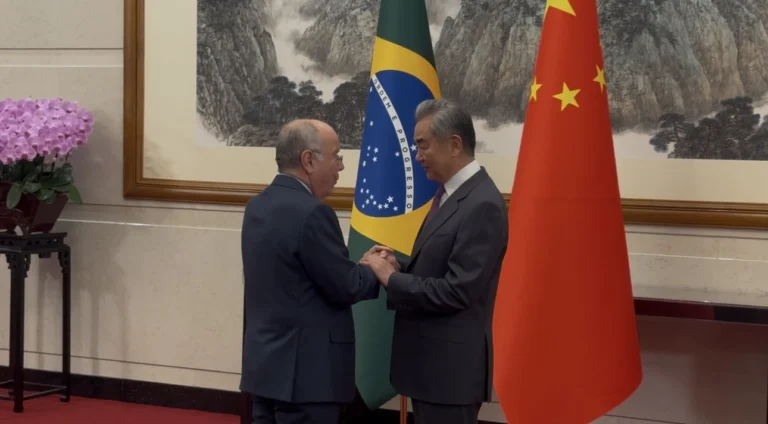
In Beijing, between May 31 and June 2, 2026, Brazil’s Minister of Foreign Affairs, Mauro Vieira, carried out a three-day agenda of meetings with Chinese authorities within the framework of the fifth edition of the Global Strategic Dialogue between the two countries.
The program included high-level meetings at the Great Hall of the People and the Diaoyutai complex, two of the main venues of Chinese diplomacy, marking a new stage of political coordination between Brasília and Beijing.
The visit took place at a time of consolidation of the Sino-Brazilian partnership as one of the main axes of Global South coordination, with Brazil maintaining China as its largest trading partner for more than a decade and an annual exchange exceeding 150 billion dollars.
The talks addressed political coordination between the two countries, the expansion of bilateral trade, the strengthening of multilateralism, and their joint role in promoting reforms in global governance, including discussions in forums such as the United Nations (UN), the BRICS, and the World Trade Organization (WTO).
The central point of the agenda was the Global Strategic Dialogue between the foreign ministries, co-chaired by Mauro Vieira and his Chinese counterpart Wang Yi, as well as bilateral meetings with Chinese Vice President Han Zheng and Minister of Commerce Wang Wentao, consolidating a round of high-level political dialogue amid the reconfiguration of international relations.
China and Brazil have responsibility in the Global South
At the Diaoyutai complex in Beijing, Mauro Vieira and Wang Yi co-chaired the fifth edition of the Global Strategic Dialogue between Brazil and China, the main commitment of the Brazilian foreign minister’s visit.
Wang Yi stated that “cooperation between China and Brazil has solid foundations” and emphasized that the partnership is not limited to the economic field, but is also advancing in technology and innovation, alongside growing people-to-people exchanges between the two countries.
The Chinese foreign minister also stressed that Brazil and China “have demonstrated responsibility in defending the interests of the Global South and multilateralism,” positioning both as key actors in the construction of a more multipolar international order.
Wang Yi also thanked Brazil for its commitment to the One China principle and advocated strengthening coordination between the two countries in multilateral mechanisms such as the UN and BRICS, arguing that Brazil and China can contribute to reforms in global governance and to greater participation of developing countries in international decision-making processes.
He added that the strategic dialogue should contribute to deepening coordination between the two countries and maintaining the positive trajectory of bilateral relations, reinforcing common understanding on key issues of the international agenda.
Wang Yi also highlighted the importance of expanding exchanges in areas such as culture, education, tourism, youth, sports, and media, as well as preparations for the China–Brazil Cultural Year in 2026.
He further stated that Beijing seeks to deepen its cooperation with Latin America and the Caribbean, with Brazil as one of its main partners in the region.
On his part, Mauro Vieira emphasized that the bilateral relationship was not episodic, but part of a continuous process of political deepening.
The minister stated that cooperation between the two countries “has been developing significantly in recent years, becoming a close and fundamental partnership in Brazil’s international relations,” highlighting its structural nature.
Vieira also recalled the recent historical dimension of the rapprochement, mentioning his participation in President Luiz Inácio Lula da Silva’s state visits to China in 2022 and 2023, a period that, according to him, reflects a high level of political coordination.
According to the minister, “the regularity of contacts between our presidents, with three state visits in three years, illustrates the highest level of trust and mutual respect between our countries.”
The Brazilian foreign minister further added that the elevation of the relationship to the Brazil–China Community with a Shared Future for a more just and sustainable world places the partnership in a long-term agenda that, in his words, “is more relevant than ever amid current international turbulence.”
Vieira also reaffirmed Brazil’s historic commitment to the One China principle and stressed that both countries share positions in defense of multilateralism, free trade, and reforms in global governance that expand the participation of developing countries and strengthen the role of the United Nations.
New Phase of Strategic Cooperation Between China and Brazil
Before the meeting between the foreign ministers, Mauro Vieira was received by Chinese Vice President Han Zheng at the Great Hall of the People in Beijing, located at the western end of Tiananmen Square and one of the main centers of China’s institutional political power, where the National People’s Congress and central government meetings are held.
The meeting marked the official opening of the visit and focused on strengthening political coordination between both governments, amid intensified bilateral dialogue and expanding cooperation in different areas.
Han Zheng highlighted the current moment of rapprochement between Brazil and China and stated that the visit contributed to “strengthening strategic cooperation under the new international circumstances,” as well as promoting the continuous development of bilateral relations.
He also stated that the meeting aimed to “implement the important consensuses reached by the heads of state of both countries,” reinforcing mutual understanding between Beijing and Brasília.
The Chinese vice president also stressed that one of the central tasks of the visit was the fifth edition of the Global Strategic Dialogue between the two foreign ministers, saying the meeting should open the way to “a new phase of strategic cooperation between China and Brazil,” maintaining the positive momentum of bilateral relations.
The meeting took place in a context of greater coordination among Global South countries and efforts to achieve a more balanced international governance system, especially in multilateral forums such as BRICS, where China and Brazil act jointly in advocating reforms in the global economic and political order.
On the Brazilian side, Mauro Vieira stated that relations between the two countries have deepened consistently in recent years, with strong political and diplomatic density.
The minister emphasized that the partnership “has been developing significantly in recent years, becoming a close and fundamental partnership in Brazil’s international relations.”
Vieira also stressed the continuity of high-level dialogue between the two leaderships, recalling his participation in President Lula’s state visits.
He further added that the elevation of the relationship to the Brazil–China Community with a Shared Future for a more just and sustainable world makes the partnership “more relevant than ever amid current international turbulence.”
Vieira also reiterated the invitation extended by Vice President Geraldo Alckmin for the Chinese vice president to visit Brazil, including the proposal for the eighth Brazil–China High-Level Commission for Consultation and Cooperation (COSBAN), scheduled for 2026, reinforcing the long-term institutionalization of bilateral ties.
Deepening Economic Agenda and WTO Reform
In the continuation of the Beijing agenda, Brazil’s Foreign Minister Mauro Vieira met with China’s Minister of Commerce Wang Wentao in a meeting focused on deepening the bilateral economic agenda.
The discussions centered on expanding and diversifying trade between the two countries, which currently exceeds 160 billion dollars annually, with China having been Brazil’s largest trading partner for more than a decade.
Trade flows remain heavily concentrated in Brazilian exports of commodities such as soybeans, iron ore, and oil, while Brazil mainly imports manufactured goods, machinery, and higher value-added products, maintaining a structurally asymmetrical relationship.
Both sides also discussed ways to diversify Brazil’s export basket and increase the value added of its exports, in a context of restructuring global supply chains and growing competition for strategic markets.
Another topic addressed was the functioning of the multilateral trading system, with emphasis on the need for reforms in the World Trade Organization (WTO), amid challenges in the dispute settlement system and rising tensions in international trade rules.
Author: Bruno Falci
Source: teleSUR