Xi Jinping: Taiwan Reunification is CPC’s Historic Mission
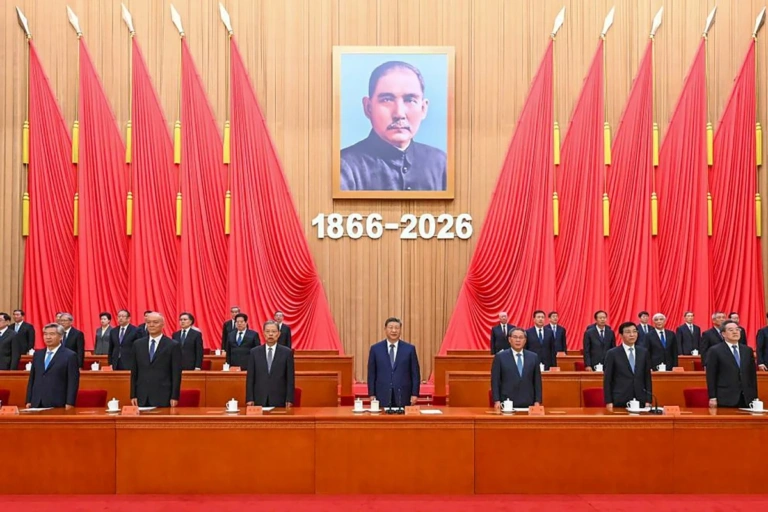
The ceremony honoring Sun Yat-sen, held on Thursday at the Great Hall of the People, was attended by the entire top leadership of China. Photo: Xinhua.
November 12, 2026 Hour: 4:11 pm
🔗 Comparte este artículo
At a ceremony marking the 160th anniversary of Sun Yat-sen’s birth, the Chinese President Xi Jinping invoked the revolutionary leader’s legacy to defend national unity, modernization and China’s national rejuvenation.
Chinese President Xi Jinping said on Thursday (12) that the reunification of Taiwan is an unshakable historical mission of the Communist Party of China (CPC), a shared aspiration of the Chinese people and a requirement for the great rejuvenation of the Chinese nation.
He made the statement during a ceremony marking the 160th anniversary of Sun Yat-sen’s birth, held at the Great Hall of the People in Beijing.
RELATED: Without the Communist Party, There Would Be No New China: Xi Jinping
“Resolving the Taiwan question and achieving the complete reunification of the motherland is an unshakable historical mission of the Communist Party of China, a shared aspiration of all the sons and daughters of the Chinese nation, and an inevitable requirement for the great rejuvenation of the Chinese nation,” Xi said.
Throughout his speech, the President revisited different moments in China’s political history and drew on Sun’s ideas to establish a link between the struggles to transform the country in the early 20th century and the current modernization project. Sovereignty, economic development, improving people’s living standards, national unity and contributions to humanity were among the issues addressed.
Around 3,000 people attended the ceremony, including Party and state leaders, representatives of social organizations, members of Sun Yat-sen’s family, foreign diplomats and guests from different sectors of Chinese society. The event was chaired by Wang Huning and attended by members of the Standing Committee of the Political Bureau of the CPC Central Committee.
Xi described Sun as a great national hero, patriot and pioneer of China’s Democratic Revolution. He structured his tribute around different aspects of the revolutionary leader’s legacy: patriotism, commitment to the people, the pursuit of truth, perseverance, national unity and an international outlook.
Sun Yat-sen and the Struggle to Transform China
Born in 1866, Sun Yat-sen was one of the leading figures in modern Chinese political history. He led the 1911 Revolution, which overthrew the Qing dynasty and brought the imperial system to an end. The movement paved the way for the founding of the Republic of China in 1912, of which Sun became the first provisional president.
Xi recalled that Sun devoted around four decades to the revolutionary cause, during a period marked by aggression from foreign powers and the crisis of the imperial system. The Chinese people, the President stressed, resisted external pressure and sought ways to transform the country.
“Faced with a country torn apart and turbulent times, the heroic Chinese people never submitted. Countless men and women of lofty ideals rose up to resist and tirelessly sought ways to save the country and its people. Sun Yat-sen was one of the most outstanding representatives of that generation,” Xi said.
The President described the revolutionary leader as “a great national hero, a great patriot and a great pioneer of China’s Democratic Revolution.” He also highlighted the formulation of the Three Principles of the People -nationalism, people’s rights and people’s livelihood- and the slogan “Revitalize China,” which inspired successive generations.
The 1911 Revolution overthrew the monarchy and paved the way for Asia’s first republic. Xi also recalled the influence of the October Revolution and Marxism-Leninism on Sun’s political thinking. With the help of the Communist Party of China, the leader developed the original Three Principles of the People into a new formulation and adopted three policies: alliance with the Soviet Union, cooperation with the CPC, and support for workers and peasants.
The reorganization of the Kuomintang and preparations for the Northern Expedition were also part of the historical review. The campaign advanced the struggle against imperialism and feudalism and later achieved victory. Sun, however, died in 1925, before the offensive began in 1926.
CPC: Continuation of National Rejuvenation Project
The relationship between Sun Yat-sen and the Communist Party of China featured prominently in the tribute. Xi presented Chinese communists as continuators of the leader’s revolutionary cause and linked that historical trajectory to the political, economic and social transformations the country has undergone over the past century.
“Chinese communists are the staunchest supporters, most loyal collaborators and most faithful heirs of Mr. Sun Yat-sen’s revolutionary cause,” he said.
The President reviewed different stages in the Party’s history: the New Democratic Revolution, the socialist revolution and construction, reform and opening-up, and socialism with Chinese characteristics in the new era. Under the CPC’s leadership, he said, the Chinese people had achieved accomplishments that represent a historic transformation of the country.
The speech also revisited the development plans presented by Sun in his work The International Development of China. The revolutionary leader envisioned an extensive infrastructure network, including railways, highways, communication systems, water conservancy projects, canals, ports and industrial facilities.
According to Xi, many of these projects not only became reality but were carried out on a scale even greater than Sun had envisaged. To illustrate the extent of the changes, the President highlighted China’s position as the world’s second-largest economy and the improvement in people’s living standards.
“Today, our great motherland stands tall in the East. Its economy firmly ranks second in the world, the people have achieved moderate prosperity in all respects, and the Chinese nation has made the great historic leap from standing up and growing prosperous to becoming strong. We are continuously contributing to the development and progress of human society,” Xi said.
In the President’s view, the country’s achievements also represent a tribute to Sun’s legacy. The best way to remember the revolutionary leader, he argued, is to preserve and develop his spirit, continuing the work of building a strong country and achieving national rejuvenation.
Patriotism, People and Common Prosperity
The defense of sovereignty and the responsibility of the Chinese people themselves for transforming the country were among the aspects of Sun’s patriotism highlighted by Xi. The President recalled that the revolutionary leader was willing to devote his own life to the struggle for the motherland and considered love for the country one of every citizen’s greatest responsibilities.
Sun also maintained that China’s development should remain under the control of the Chinese people themselves. Among the statements recalled by Xi was the following: “The right to development, when in our own hands, survives; when in the hands of others, it perishes.” The President also recalled the revolutionary leader’s conviction that saving China was a responsibility that rested entirely with the Chinese people.
Xi linked this thinking to current political guidelines, advocating unity between patriotism, love for the Party and love for socialism.
“We must uphold the unity of patriotism, love for the Party and love for socialism, uphold the Party’s overall leadership and the Central Committee’s centralized and unified leadership, strengthen confidence in the path, theory, system and culture of socialism with Chinese characteristics, and encourage all the sons and daughters of the Chinese nation, both at home and abroad, to deepen their patriotic sentiments and strengthen their determination to build a powerful country,” he said.
The social dimension of the revolution was another point of connection between Sun’s thinking and Xi’s speech. The historical leader regarded the people as the foundation of the state, placed their happiness among the objectives of politics and understood revolutionary transformation as a path toward eliminating social suffering.
Xi recalled a statement by Sun on the responsibility of public authorities toward people’s needs: “What the people cannot do, we must do for them; the rights the people do not possess, we must fight to secure.”
The Three Principles of the People were also linked to the population’s well-being. Sun advocated equalizing land rights and regulating capital as ways to address economic inequalities. His objective, Xi recalled, was to enable everyone to enjoy “equal economic well-being, without the problem of inequalities.”
The President linked this concern for people’s material conditions to China’s current development approach, emphasizing improved living standards and the distribution of the benefits of modernization.
“We must remember that the country is the people and the people are the country, uphold the people-centered position, understand the people’s aspirations, respect their creativity and pool their wisdom. We must develop whole-process people’s democracy, safeguard and improve people’s livelihoods, ensure that the fruits of modernization benefit the entire population more extensively and more fairly, and promote solid progress in human development and common prosperity,” Xi said.
RELATED: Cuba and China Boost Economic Cooperation and New Commercial Opportunities
Perseverance, the Pursuit of Truth and National Unity
Sun Yat-sen’s life was marked by defeats and obstacles, but also by his determination to continue the struggle. Xi recalled a statement by the revolutionary leader that encapsulates this resolve: “My determination is to move forward without hesitation; the greater the setbacks, the stronger my resolve, and I will continue to fight.” He also recalled Sun’s final words, “Peace, struggle, save China,” as an expression of his commitment to transforming the country until the end of his life.
The President linked this perseverance to the challenges facing contemporary China. He called for coordination between development and security and for the ability to confront pressure and risks.
“We must coordinate the domestic and international situations, as well as development and security; promote a fighting spirit and strengthen our ability to face challenges. We will fear no difficulties and submit to no enemy. We must be prepared to face major tests, with strong winds, rough seas and even storms, overcome the risks and challenges that arise along our path, and achieve new victories,” he said.
The pursuit of knowledge and truth also emerged as part of Sun’s legacy. According to Xi, the revolutionary leader sought to follow global transformations and respond to the needs of his time. Among his convictions was the belief that the success of the revolution required a transformation in thinking.
Linking this idea to contemporary experience, the President advocated combining the fundamental principles of Marxism with China’s specific realities and its traditional culture. The Party calls this process the “two integrations.”
“We must persist in combining the fundamental principles of Marxism with China’s specific realities and its fine traditional culture, have the courage to explore and innovate theoretically, and provide scientific answers to the questions of China, the world, the people and our times,” Xi said.
Popular mobilization and the building of national unity completed this set of references. The President recalled Sun’s assertion that “the revolutionary cause is initiated by the masses and also accomplished by the masses,” as well as his efforts to mobilize the population and Chinese people living abroad.
Xi also cited another statement by the revolutionary leader on the need to unite forces around common goals: “Unite in step, giving priority to the country’s long-term interests, and fight with determination.”
This principle was linked to the defense of the patriotic united front and unity among political parties, ethnic groups, religious communities, different social sectors and Chinese people at home and abroad. Xi called for mobilizing all possible forces to advance China’s modernization.
Taiwan and Reunification as a Historic Mission
The defense of China’s territorial unity was one of the central themes of the tribute to Sun. Xi recalled that the revolutionary leader opposed initiatives to divide the country and regarded national integrity as an aspiration shared by the entire population.
The President cited Sun’s statement that “China is a unified country” and his willingness to use all the political influence he possessed to work toward national unity. It was through this legacy that Xi linked the Taiwan question to China’s contemporary national rejuvenation project.
According to the President, people on both sides of the Taiwan Strait are Chinese and belong to the same family, united by historical and cultural ties. He therefore advocated deeper exchanges and integration between the two sides, with the aim of improving people’s well-being.
“Compatriots on both sides of the Strait are Chinese, members of the same family bound by blood. When members of a family talk openly and consult one another about their affairs, there are no differences that cannot be resolved,” Xi said.
The President reiterated Beijing’s position in favor of peaceful reunification under the “one country, two systems” framework. He also stated that the Chinese government is willing to maintain dialogue and consultations on cross-Strait relations and national reunification with figures from different sectors in Taiwan, on the basis of the One-China principle and the 1992 Consensus.
Xi said Chinese authorities would take into account Taiwan’s realities and the interests and feelings of its population, but stressed that there would be no room for separatist activities advocating Taiwan independence.
“Taiwan’s future lies in national reunification, and the interests and well-being of our compatriots in Taiwan are linked to the great rejuvenation of the Chinese nation,” he said. Xi called on Chinese people on both sides of the Strait and those living abroad to unite against separatist forces and work for peace and the development of relations between the two sides.
Concluding his remarks on Taiwan, the President said: “The tide of history cannot be stopped. The complete reunification of the motherland must be achieved and will certainly be achieved.”
Beijing’s position is rejected by Taiwan’s authorities. In response to the proposal for reunification under the “one country, two systems” framework, Taiwan’s Mainland Affairs Council said the model would mean submission to the government of the Communist Party of China. Reuters reported that Xi did not mention the possible use of force during his speech. Beijing, however, has not formally renounced that possibility.
The International Vision and the New Long March
Sun Yat-sen’s thinking also had an international dimension. Xi emphasized that the revolutionary leader linked China’s development to the future of humanity and believed that strengthening the country should represent a contribution to the world.
According to the President, Sun believed that a strong China would have great responsibilities toward the international community and that the country’s transformation could open the way to a brighter future for all humanity.
Xi recalled the traditional Chinese expression Tianxia weigong, translated as “the world for the common good,” as an ideal of human progress. He also mentioned Sun’s advocacy of openness and exchanges between civilizations, without China having to reproduce the historical paths taken by Western powers.
The President linked this vision to the promotion of the common values of humanity -peace, development, equity, justice, democracy and freedom- and the building of a community with a shared future for humanity.
“We must always view the future and destiny of humanity from a global perspective, understand and properly handle our relations with the outside world in light of the major trends in human development, changes in the international situation and the long history of China’s development, promote the common values of all humanity –peace, development, equity, justice, democracy and freedom- and advance the implementation of the four global initiatives, contributing China’s efforts to building a community with a shared future for humanity,” he said.
In his conclusion, Xi presented Chinese modernization as the path toward realizing the ideal of “Revitalize China,” put forward by Sun Yat-sen more than a century ago. The President compared the current process of building a strong country and achieving national rejuvenation to a new Long March.
“Advancing the all-round building of a strong country and the great rejuvenation of the nation through Chinese modernization is the new Long March of the Communist Party of China and the Chinese people, as well as the necessary path to realizing Sun Yat-sen’s ideal of ‘Revitalize China’,” Xi said.
Xi concluded his speech by calling on Chinese people living in the country and abroad to unite around this project and carry forward the revolutionary leader’s legacy.
“I call on all the sons and daughters of the Chinese nation, both at home and abroad, to unite even more closely, carry forward Sun Yat-sen’s legacy and work together to advance the great rejuvenation of the Chinese nation, turning into reality the great dreams for which the country’s various ethnic groups have struggled since modern times,” he said.
Author: Bruno Falci
Source: teleSUR