World Media Summit Tackles AI and Global News Standards
Around 500 delegates from 112 countries gathered in Beijing for the 7th World Media Summit to discuss artificial intelligence, misinformation and international media cooperation. Expected outcomes include initiatives on AI governance and global media standards.
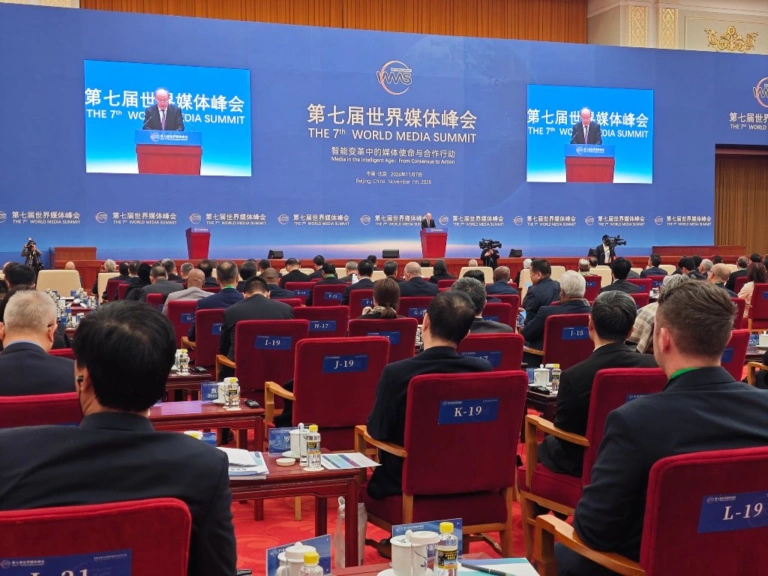
Delegates discuss artificial intelligence and the future of global media at the 7th World Media Summit in Beijing. Photo: Prensa Latina
November 7, 2026 Hour: 1:30 am
🔗 Comparte este artículo
Around 500 delegates from 112 countries discuss artificial intelligence, misinformation and international media cooperation.
The 7th World Media Summit opened in Beijing on Friday, bringing together around 500 delegates from approximately 330 media organizations, think tanks and institutions across 112 countries to discuss artificial intelligence, misinformation and the future of global communication.
RELATED: China and Oman Sign Historic Bilateral Deals After Beijing Summit
Hosted by China’s Xinhua News Agency and the Beijing municipal government, the summit comes as artificial intelligence reshapes media production and raises questions about technological access, information governance and international cooperation.
Representatives from Cuba’s Prensa Latina, Juventud Rebelde and Ideas Multimedios, as well as Venezuela’s teleSUR, are among the participants. Delegations also include Iraqi Media Network, Japanese media organizations and representatives from several Gulf countries.
Text Reads: 📰 This Friday, the Chinese capital welcomed approximately 500 representatives from 330 media outlets, think tanks, and institutions for the seventh edition of the World Media Summit—the largest gathering of its kind in the sector to date.
🤝 Cuba is represented by Prensa Latina, Juventud Rebelde, and Ideas Multimedios; teleSUR is in attendance for Venezuela, and the Iraqi Media Network for Iraq. The delegation also includes media outlets from Japan and nations of the Persian Gulf, with the state news agency Xinhua and the Beijing municipal government serving as hosts.
🤖 The event coincides with the 95th anniversary of Xinhua and has brought to the forefront discussions on the impact of artificial intelligence, the reconfiguration of the information ecosystem, and the need for cooperation in the face of cognitive warfare and “fake news”—both of which are used as tools for destabilization against sovereign nations.
Discussions focus on developing AI applications for newsrooms, sharing technological resources and narrowing the digital divide between developed countries and the Global South, which has historically had limited control over digital platforms, satellites, cables and algorithms.
Delegates are also examining how media organizations can strengthen international cooperation through information sharing, fact-checking and efforts to counter misinformation.
AI governance is another central theme, with participants discussing algorithmic transparency, data security, content traceability and the development of international standards for the technology.
The summit also explores how emerging technologies can foster dialogue between civilizations, preserve cultural diversity and strengthen exchanges among peoples.
Organizers have highlighted the role of media in promoting a safer international environment through information sharing, verification and cooperation against disinformation.
The gathering coincides with the 95th anniversary of Xinhua’s founding. Its agenda also includes presentations on China’s modernization, focusing on Beijing’s urban development, heritage preservation and green growth.
Expected outcomes include the Beijing Consensus of the 7th World Media Summit, the 2026 report on artificial intelligence and global media development, the launch of a biomimetic humanoid presenter and the Xinhua Dictionary AI Agent. Organizers also plan to launch a Global Media Initiative aimed at establishing common standards for artificial intelligence.