







Venezuela-EU High-Level Delegation Meet to Strengthen Bilateral Cooperation
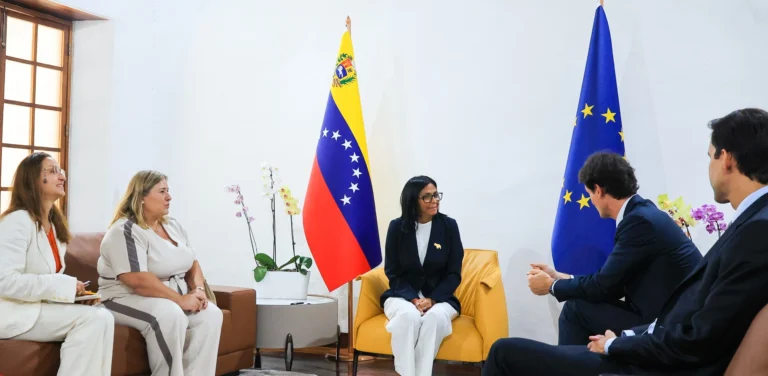
The meeting had as main objective to discuss strategies to strengthen bilateral cooperation and lay the foundations for a new stage of productive relations. Photo: EFE.
April 15, 2026 Hour: 8:43 pm
🔗 Comparte este artículo
Venezuela’s Acting President Delcy Rodríguez met today with a high-level delegation from the European Union and the European External Action Service in Caracas, aiming to strengthen bilateral cooperation and initiate a new phase of productive relations.
Venezuela’s Acting President Delcy Rodríguez held a pivotal meeting on April 15, with a senior delegation from the European External Action Service (EEAS) and the European Union (EU). The encounter, which took place at the Miraflores Palace, served as a crucial platform to discuss strategies aimed at fortifying bilateral cooperation and establishing the groundwork for what both parties hope will be a new stage of constructive and productive relations.
This high-level dialogue signifies a mutual commitment to re-engage and explore avenues for enhanced interaction between Venezuela and Europe.
The meeting brought together key figures from both sides, emphasizing the high-level nature of the dialogue. Representing the EEAS were Pelayo Castro, Deputy Managing Director for the Americas; María Antonia Calvo Puerta, Chargé d’Affaires of the EU in Venezuela; and Adriana Vázquez, Head of the Division for South America. On the Venezuelan side, Acting President Rodríguez was accompanied by Oliver Blanco, Vice Minister for Europe and North America, highlighting the collaborative approach to the discussions.
The European External Action Service (EEAS), headquartered in Brussels, Belgium, stands as the EU’s diplomatic corps, entrusted with the vital task of developing and implementing a more cohesive and effective European foreign policy on the global stage. Its significant presence in Caracas for these discussions underscores the importance the EU places on its relationship with Venezuela, signaling a potential shift towards renewed engagement.
Central to the conversations were key themes underpinned by the principles of mutual respect, adherence to sovereignty, and the pursuit of constructive dialogue. These foundational tenets were crucial in shaping the agenda for the meeting, as both Europe and Venezuela sought to identify and define a joint work plan. This agenda is specifically oriented towards boosting strategic areas where enhanced cooperation can yield significant benefits for both parties.
The emphasis on these principles suggests a conscious effort to rebuild trust and foster an environment conducive to sustained engagement, moving past any previous points of contention through diplomacy and shared understanding.
This initiative to deepen ties through respectful and constructive engagement could pave the way for a more stable and predictable relationship between Venezuela and the European Union, potentially unlocking new opportunities for development and collaboration in a diverse range of sectors. The very fact that such a high-level meeting took place signifies a mutual willingness to invest in future relations and signals a potential shift in their diplomatic posture.
By engaging directly with Venezuelan authorities, the EU demonstrates its commitment to understanding the country’s realities and seeking common ground for cooperation, rather than solely relying on distant diplomatic channels. This proactive approach by Brussels may open doors for resolving existing challenges and building new bridges, especially in a region that has often seen complex political dynamics.
The delegation’s visit is not just a singular event but potentially the first step in a longer process of re-evaluation and recalibration of EU-Venezuela relations, driven by a shared interest in stability, progress, and mutual benefit within an international framework of respect and understanding.
The future agenda promises to be robust, focusing on tangible outcomes that serve the interests of both the Venezuelan people and the broader European community, aiming for a more collaborative future.
Author: Laura V. Mor
Source: Venezuelan Presidential Press