







USS Abraham Lincoln to return home after 260-day deployment
The USS Abraham Lincoln will return to the United States after more than 260 days at sea, Acting Navy Secretary Hung Cao said Friday. The announcement comes amid congressional and family concerns over reported conditions and mental health issues aboard the carrier.
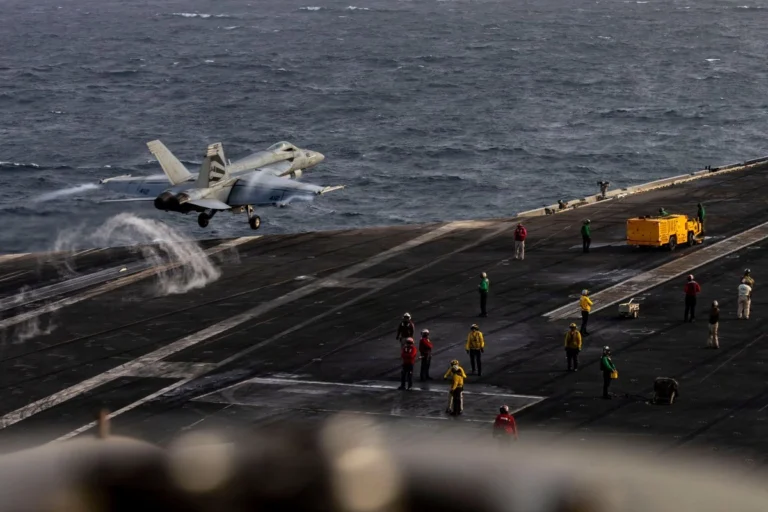
The USS Abraham Lincoln is set to return to the United States after an extended deployment of more than 260 days. Photo: AFP
August 15, 2026 Hour: 4:19 am
🔗 Comparte este artículo
The carrier will be replaced after an extended deployment as lawmakers raise concerns over reported conditions and crew morale.
The USS Abraham Lincoln will return to the United States after more than 260 days at sea, Acting Navy Secretary Hung Cao said Friday, as the aircraft carrier faces mounting scrutiny over reported supply shortages, difficult living conditions and mental health concerns among its crew.
RELATED: Iran Forces USS Abraham Lincoln to Flee to Indian Ocean
Cao said the carrier’s return is part of a planned rotation and that its deployment was extended because the mission required it. The Nimitz-class aircraft carrier left San Diego in November and has spent about 200 days in a war zone, he said.
“The USS Abraham Lincoln crushed their deployment and will return home soon as part of a planned rotation,” Cao said. “Details will come but let me be clear: the safety and security of our Sailors and Marines always comes first.”
Lawmakers raise concerns over crew welfare
The announcement comes after reports of deteriorating conditions aboard the carrier, including shortages of basic supplies, food and other necessities, as well as concerns about sailors’ mental health. Democratic lawmakers have called for an investigation and urged the Navy to allow a bipartisan congressional delegation to inspect the ship.
Senator Richard Blumenthal asked Defense Secretary Pete Hegseth and the Navy for information about conditions aboard the carrier, including the measures being used to assess the crew’s mental health. Other lawmakers have also pressed the Navy to allow Congress to examine the vessel.
Cao acknowledged that a small number of sailors had received treatment for mental health issues, but said there had been no loss of life. He said meal plans were adjusted when fresh supplies were unavailable, without any meals being missed, and that calls home were sometimes limited because of operational threats.
The acting Navy secretary said the carrier had completed more than 10,000 sorties and dropped about 1.5 million pounds of ordnance during its deployment. He also said retention rates aboard the vessel were among the highest of all aircraft carriers.
Cao defended the crew’s performance while acknowledging the strain of an unusually long deployment.
“There is no question our young men and women have been pushed to their limits—but they have never broken,” he said. “They are rightly tired—but have never been out of the fight.”
Trump and Hegseth reject reports of poor conditions
President Donald Trump has also rejected concerns about the length of the deployment and conditions aboard the carrier.
Asked Friday whether the families of sailors and Marines on the ship were worried, Trump replied: “No, they’re not.”
Asked whether the Lincoln had been deployed for too long, Trump said: “No. Not nearly long enough.”
Hegseth likewise rejected reports of poor conditions aboard the carrier, describing them as “completely misrepresented” during a visit to Panama on Thursday.
“We make sure that every ship, every crew, every captain has everything we can provide them at every single moment,” Hegseth said. “Some deployments are longer than others, and I have more respect and gratitude for those sailors than anybody. What they do in those high seas and those austere conditions with less port calls, it’s incredible.”
The administration has repeatedly defended the conditions aboard the Lincoln as lawmakers and families have raised concerns over the length of its deployment.
Navy denies increase in suicide attempts
A US official said the Navy had not observed an increase in suicidal thoughts or attempts aboard the ship. The official said the carrier has five chaplains, one psychologist, one social worker, three behavioral health technicians and one embedded prevention counselor, as well as an emotional support dog.
The Navy has also denied claims of an increase in suicide attempts aboard the Lincoln.
The concerns have nevertheless prompted calls for greater scrutiny of the crew’s welfare. Lawmakers have cited reports of sailors attempting to jump from the carrier and have urged the Navy to permit a bipartisan congressional visit to assess conditions aboard the vessel.
Reports raise questions over official account
The administration’s assurances have come as families of sailors and Marines aboard the Lincoln continue to raise concerns about the conditions facing the crew.
Relatives of the roughly 5,000 sailors and Marines aboard the carrier have reported shortages of supplies, long working hours, exhaustion and fears over self-harm, according to several reports published last week. Concerns about the crew’s mental health and safety were discussed during a meeting with Acting Navy Secretary Hung Cao and later in a virtual meeting with senior Navy commanders.
Complaints about conditions aboard the carrier first emerged in April, when the Navy denied them and Hegseth dismissed the reports as false news.
On Monday, Democratic Congressman Mike Levin of California said sailors aboard the Lincoln lacked basic hygiene products and had access only to moldy showers and broken toilets. He also said they often went without hot water or adequate food.
Specialized military media have reported concerns from relatives over the mental health and safety of sailors aboard the carrier, including reports of suicide attempts and declining morale.
Retired US Navy Vice Adm. Robert Murrett, now a professor of practice in public administration and international affairs at Syracuse University, said the Navy normally tries to avoid excessively long periods at sea and that the Lincoln had an “unenviable record” in this regard in recent history.
Studies have found that sailors who spend extended periods at sea can experience high levels of stress and may lack adequate medical care or other support to cope with it, highlighting the importance of access to assistance aboard ships to prevent suicides.
The conflicting accounts have kept conditions aboard the carrier under scrutiny even as Navy officials maintain that the crew has been supported and that the prolonged deployment was necessary to meet operational demands.
Cao said the sailors and Marines aboard the Lincoln should receive a warm welcome when they return.
“So, when the USS Abraham Lincoln pulls into the pier, join me and stand proudly with a grateful heart and give our Sailors and Marines the Hero’s Welcome they deserve,” he said.
USS George Washington to replace Lincoln
The Pentagon has sent the USS George Washington to replace the Lincoln. The Washington was spotted crossing the Strait of Malacca on Thursday.
About 5,000 sailors and Marines are aboard the Lincoln, which left San Diego in November. Its deployment was initially expected to end in May but was extended multiple times.
The carrier has been deployed for nearly nine months. It was initially assigned to the Pacific before being redirected to West Asia as the White House prepared to launch its war against Iran in late February. During the deployment, the ship made only a brief port call in Guam in December.
Cao said the deployment demonstrated both the demands placed on service members and the need for commanders to balance operational requirements with the welfare of their personnel.
“One of the hardest aspects about warfighting beyond knowingly placing our service members in harm’s way is that even with the best planning and communication, change and uncertainty will always be in play,” he said. “Our success depends on how we adapt.”
Author: MK
Source: Agencies