


U.S. Designates Two Brazilian Gangs as Global Terrorist Groups
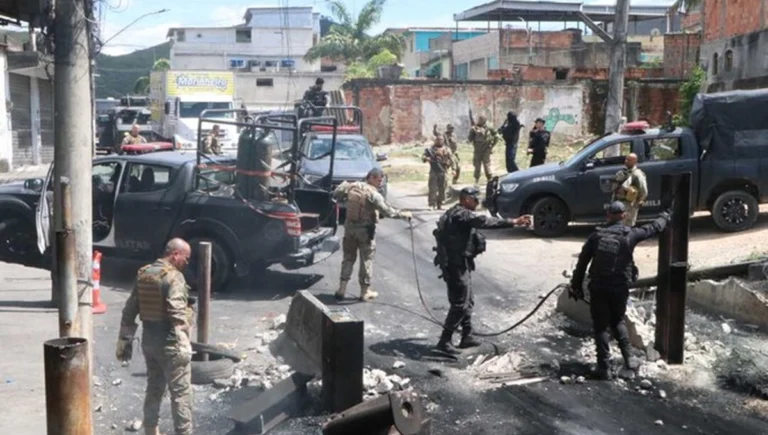
Anti-gang police operation in Brazil. X/ @cantabro
May 29, 2026 Hour: 1:34 pm
🔗 Comparte este artículo
They have been also been classified as ‘Foreign Terrorist Organizations,’ Rubio stated.
On Thursday, the U.S. Department of State designated Comando Vermelho (CV) and Primeiro Comando da Capital (PCC) as Specially Designated Global Terrorists (SDGTs).
RELATED:
Brazil Establishes First Indigenous Federal University
“Primeiro Comando da Capital and Comando Vermelho are two of the most violent criminal organizations in Brazil. Their reach extends throughout our region and into our country,” Secretary of State Marco Rubio said.
Starting June 5, those criminal groups will also be considered Foreign Terrorist Organizations (FTOs). The following are some key facts to understand their current characteristics.
PCC born inside a São Paulo prison
PCC was founded in 1993 inside a Sao Paulo prison. It emerged as a kind of union aimed at protecting its members within Brazil’s degrading prison system. The group even published bylaws establishing its rules and created a rigid hierarchy.
Today, it is one of the most powerful gangs in South America, with operations extending across virtually the entire region, especially in Paraguay and Bolivia.
PCC’s highest decision-making body is known as “Sintonia Final,” a kind of council of elders. Its top leader is Marcos Herbas (aka Marcola), who is currently imprisoned in a maximum-security facility. The group is estimated to have between 30,000 and 40,000 members in Brazil alone.
CV is expanding into the Amazon
Comando Vermelho was also founded within Rio de Janeiro’s prison system. Its origins date back to the 1970s, during the military dictatorship (1964-1985), evolving from an older faction called “Falange Vermelha,” which at the time focused on fighting torture and abuse inside prisons.
Over the years, it evolved into a criminal structure that controls entire neighborhoods in Rio, with a presence across much of the country and growing operations in the Amazon region and northeastern Brazil.
Poverty as breeding ground
A large share of recruits for both groups comes from prisons and the poorest sectors of society. Currently, Brazil holds 727,301 people in prison, but the system has capacity for only around half a million inmates.
Under such precarious conditions, new prisoners join these gangs seeking protection inside prisons. As a result, it is common for Brazilian prisons to have separate wings for inmates belonging to each faction.
In addition, many PCC and CV leaders are already behind bars but continue issuing orders from prison through lawyers, relatives and other channels.
Political influence and economic networks
In recent years, drug trafficking gangs have infiltrated politics, funneling money to mayors, lawmakers, and other authorities in exchange for protection. At the same time, PCC and CV have diversified their operations by creating front companies to launder money and expand their revenue sources.
Recent police operations revealed that PCC infiltrated municipal transportation companies, motels, gas stations, the real estate market and even fintech companies headquartered on Faria Lima Avenue, the financial center of São Paulo. More recently, authorities dismantled a PCC money laundering network that operated through stuffed animal stores.
CV has adopted a different criminal strategy, focusing more heavily on territorial control and exploiting those areas through extortion of merchants or monopolization of essential services such as gas, internet, transportation and cable television.
teleSUR/ JF
Source: EFE